

Design Protection for Furniture Makers: Guarding a Collection From Knockoffs

A furniture maker spends a year developing a new lounge chair. The frame geometry is original, the curve of the armrest is unmistakable, and the piece tests beautifully at the showroom. The collection launches at a major furniture fair, the orders come in, and within four months a near-identical chair appears on a marketplace at half the price, made by a workshop that saw the original on the fair floor and reverse-engineered it from photographs. The maker has the better product and the worse legal position, because nothing was registered before the design went public.
Furniture is one of the most copied categories in industrial design. The shapes are visible, the manufacturing is widely accessible, and a successful piece broadcasts its own blueprint the moment it sits in a catalogue or on a fair stand. The protection that actually answers this problem in Turkey is the industrial design right, and the way a furniture business uses it is different enough from a one-off product filing to deserve its own playbook.
The look of the piece is the asset, and the design register is where it lives
A patent protects how something works. A piece of furniture rarely contains a novel mechanism, and when it does, the mechanism is not what competitors copy. They copy the silhouette: the taper of a table leg, the proportion of a sofa back, the join detail that gives a cabinet its character. Turkey protects that appearance through industrial design rights, which sit on the EU and UK style register rather than under any patent. An industrial design registration covers the visible features of a product, its lines, contours, shape, surface texture and ornamentation, independently of any function underneath.
Two conditions decide whether a chair or a table qualifies. The design has to be new, meaning no identical design has been made available to the public before your filing date, and it has to have individual character, meaning the overall impression it gives an informed user differs from what already exists. For furniture this is a forgiving but real bar. A genuinely fresh form clears it easily. A chair that is a slight variation on a thousand existing dining chairs does not, because an informed user, someone who knows the furniture market, would see nothing distinctive in it.
The one feature you cannot monopolise is a shape dictated purely by technical function. If a leg has to be exactly that thickness to bear the load, the proportion forced by engineering is not yours to own. The aesthetic choices layered on top of the function are. A good design registration is drafted to claim the expressive form while staying clear of the purely functional elements, which is where the views and the choice of what to show in the drawings start to matter.
Register the whole line in one application, not one chair at a time
This is the move that changes the economics for a furniture business, and most makers do not know it exists. Turkish design law allows a multiple application: a single filing that contains many separate designs, as long as they fall in the same Locarno class. Furniture sits in Locarno Class 6, so an entire seating range, the armchair, the two-seater, the three-seater, the matching footstool and the side table, can go into one application as a set of related designs rather than five or six separate filings.
The benefit is not only the official fee structure, where a multiple application is far cheaper per design than filing each one alone. It is also administrative coherence. One filing date, one renewal date, one file to manage for the whole collection. When a furniture house releases a season of twenty pieces, the difference between twenty scattered registrations and two or three well-organised multiple applications is the difference between a portfolio someone actually maintains and one that quietly lapses.
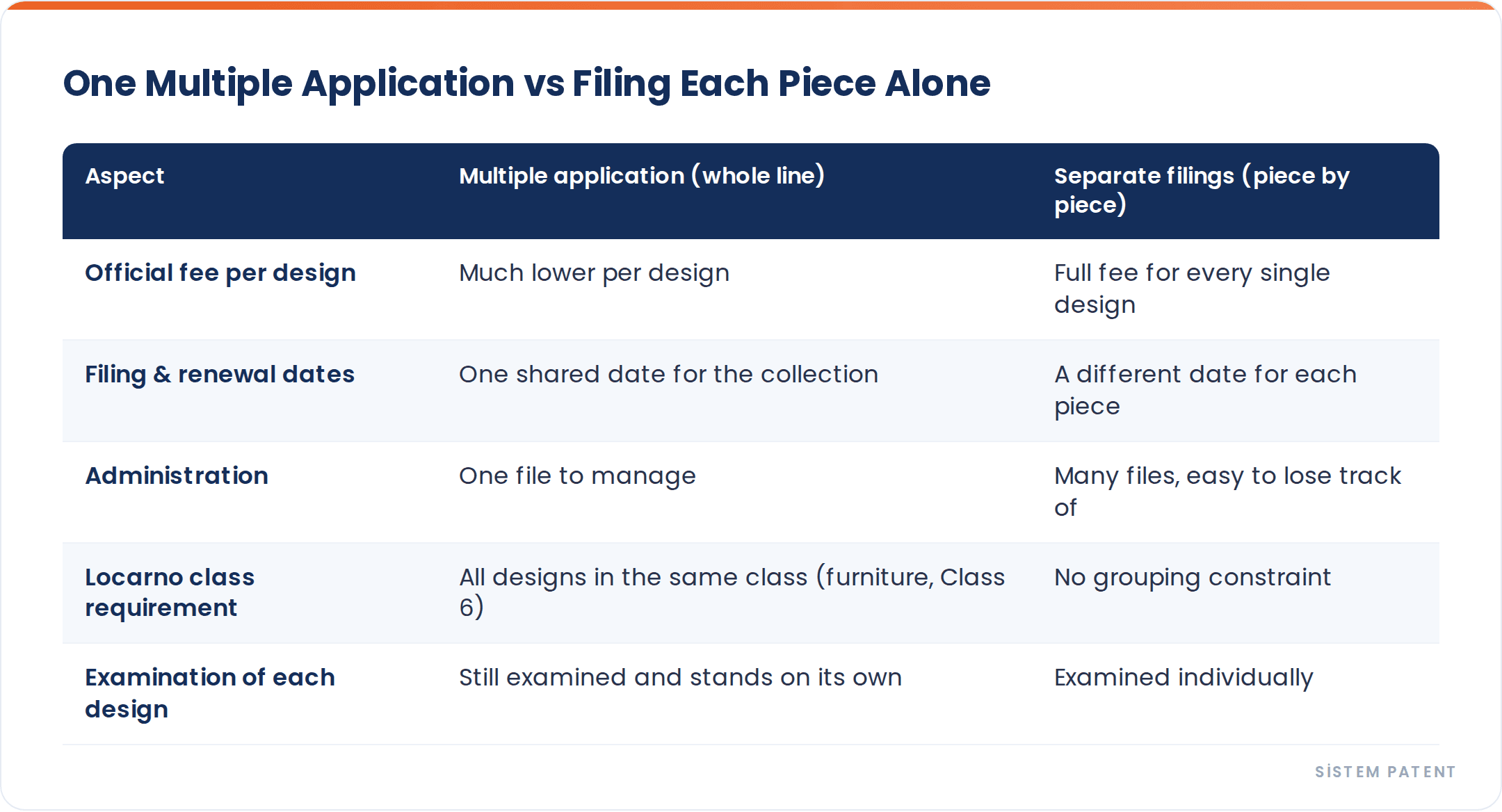
There is judgement in how you group them. Each design in a multiple application is still examined and stands on its own, so a weak member does not drag down a strong one, but it makes sense to keep a coherent collection together so the renewal and enforcement story stays simple. Variants of one model, the same chair in three frame finishes, can often be captured as one design with well-chosen views rather than three, while genuinely different models each take their own slot. Getting that structure right at filing is the single most consequential decision in a furniture portfolio, and it is worth planning before the drawings are even commissioned.
File before the fair, because the fair is a public disclosure
Furniture sells through fairs, and fairs are where designs die. The moment a new piece stands on a stand at a trade fair, photographed by buyers and competitors, it has been made available to the public. If you file after that, your own piece can be cited as prior art against your own application, and the novelty you needed is gone.
Turkish law does soften this with a grace period. A disclosure made by the designer, or by someone who got the design from the designer, within the twelve months before the filing date does not destroy novelty. So a piece shown at a fair can still be registered if you file within that year. The honest framing is that the grace period is a safety net for an accident, not a filing strategy. It does not protect you against a competitor who sees your fair launch and races their own application to the register before you do, and it is narrower or absent in several export markets, so a disclosure that is survivable in Turkey can still sink the same design abroad. The discipline that protects a furniture collection is plain: file the designs before the collection is shown, then unveil at the fair from a protected position.
That sequencing also fixes the calendar problem every furniture business has. The big fairs cluster in a season, the collection has to be ready months ahead, and the temptation is to treat registration as paperwork to handle after the orders land. Reverse it. The design filing belongs in the pre-fair production schedule, slotted in once the pieces are finalised and before any image leaves the studio, so the launch and the legal protection arrive on the same timeline instead of fighting each other.
Drawings decide how much of the copy you can actually stop
A design right is only as broad as the representation you file. For furniture, the views you submit, and what you choose to show or leave out, set the boundary of what counts as infringement. File a single front photograph of a sofa and you have protected one angle of one upholstery. File a considered set of views, perspective, side, back and a detail of the signature join, and you have claimed the three-dimensional form that a copyist cannot escape by changing the fabric.
There is a strategic use of partial disclaimer here. By showing the parts you want to protect in solid line and the context in broken line, the form can be claimed independently of finish, colour or a particular accessory, which widens what you can enforce against a knockoff that copies the shape but swaps the material. This is craft, and it is where an experienced design agent earns the fee, because the drawings are the part of the application a furniture maker is least equipped to optimise alone and the part that most determines whether the registration stops a copy or merely decorates a wall.
A registered collection turns a knockoff fight into a short conversation
When the copy appears, and in furniture it usually does, a registered design changes the entire dynamic. Instead of arguing about who designed what first, you hold a dated registration certificate that names the protected form. That certificate is what powers a marketplace takedown, a customs notice against imported copies, and a cease-and-desist that the copyist's own lawyer will tell them to respect. Without it, you are left arguing unregistered rights and unfair competition, a slower and far less certain road.
The furniture makers who stay ahead of copying treat design registration as part of product development, not as a reaction to being copied. They file the collection as a multiple application before the season's fair, they brief their designer to produce drawings built for enforcement, and they keep the renewals on a calendar so a five-year right does not quietly expire on a piece still selling. If you are bringing a new collection to market and want it protected before it reaches the fair floor, our trademark and patent agents can structure the filings around your launch and build a design portfolio that holds up when the copies arrive.
Picked for You
Related Articles
Registered vs Unregistered Design Rights: What You Get for Free and Why It Is Rarely Enough
Read More →
Turn Your Design Investment Into a Tax Position: Design Centres, R&D and IP Incentives
Read More →