

Protecting a Screenplay or Film Treatment Before You Pitch It to a Studio
A screenwriter has carried the same story for three years. She finally gets a meeting, sits across from a producer, and talks the film through: the world, the lead character, the twist nobody sees coming. The producer nods, says it is not quite right for them, and she goes home. Eight months later a film goes into production with the same setup and a strikingly familiar turn. Did they take it? The question feels obvious. The legal answer is not, and it hinges on something most writers never get told before that meeting: copyright never protected the thing she pitched out loud.
What the law protects is the screenplay she wrote, not the idea she described. The premise, the logline, the concept of the twist: those were never hers to keep. The specific scenes, the particular characters, the dialogue and the structure she committed to the page are. So the real question after a pitch is never simply, was my idea stolen. It is two narrower questions: can I show that what they made copies what I expressed, and can I prove they had my version in front of them. Everything you do before you walk into the room should be aimed at being able to answer both with paper.
A pitch gives away the idea, and the idea was never yours to keep
Turkish copyright runs under the Law on Intellectual and Artistic Works (Law No. 5846). It protects works, including a screenplay as a literary work, once they exist in a perceptible form and carry the personal stamp of their author. The protected thing is the work as written, not the underlying notion that prompted it. Two writers can both decide to write a heist that goes wrong because of a betrayal inside the crew. Neither owns that premise, and neither can stop the other from building a completely different script around it. This is the idea-expression line, and a verbal pitch sits entirely on the free side of it. When you describe your film in a meeting, you are handing over precisely the part the law leaves open to everyone.
This is why the screenwriter's instinct, protect the idea, points at the one thing that cannot be protected. The concept of a story about a grieving detective, a heist, a doomed romance between rivals, belongs to the culture. What belongs to you is the version of it only you wrote: this detective, with this backstory, moving through these scenes in this order, saying these lines. The closer a later film tracks that specific execution, the stronger your position. The further it sits, sharing only the premise, the weaker it gets, no matter how certain you feel that the meeting is where the idea leaked.
You hold copyright the moment you write it down, but not the proof
Here is the part that surprises people in the other direction: you are not unprotected while you pitch. Copyright in a screenplay arises automatically the moment the work is fixed in written form. There is no filing you must complete to hold the right, and that automatic protection is recognised across borders through the international framework administered by WIPO (the World Intellectual Property Organization). The literary work you wrote is protected the instant it exists on the page.
The gap is not the right. It is the evidence. When a similar film appears, having copyright is not enough; you have to prove two things. First, that the new work is substantially similar to your protected expression, not just your premise. Second, that the people behind it had access to your version. Automatic copyright gives you the first foothold but supplies neither proof on its own. This is the entire reason a formal record matters. Registering the work creates a dated, official document that you authored it and when, which is why putting an official copyright record in place turns authorship you would otherwise have to reconstruct into something you can show on a single page. A registered record of the work is not what creates your right, but it is what lets you prove it cheaply later.
A treatment is mostly premise, so the date on it does the heavy lifting
A short treatment or a one-page outline is the most exposed document a writer hands around, and for a precise reason. A treatment is mostly idea: a premise, a tone, a sketch of where the story goes. The protectable expression inside it is thin, because there are few concrete scenes, little dialogue and not much specific structure to point to. The thinner the expression, the harder it is to prove that a later work copied it rather than merely sharing the same concept. That is exactly when the date and the record carry the case, because they let you establish the one fact the other side cannot wave away: your version existed, in this form, before they ever saw it.
Two habits follow from this. Flesh the treatment out in writing before it leaves your hands, so there is real expression to protect and not just a logline. Then create a dated record of it before you pitch. For film work specifically, an official film and screenplay registration gives you a record whose date sits before the meeting, which is the single most useful fact you can own if a dispute ever starts.
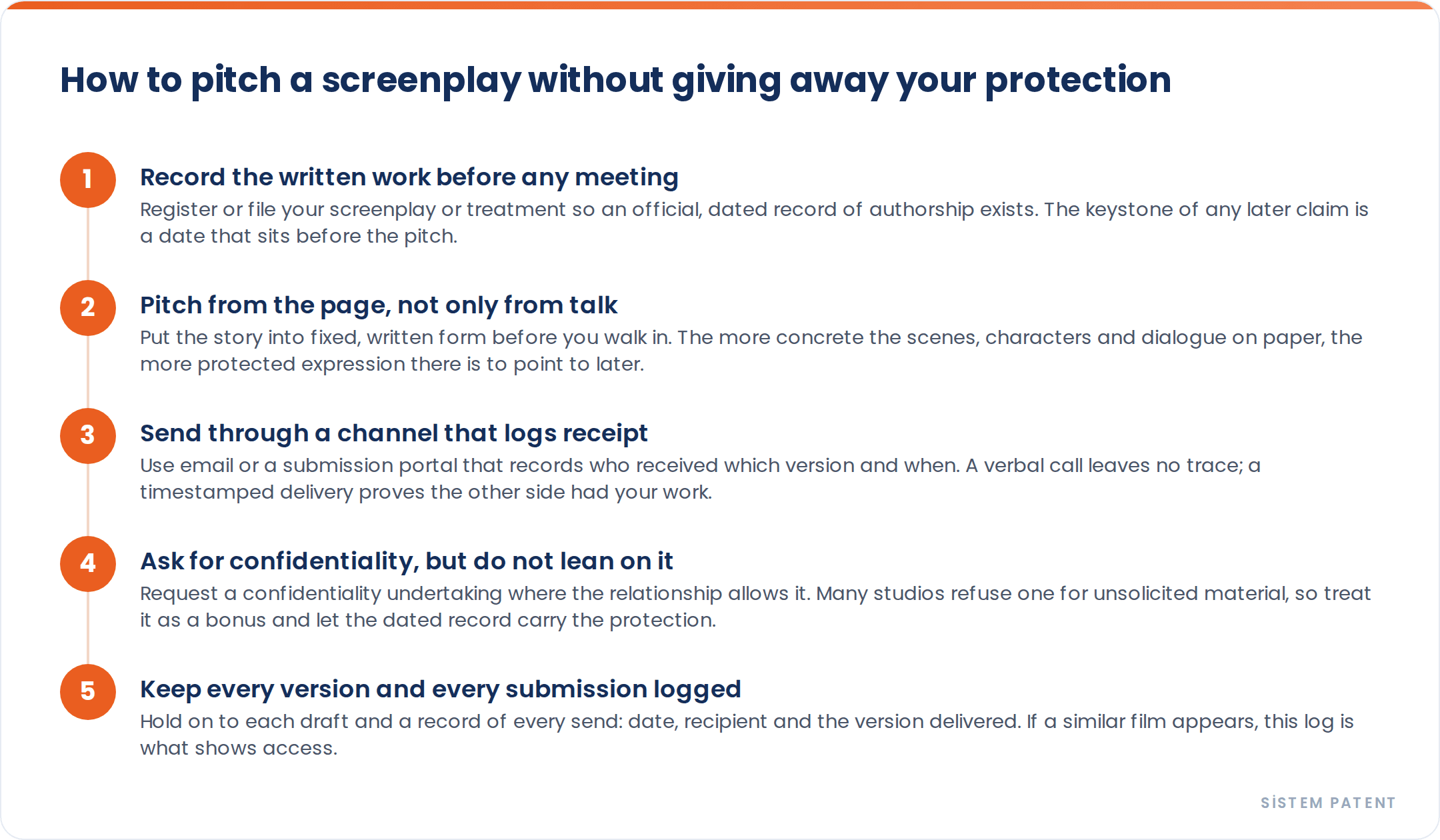
How to put a script in front of a producer and keep your protection
Protecting a script in a pitch is not about secrecy theatre. It is about building a trail that, months later, lets you prove what you wrote and that they received it. A few habits do almost all of the work.
Record the written work before any meeting, so an official dated record of authorship exists before the conversation happens. Pitch from the page rather than from talk alone, because the more concrete the scenes and dialogue you have fixed in writing, the more protected expression there is to rely on. Send the document through a channel that logs receipt, an email or a submission portal that records who received which version and when, and keep that timestamp. A verbal call leaves nothing behind; a delivered file with a date proves access.
An NDA is a bonus; the dated record is the spine
Writers often assume a confidentiality agreement is the answer. Ask for one where the relationship allows it, and use it when you can get it. But do not build your protection on it. Many studios and producers refuse to sign anything for unsolicited material, precisely to avoid the kind of claim you are worried about, and they prefer solicited submissions that come through an agent, a manager or a recognised competition. An NDA depends on the other side agreeing and then honouring it. A dated record does not depend on anyone's goodwill, which is why it, not the NDA, is the part of your protection you should never skip. Keep every draft and a log of every submission: date, recipient and the version sent. If a similar film surfaces, that log is what shows access.
A copying case turns on similar expression plus proven access
If a film does borrow from your script and you decide to act, the dispute resolves on two questions, and your preparation maps onto both. Access is shown by your record: the dated registration of the work and the submission log that places your version in the producer's hands before their film existed. Similarity of expression is shown by reading the two screenplays side by side, weighing how much of your specific detail, your scenes, characters, structure and lines, survives in theirs. A court looks at the protected detail that carried over, not at whether the one-line premise matched. This is the ground on which an intellectual property infringement claim is fought, and it is won far more often by the writer who arrived with a dated file and a clean submission history than by the one who is sure, but cannot show when their idea left the room.
Protect the page you wrote, then pitch it widely
The fear that pitching gives your film away is half right. The idea does leave the room, and it was always free for anyone to use. The expression does not have to leave unprotected. Put the screenplay or treatment into detailed written form, create a dated official record of it before the first meeting, and log every version you send. Do that and your protection stops depending on whether a producer behaves, because it now lives in a file with a date on it, not in your memory of a conversation.
If you are about to start pitching a screenplay or a treatment you care about, the practical move is to get it on the record first. Sistem Patent can register your screenplay or film treatment and document your authorship before you take a single meeting, so the work you wrote is protectable on paper from the day you start showing it around.
Picked for You
Related Articles

Who Owns Your Reels: A Creator's Guide to Copyright, Music and Brand Deals
Read More →
Work-for-Hire and Freelancers: Who Owns the Design, Code or Copy You Paid For
Read More →