
How to Protect a Database in Turkey When the Data Itself Is Public
A logistics startup spends three years building a directory of every cold-storage warehouse in Turkiye: their capacities, certifications, contact details and live availability. None of those facts is secret. A determined person could phone each warehouse and confirm the same numbers. Then a competitor copies the whole directory in an afternoon, reskins it, and launches a rival service off the back of someone else's three years of fieldwork. The owner's first instinct is that nothing can be done, because the underlying data was public. That instinct is wrong. Turkish law protects the investment in collecting and arranging a database separately from the individual records inside it, and that distinction is the whole point.
The confusion is understandable. Copyright protects original expression, and a phone number or a warehouse capacity is a plain fact with no expression to protect. So if you ask only whether the data is copyrightable, the answer for raw facts is usually no. The right question is different. The law asks whether you made a substantial investment to obtain, verify or present the contents, and if you did, it gives you a right over the database as a whole, even when every cell in it is a fact anyone could have looked up.
The database right protects your effort, not the facts inside
Turkish copyright law (Law No. 5846 on Intellectual and Artistic Works) recognises two distinct layers of protection for a database, and keeping them apart is what makes this topic make sense.
The first layer is the classic one. A database can qualify as a protected work in its own right when the selection or arrangement of its contents is the author's own intellectual creation. A curated, editorially shaped collection earns this. A flat, exhaustive list of every entry in a category usually does not, because listing everything involves no creative choice. This layer is narrow, and it is not what saves the warehouse directory.
The second layer is the one that does the work. Independently of any creativity, the maker of a database holds a separate right tied purely to investment. If you put substantial resources, money, time or effort, into obtaining, verifying or presenting the contents, you hold a right to prevent others from extracting or re-using a substantial part of the database without your consent. This is the sui generis database right, and it exists precisely so that the person who funded the collection effort, not the copyist, captures its value. The facts stay free. Taking the assembled collection wholesale does not.
What "substantial investment" actually means
The right turns on investment in the database itself, so it pays to be precise about which spending counts. Investment in obtaining the contents (sourcing, gathering, licensing data), verifying them (checking accuracy, cleaning, deduplicating) and presenting them (structuring, indexing, building the access layer) all count. The leading European case law, which Turkish practice tracks closely on this point, draws one sharp line: money spent creating the data in the first place does not count toward the database right. A football league that generates its own fixtures has created that data, not collected pre-existing data, so the investment in producing it sits outside the database right even though the schedule is valuable. The warehouse directory is the opposite case. The capacities and certifications existed already, scattered across the market, and the startup's spend went entirely into finding, checking and arranging them. That is textbook protectable investment.
A competitor can read your database; it cannot harvest it
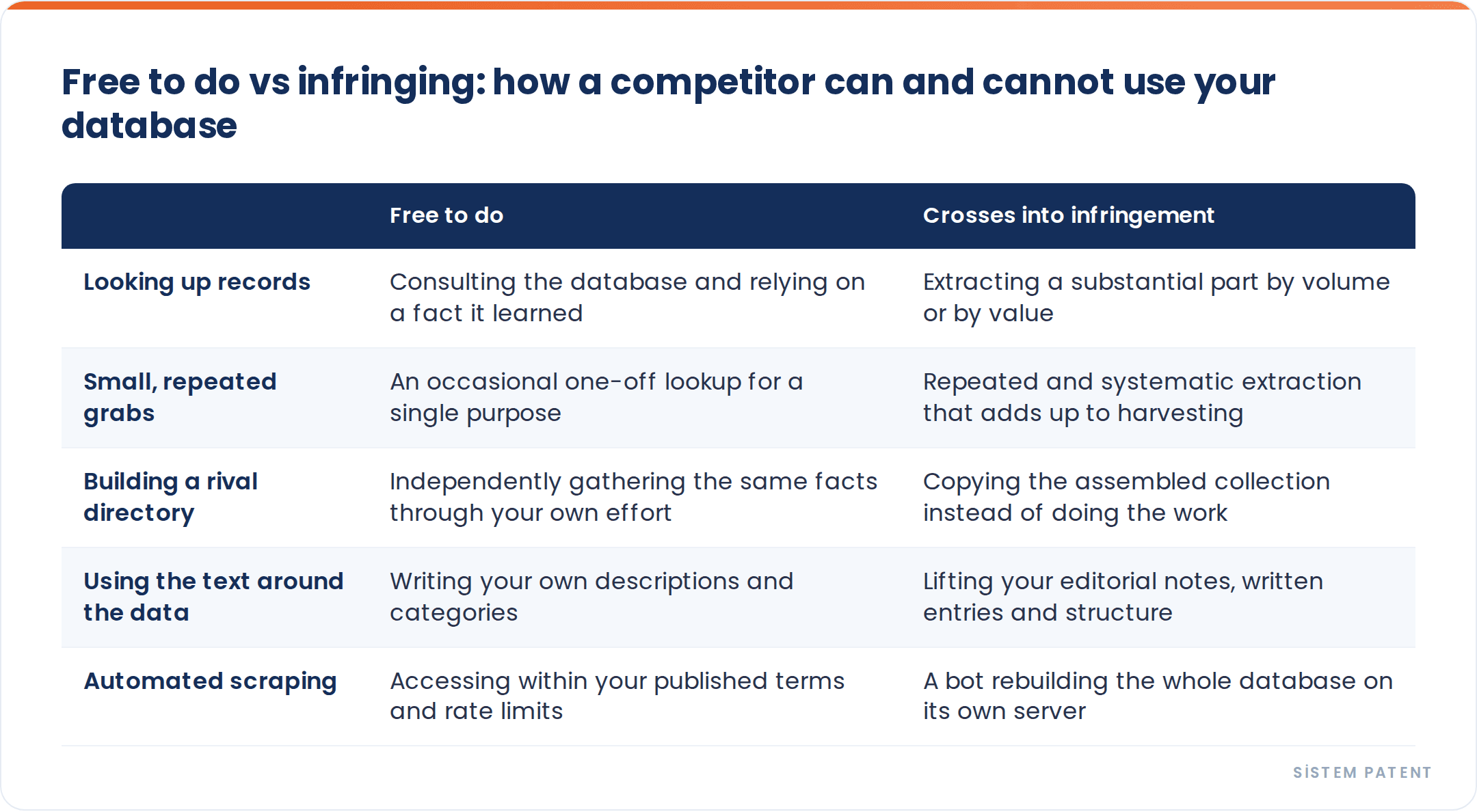
The most common question from data businesses is the practical one: what can a rival actually take. The answer separates normal use from infringement along two lines drawn in the law.
The first line is the quantity taken. The right bites on the extraction or re-use of a substantial part of the contents, judged by volume or by value. Lifting the entire directory is plainly substantial. Copying one region's listings can be substantial too if that slice represents a meaningful share of the investment. A single record looked up for a one-off purpose is not.
The second line catches the clever workaround. Repeated and systematic extraction of insubstantial parts is also barred when, taken together, it amounts to harvesting the database or conflicts with its normal exploitation. A scraper that pulls ten records a minute around the clock cannot claim each grab was trivial. The cumulative effect rebuilds your database on someone else's server, and the law treats that as the substantial taking it really is. This is the provision that matters most against automated scraping, where no single request looks like much but the pattern reconstructs the whole.
What a competitor remains free to do is consult the database, rely on a fact it learned, and independently gather the same facts through its own effort. If a rival phones every warehouse itself and builds a parallel directory the hard way, it has made its own substantial investment and earned its own database, however much it overlaps with yours. The database right rewards investment; it does not let you fence off facts from anyone willing to do the work themselves.
The protection is real but time-limited, and it can reset
Unlike a trademark that can live forever through renewal, the database right runs for fifteen years from the start of the year following completion of the database. A live commercial database is rarely a finished object, though. It is continuously corrected, expanded and re-verified, and a substantial new investment in those updates starts a fresh fifteen-year term for the resulting database. A directory that is genuinely maintained, with documented ongoing spend on accuracy and growth, effectively renews its own protection through the act of being kept current. A database left to rot, by contrast, simply runs down its clock.
This is why the maintenance log is not just operational housekeeping. The same records that prove your database is alive, change histories, verification dates, sourcing records, sales and update invoices, are the evidence that establishes both the original substantial investment and each later one. A dispute over whether someone harvested your data is won or lost on whether you can show, with dates, what you spent building and maintaining the collection. Treat that documentation the way a careful owner treats any other proof of an asset's value.
Layer the database right with the protections around it
The database right is strong, but it is rarely the only tool in play, and the practical posture is to stack it with the protections that sit alongside it. Three of them matter most.
- Technical and contractual control. Access terms, an enforceable usage agreement, rate limits and authentication shape what a user is permitted to do before any copyright question arises. A clear prohibition on bulk extraction in your terms turns a scraping dispute into a straightforward breach as well as a database-right claim.
- Copyright in the original parts. The facts may be free, but the descriptions, categories, editorial notes, written entries and the interface around your data can carry their own copyright. A copyist who lifts your prose and your structure, not just your numbers, hands you a second cause of action. Where any element of your collection involves genuine authorship, recording it as a work strengthens the file.
- An evidenced creation date. Because the database right depends entirely on proving investment and timing, a dated, independent record of the database and its build history is the spine of any enforcement. This is exactly where a formal registration of the work earns its place: not because it creates the right, which arises automatically, but because it fixes a credible date and description you can put in front of a court when a copyist claims they got there first.
The instinct that public data cannot be protected costs Turkish data businesses real ground they did not have to give up. The facts in your database belong to everyone; the database you built out of them belongs to you. If you run a directory, a listings platform, a price index or any structured collection that took real effort to assemble, treat it as the asset it is. Our team can register the work to fix a credible creation date through our database copyright registration service, document the supporting work registration record for the editorial and written parts, and map out how the database right, contract terms and copyright fit together for your specific platform under our broader intellectual property law practice. Build the evidence file before the copyist arrives, not after.
Picked for You
Related Articles

Who Owns Your Reels: A Creator's Guide to Copyright, Music and Brand Deals
Read More →
Work-for-Hire and Freelancers: Who Owns the Design, Code or Copy You Paid For
Read More →