
Songwriter vs Composer vs Performer: Who Owns Which Rights in a Single Song
Picture a single three minute track on a streaming service. One person wrote the words, another wrote the melody, a band played it, and a label paid for the studio time. To a listener it is one song. To the law it is at least four separate property rights, each owned by a different person, each registrable, licensable and payable on its own. When the royalties start arriving, that is exactly when collaborators discover they never agreed who owns what.
This confusion is the single most common reason music collaborations end in a dispute. The fix is not complicated, but it does require seeing the recording for what it legally is: a stack of rights, not a single asset. Once you can name each layer, you can register the right one, license the right one, and collect from the right one.
One recording holds four rights, and they rarely belong to one person
Turkish copyright sits under the Law on Intellectual and Artistic Works (Law No. 5846), which protects two very different things. The first is the work itself, the creative content. The second is a set of neighbouring rights (baglantili haklar) that belong to the people who bring that work to the public. A song recording engages both at once.
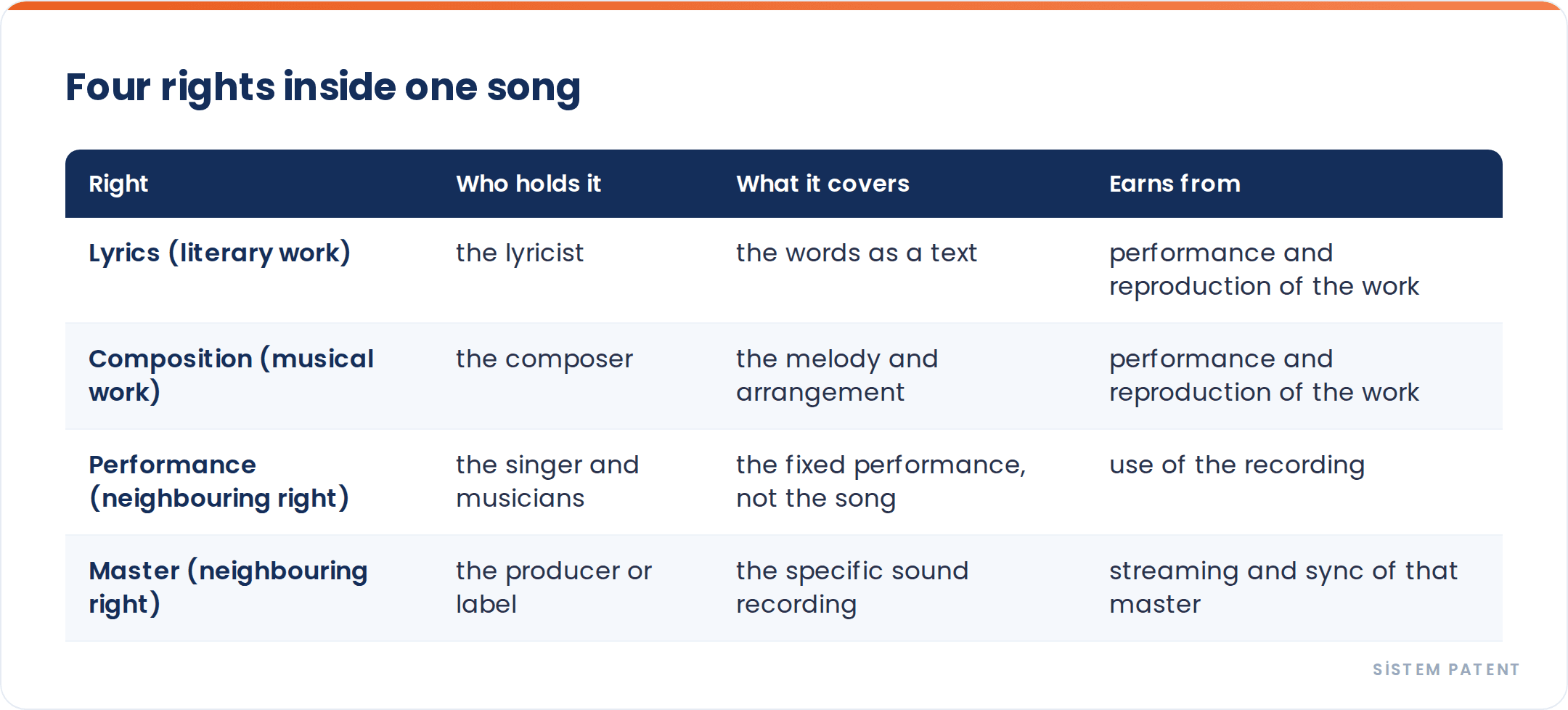
Break the track apart and four distinct rights appear:
- The lyrics. The words are a literary work. The person who wrote them is their author and holds copyright in the text, separate from any music.
- The composition. The melody and musical arrangement are a musical work. The composer is its author and holds copyright in the music, separate from the words.
- The performance. The singer and the musicians who play on the recording hold a performer's neighbouring right in their fixed performance. They did not write anything, yet the law protects how they rendered it.
- The sound recording. The producer, often a label, holds a neighbouring right in the master recording, the specific captured audio, as a reward for the organisational and financial effort of making it.
A solo singer-songwriter who records alone in a home studio can hold all four. A typical commercial track splits them across four or more parties. The mistake is assuming that buying or clearing one of these rights gets you the others. It never does.
The lyricist owns the words, and nothing else
A lyricist's copyright covers the text as a literary work. That right lets the author authorise reproduction, public performance, adaptation and distribution of the words, and it carries the moral rights of authorship, the right to be named and to object to distortion, which never transfer even when the economic rights are sold.
What the lyricist does not control is the melody those words are set to, or any particular recording of the song. If a different artist sets the same lyrics to new music, that is a fresh musical work over the same literary work. The cleanest way to fix authorship and a provable creation date is to register the text, which is why placing the lyrics on record through a dedicated song lyrics copyright registration is the first thing a serious writer does before sharing a demo.
The composer owns the music, even when someone else sings it
The composition is the melody, harmony and arrangement, the musical work that exists independently of any lyric or any performance. The composer is its author and holds the same bundle of economic and moral rights over the music that the lyricist holds over the words.
This independence is the part collaborators most often miss. A composer can license the same melody for an advertisement while the lyricist refuses to license the words, because they are two separate works with two separate owners. When a band writes together, the safe assumption is joint authorship of the composition, which means every contributor co-owns it and, absent an agreement, decisions need consensus. Settling that split in writing before release, and recording the music through a composer registration, prevents the most expensive argument a band can have years later.
The lyrics, the composition and the recording are three different works owned by potentially three different people. Clearing one gives you no rights in the other two.
The performer owns the performance, not the song
Here is where neighbouring rights enter. A performer, the lead vocalist, the session guitarist, the drummer, did not author the lyrics or the composition, yet Law No. 5846 grants them a right in their performance. That right lets them control the fixation of their performance, its reproduction, and its communication to the public.
The scope is narrow and specific. A singer's performer right attaches to that recorded vocal take, not to the song. Anyone is free to record their own cover of the same composition (clearing the underlying works) without touching the original singer's right. But you cannot copy, sample or stream the original vocal recording without the performer's permission, even if you have separately licensed the lyrics and the music. This is the right that gets overlooked when a brand drops a famous track into an advertisement after clearing only the songwriting.
The producer owns the master, and that is what streaming pays for
The fourth right belongs to the phonogram producer, the person or company that organises and finances the recording. Their neighbouring right is in the master, the specific captured sound recording. In commercial music this is usually the record label, and it is commercially the most valuable layer, because a stream or a sync of a particular recording is, first and foremost, a use of that master.
This is why two parallel licences exist for almost every commercial use of a song. To use a known recording in a film, you clear the master with the label and the underlying work (lyrics plus composition) with the writers or their publisher. Re-record the song from scratch and you avoid the master entirely, but you still owe the writers. Holding the master without the underlying rights, or the reverse, leaves you unable to exploit the track on your own.
Where the money actually splits
Because the rights are separate, the income streams are separate too, and they flow to different people through different channels. Writers and composers earn from the public performance and reproduction of the work, typically collected through an authors' collecting society. Performers and producers earn from the use of the recording, collected through the related-rights societies. A streamed play of a hit single therefore pays at least three different pockets at once: the writers, the featured performers, and the master owner.
Two practical consequences follow. First, a person can hold a valuable share of one stream and nothing in the others. A session musician may be owed performance royalties on a track whose songwriting credits do not include them at all. Second, a contract that assigns one right says nothing about the rest. Signing away your master to a label does not hand over your songwriting; selling your publishing does not surrender your master. Each layer is negotiated and recorded on its own terms.
Settle the splits in writing before release, not after the first royalty
None of this requires a dispute. It requires a short agreement, made before the track goes out, that names who wrote the words, who wrote the music, who performed, who owns the master, and in what percentages. Pair that with a dated registration of each protectable element and the ownership picture is fixed and provable from day one.
For the underlying work, that means registering the lyrics and the composition; for the finished recording, it means logging the master and the performances so the chain of rights is documented. Sistem Patent handles the full registration of musical works and recordings, from the words and the melody through to the master, so collaborators know precisely what each of them can license and earn before the first royalty ever lands. If you are putting out a record, treat a clear music work copyright registration as part of releasing it, not as paperwork to chase once a conflict has already started.
Picked for You
Related Articles
Who Owns Your Reels: A Creator's Guide to Copyright, Music and Brand Deals
Read More →
Work-for-Hire and Freelancers: Who Owns the Design, Code or Copy You Paid For
Read More →