

Jewellery Design Protection: Securing a Signature Piece Against Imitation
A jewellery house in Istanbul spends a season developing a ring: a particular twist in the band, a setting that holds the stone a few degrees off-axis so it catches light differently. The piece sells well through the autumn. By spring, a near-identical ring is on three competing websites at half the price, cast from a mould someone took off a photograph. The house calls a lawyer and learns the hard part too late. The shape was protectable from the day it was drawn. It was never registered, so on paper it belonged to no one.
This is the most common way an atelier loses a signature piece. The design was good enough to copy, which is exactly the point, and the protection that would have stopped the copy was never put in place. Industrial design is the right that protects how a piece looks: the form of a ring, the silhouette of a pendant, the arrangement of stones, the texture of a finish. In Turkey it sits under the Industrial Property Code (Law No. 6769) and is examined by TURKPATENT (the Turkish Patent and Trademark Office). For jewellery, where the value lives almost entirely in appearance, it is the single most important right a maker can hold.
For jewellery, the design right covers the part that actually sells the piece
What a customer buys in a piece of jewellery is the look. Not the gold as raw metal, not the manufacturing method, the visible result on the hand or at the neck. That is precisely what an industrial design protects: the shape and contours of the piece, its lines, the surface texture, the ornamentation, the pattern a setting of stones creates, and the way all of it combines into one overall impression.
A registration covers the appearance as drawn and photographed, which means it reaches further than people expect. The band of a ring, the drop of an earring, the clasp design on a bracelet, the engraving pattern on a cuff, each is part of the protectable look. What the design right does not reach is a functional mechanism. If you invent a genuinely new clasp that locks in a way no clasp did before, the mechanism belongs to the patent or Utility Model system, judged on how it works rather than how it looks. The ornament on that clasp is still a design. Most jewellery sits cleanly on the design side, because the worth is in the form, not in an engineering step.
Two requirements decide whether a piece can be registered. It must be new, meaning no identical design was made available to the public before your filing date, and it must have individual character, meaning it produces a different overall impression on an informed user than designs already out there. The informed user here is not a casual shopper and not a master jeweller. Picture a serious buyer who follows the category, has seen the season's collections, and notices the difference between one solitaire setting and another. If that person would see your ring and an existing ring as the same overall impression, the design lacks individual character. In a crowded form like a plain band, small differences carry more weight, because the room to differ is narrow to begin with.
The photographs you file decide the scope of what you own
For most products the drawings are a formality. For jewellery they are the protection itself, because the right attaches to exactly what the images show. A careless set of photos can hand you a registration that protects a blurred, badly lit object that looks like half the rings on the market. A precise set fixes the distinctive features clearly enough that a copy cannot pretend to be something else. This is where ateliers either secure real protection or quietly waste the filing.
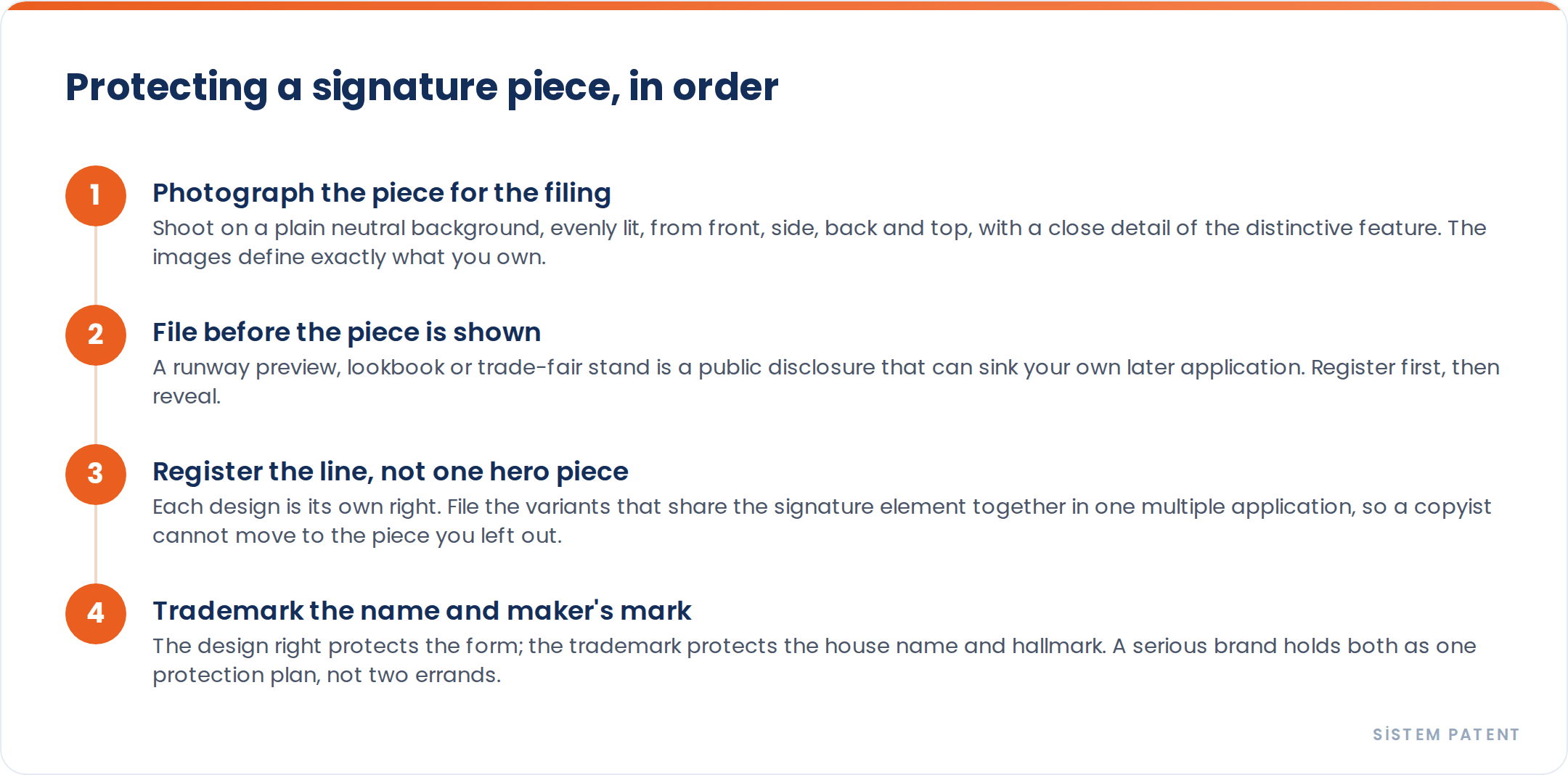
A few rules carry most of the weight. Shoot the piece against a plain, neutral background so nothing in the frame competes with the design or accidentally becomes part of it. Use even, diffused lighting that shows the true form without hard reflections washing out a faceted surface. Capture the piece from several angles, the front, the side, the back, and a top view, because a copyist will argue that any view you did not show is different from theirs. Include a close detail of the feature that makes the piece yours: the twist, the setting, the engraving. Keep models, hands, and styling props out of the protected images, since the right is in the piece, not in the photograph's mood. If the line comes in several stones or metals but the same form, the form is what you register, and the variants can be filed alongside it.
Getting these images right is the practical heart of a jewellery filing, and it is the step most worth doing carefully before anything is submitted. Our industrial design registration page sets out how the application is built around exactly this kind of representation.
A collection is protected piece by piece, and that is a strategy, not a chore
A jewellery brand rarely lives or dies on one ring. It builds a language: a recurring motif, a signature setting, a proportion that repeats across a line so that a customer recognises the house before reading the name. The mistake is to assume that protecting one hero piece somehow protects the family. It does not. Each design is its own right, and the recurring elements are only protected on the pieces you actually register.
This sounds like a burden and is in fact a useful lever. Turkish practice, in line with the European system, lets a single application carry several designs in the same class, which is exactly where jewellery falls. You can register an entire collection, or a season's line, in one multiple application rather than filing each ring separately at full cost. That changes the economics of protecting a range. It means the rational move for a brand with a coherent design language is to file the line as a set, capturing the variants that share the signature element, so a competitor cannot copy the look by simply moving to the piece you left out.
There is a timing rule that decides whether any of this works. A design must be new at the filing date, and showing the collection first usually destroys that novelty. A runway preview, a lookbook posted online, a stand at a trade fair, each is a public disclosure that can sink your own later application. Law No. 6769 gives a designer a limited grace period to file after their own disclosure, but relying on it is a gamble: a competitor who saw the preview can file faster, and in other markets that grace period may not exist at all. The disciplined order is to file before the collection is shown, then reveal it. The most common loss in this field is not a weak design, it is a strong one shown to the world a month before anyone protected it.
The design right and the maker's mark protect two different things, and a serious house holds both
An industrial design protects the form of the piece. It does nothing about the name, the signature, or the hallmark a house stamps into its work, and that name is often the most valuable asset of all. Protecting it is a trademark question, not a design one. The two rights sit side by side and cover different ground.
Think of it as two layers. The design right stops a rival from copying the shape of your ring. The trademark on your house name and maker's mark stops a rival from passing their ring off as yours, from stamping a confusingly similar signature inside the band, or from trading under a name a customer would mistake for the brand. A copyist who reproduces your form and brands it with your name infringes both. One who reproduces only the form infringes the design; one who only mimics the name infringes the mark. A house that holds just one of the two leaves an open flank, which is why mature jewellery brands register the signature pieces as designs and the name and maker's mark as trademarks, and treat them as one protection plan rather than two errands.
There is a further layer worth knowing for genuinely original artistic pieces. A one-off, highly creative work can also attract copyright as a work of applied art, which arises automatically without registration. That is a real backstop for couture and art jewellery, but it is harder to prove and slower to enforce than a dated registration, so it complements a design filing rather than replacing it.
Where to start before the next piece goes public
The order that protects a jewellery house is straightforward once the parts are clear. Photograph the piece properly, file the design before it is shown, register the line rather than a single hero piece, and put a trademark around the house name and maker's mark so the form and the identity are both covered. None of it works retroactively once a copy is already on the market, which is the whole reason to move before the launch rather than after the imitation.
If you are about to release a collection or a signature piece, the practical next step is a short conversation about how to stage the filings and what the photographs need to show. Our design registration service walks through that sequence, and for a brand building a recurring design language across a line, our industrial design registration page covers how to protect the whole family rather than one ring at a time.
Picked for You
Related Articles
Registered vs Unregistered Design Rights: What You Get for Free and Why It Is Rarely Enough
Read More →
Turn Your Design Investment Into a Tax Position: Design Centres, R&D and IP Incentives
Read More →