

Photographers' Rights: Proving You Own the Shot and Shutting Down Unlicensed Use

A photographer shoots a campaign for a small brand, delivers ten edited frames for a single social post, and gets paid. Eight months later the same images are on the brand's billboard, its website header, a paid ad set and a reseller's packaging. Nobody asked. When the photographer sends an invoice for the extra use, the reply is the line every working shooter eventually hears: we paid you for the photos, so they are ours. They are not. That single misunderstanding, about who owns a commissioned image and what a fee actually buys, is behind most of the disputes photographers walk into.
Photography sits in an awkward spot. The work is created in a fraction of a second, it is trivially easy to copy, and clients routinely assume that paying for a shoot means buying the copyright outright. None of those assumptions match the law. A photograph is a protected work the moment it is taken, the rights start with the person who took it, and a payment buys only what the contract says it buys. Knowing exactly where you stand, before a client reposts your work across channels you never licensed, is what turns a frustrating argument into a position you can actually enforce.
Your photo is protected the second you press the shutter
Under the Law on Intellectual and Artistic Works (Law No. 5846), an original photograph is a protected work, and the protection arises automatically. There is no form to file and no stamp to collect before the right exists. The instant you create an original image, you are its author and you hold the rights that come with that status. This is the same logic that protects a song or a manuscript: the right is born with the work, not granted by an office later.
Two kinds of rights come attached, and photographers lose money by thinking only about the first. The economic rights are the commercial controls: who may reproduce the image, publish it, put it online, adapt it or distribute copies. These are the rights you license to clients, and they can be sliced finely by medium, territory and time. The moral rights are personal and stay with you even after you have licensed the commercial use. They include the right to be named as the author and the right to object to distortion of your work. A client who buys broad commercial use still does not buy the right to strip your credit or mangle the image and pass the result off as yours.
What protection does not cover is just as worth knowing. Copyright protects the specific photograph, your particular framing, light, moment and treatment. It does not protect the underlying subject or idea. Another photographer is free to shoot the same landmark, the same product on a white background, even the same model in a similar pose, as long as they create their own image rather than copy yours. The protectable thing is your expression of the scene, not the scene itself. This is why a near-identical copy of your exact frame is infringement, while a competitor independently shooting the same subject usually is not.
A commission does not hand the client your copyright
The most expensive assumption in commercial photography is that whoever pays for the shoot owns the results. In Turkish law the starting position is the opposite. The rights begin with the photographer as author, and they move to the client only to the extent the parties agree in writing. A fee, on its own, buys a licence to use the images for the purpose the parties had in mind, not a transfer of the copyright itself and not an open-ended right to use the photos anywhere forever.
This is where the written agreement does all the work, and where most photographers leave themselves exposed. A licence and an assignment are not the same thing. A licence is permission to use the images within defined limits, and you remain the owner. An assignment of the economic rights hands those commercial controls to the client, and once signed it is genuinely gone. Plenty of photographers sign away far more than the job required because the contract said transfer of rights and nobody read it as the surrender it was. The healthy default is to license tightly for the agreed use and charge separately when the client wants more, rather than assign everything for a single-campaign fee.
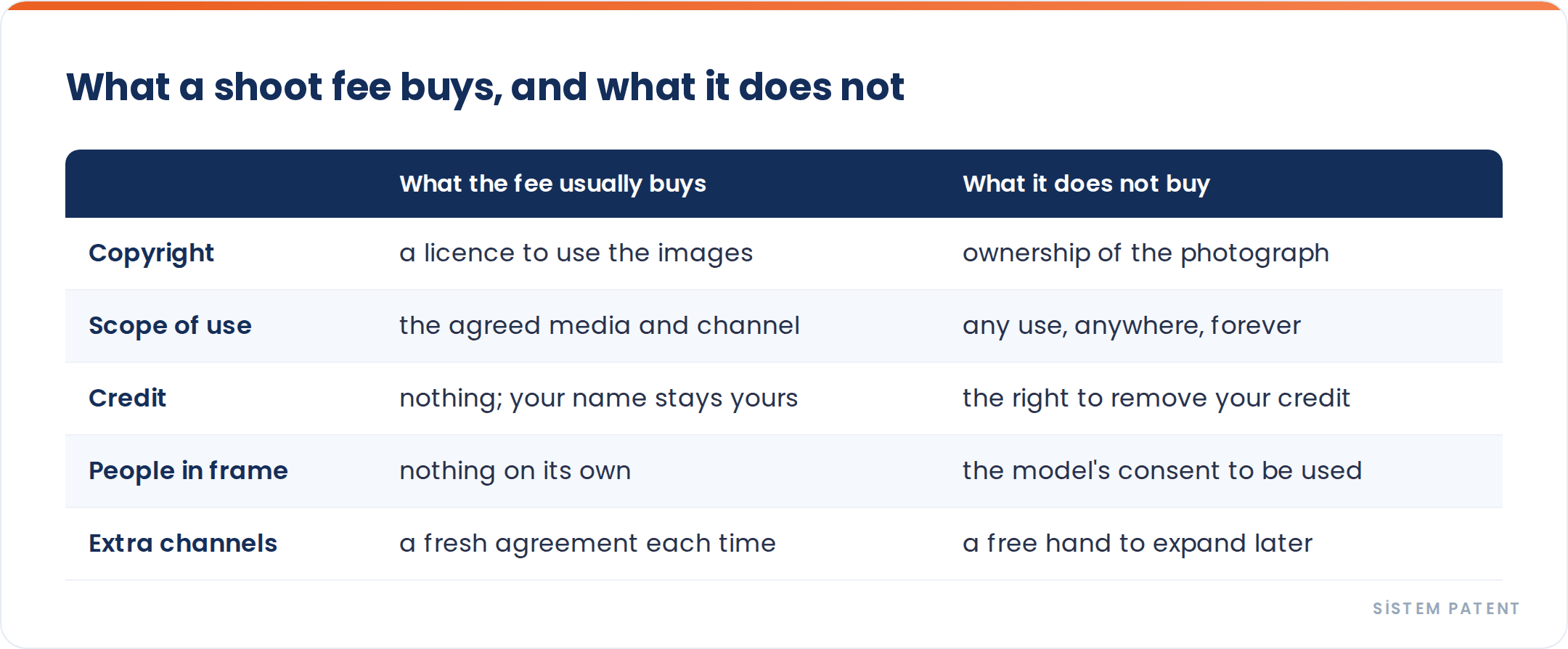
The practical move is to write the scope down before the shoot, not after the dispute. State what the images may be used for, on which media, in which territory and for how long. Make clear that uses beyond that scope, a billboard when you licensed a social post, a national rollout when you licensed one store, need a fresh agreement. When the brief is on paper, the eight-months-later billboard stops being a he-said argument and becomes a plain breach of an agreed limit, which is a far stronger place to stand.
Releases cover the people and places in the frame, not your ownership
Owning the copyright in a photograph is not the same as being free to use it however you like. If a recognisable person appears in the image, their own personal rights are in play. Under the Turkish Civil Code a person controls the commercial use of their image, which is why a model release matters: it is the subject's written consent to the specific uses you intend, and without it a commercial use of someone's likeness can expose you regardless of who owns the copyright. A model release and a copyright licence answer two different questions. The licence governs what the client may do with your photo; the release governs what anyone may do with the person in it.
Property releases work on a similar principle for certain locations and objects, a private building interior, an identifiable artwork, a branded product, where the owner's permission may be needed for commercial exploitation. These are usually contractual rather than pure copyright issues, but they land in the same lap, because the photographer is the one who delivered the image and is expected to have cleared it. Building the habit of collecting signed releases on commercial shoots protects you and your client at the same time, and it is far cheaper than discovering the gap after the campaign is live.
Proving the shot is yours starts long before the dispute
When use goes wrong, the first question is always evidence: can you show, on an official footing, that you created this image and when. Copyright exists without registration, but a dated record of authorship is what lets you prove it quickly instead of reconstructing the history from camera files and memory years later. A voluntary fine art copyright registration creates exactly that, an official, dated statement that you deposited this work on this day, and it is most valuable when it is oldest, filed for the images you expect to defend rather than scrambled together once a copy appears.
Registration is not the only proof, and it works best layered with the everyday records you already generate. Raw files carry capture dates and camera data. Delivery emails and invoices tie the images to a date and a client. Contracts define the licence. Together these build a timeline, and the formal record sits on top as the cleanest single piece. The photographers who win these arguments are rarely the ones with the most dramatic infringement; they are the ones who can produce, fast, a dated chain showing the image was theirs first and the use exceeded what was licensed.
What you can actually do when a photo is used without a licence
Discovering unlicensed use is the start of a decision, not an automatic lawsuit. The response should fit the infringement, and the cheapest effective move usually comes first. A platform takedown removes the image fast where it sits on a social network or marketplace, and a registered, documented work makes those requests far harder to brush off. A direct notice to the user, setting out your ownership and the unlicensed use and proposing a resolution, settles a large share of cases without a courtroom, especially where the other side simply assumed the fee covered everything.
Where the use is deliberate, commercially significant, or the other side refuses to engage, the formal route opens up. Turkish law gives the rights holder real teeth here. You can demand that the infringement stop, seek removal of the offending material, and claim compensation for the unauthorised use. Law No. 5846 also allows a rights holder, in cases of unauthorised use, to claim compensation calculated as a multiple of the fee that would have been agreed had the user asked permission properly, which is designed precisely for the brand that used your images well beyond the licence it paid for. The exact figures depend on the facts and are set by the court, so the honest framing is qualitative: the law lets you recover meaningfully more than the original fee, not merely the fee you should have been paid in the first place.
Choosing the proportionate response is the skill. A one-off repost by a small account may deserve a polite takedown and nothing more. A national campaign built on images licensed for a single post is a different matter, and that is where an intellectual property infringement lawsuit backed by a dated record of authorship moves from a standing start rather than spending months proving you took the photo at all. The stronger your documentation, the wider your realistic options, and the more often the matter resolves before it ever reaches a judge.
The throughline for a working photographer is simple. You own your images from the moment you shoot them, a fee buys only the use your contract describes, and the people and places in the frame carry their own permissions. Get the licence in writing, collect your releases, and put a dated record of your key work on file before you need it. If a brand has already pushed your photos past what they licensed, Sistem Patent can assess where your rights and evidence stand and help you choose the response, from takedown to a formal claim, that actually fits the use.
Picked for You
Related Articles

Who Owns Your Reels: A Creator's Guide to Copyright, Music and Brand Deals
Read More →
Work-for-Hire and Freelancers: Who Owns the Design, Code or Copy You Paid For
Read More →