
Should You Register a Song Before You Release It? A Pre-Release Protection Checklist
An independent producer finishes a beat on a Tuesday night, drops it into a shared folder so a vocalist can lay down a hook, and posts a fifteen second snippet to an Instagram story to gauge the reaction. The reaction is good. Three months later the full track is climbing on streaming, and a message arrives from someone who says the topline melody is theirs, sent over in that same folder, and that nobody ever agreed who owned what. Now there is a hit, a co-writer nobody documented, and no dated record of who brought which part to the session. The music is finished. The paperwork that should have come first does not exist.
This is the gap that swallows independent artists. The creative work moves fast and the protective work moves never, because releasing feels like the milestone and the legal side feels like something to deal with if the song actually does something. By the time a song does something, the cheapest moment to protect it has already passed. The point of a pre-release routine is not to slow the release. It is to spend one focused hour before the upload so that a dispute six months later is a short conversation backed by records rather than an argument backed by memory.
Copyright exists the moment you record the song, but proving it is the real problem
Under Turkish law the rule is the same as in most of the world: a musical work is protected by copyright from the moment it is fixed in a tangible form, the second you record the demo or write the notation down. You do not file anything to own the copyright. That is the part artists hear and relax about, and it is also the part that misleads them. Owning a right and being able to prove you owned it first are two completely different things, and a dispute is decided entirely on the second one.
The weakness of automatic copyright is that it leaves no external timestamp. If you and another person both claim the same melody, "it is mine because I made it" is a statement, not evidence. What turns it into evidence is a dated record that existed before the dispute and that a third party can stand behind. That is the entire value of a formal music work copyright registration: it does not create your ownership, it creates the proof of when your version existed, lodged with an institution rather than sitting in your own files where you could have backdated it.
The distinction matters most in exactly the situations independent artists run into. Sampling claims, where someone says you took their sound. Ghost-production fallouts, where a producer who sold or shared a beat later says the deal was different. Co-writing disputes, where two people remember the split differently. In every one of these, the person holding a credible dated record is the person who sets the terms of the conversation.
A song is not one copyright, it is at least two
The single most common mistake is treating a finished track as one thing to protect. It is not. A recorded song contains two separate copyrights that can belong to different people, and an artist who protects one while ignoring the other has left half the work exposed.
The first is the underlying composition: the melody and the lyrics, the song as it could be written on paper or played by anyone. The second is the sound recording, the specific captured performance, the master. A bedroom producer who writes, performs, and records everything alone may control both. The moment a vocalist, a topline writer, or a producer who licensed you the instrumental is involved, those two copyrights start to split across different hands, and the words are often where it gets messiest. If you bring in a lyricist, the lyrics carry their own authorship, which is why the words specifically can warrant a separate song lyrics copyright registration rather than being folded silently into the track.
Mapping these layers before release is what tells you who actually needs to sign off on the upload, and who has a claim on the income. Skip the mapping and you discover the answer later, usually from a lawyer's letter.
The split sheet is the one document most musicians skip and most regret
A split sheet is a short written agreement, made at the session or right after, that records who contributed to the song and what percentage of the songwriting each person owns. It names the work, lists every contributor, assigns the shares, and gets signed by everyone. It is not glamorous and it takes ten minutes. It also prevents the single most destructive kind of music dispute, the one between collaborators who were friends when the song was made.
The reason to do it before release, and ideally on the day of creation, is that splits are easy and friendly to agree when nothing is at stake and bitter to agree once there is money on the table. Memory does not hold a 40/35/25 split across three people and two years. A signed sheet does. When a song earns nothing the split sheet is irrelevant, and when a song earns something it is the most valuable page in the file, because royalty collection, licensing, and any later registration all depend on knowing the ownership it records.
Clearing samples before release, not after a takedown
If the track contains a sample, an interpolation, or a melody borrowed from somewhere, that is a use of someone else's copyright, and recording your own version does not erase it. An interpolation, replaying a recognizable melody yourself, still uses the underlying composition even though you did not lift the original master. Clearance means getting permission, and permission is something you negotiate from a position of strength before release and from a position of weakness after a track is already monetized and getting attention.
The pre-release logic is straightforward. Before you upload, a sample either is cleared, has been replaced, or is small and identifiable enough that you have made a conscious decision about the risk. After you upload, all three of those options get more expensive, and the cleanest one, quietly swapping the sample out, may no longer be possible without re-cutting a track the audience has already heard.
What to actually lock down before the upload button
The pre-release checklist is short, and none of it requires you to be a lawyer to start. It requires you to do it in the right order, before the work is public.
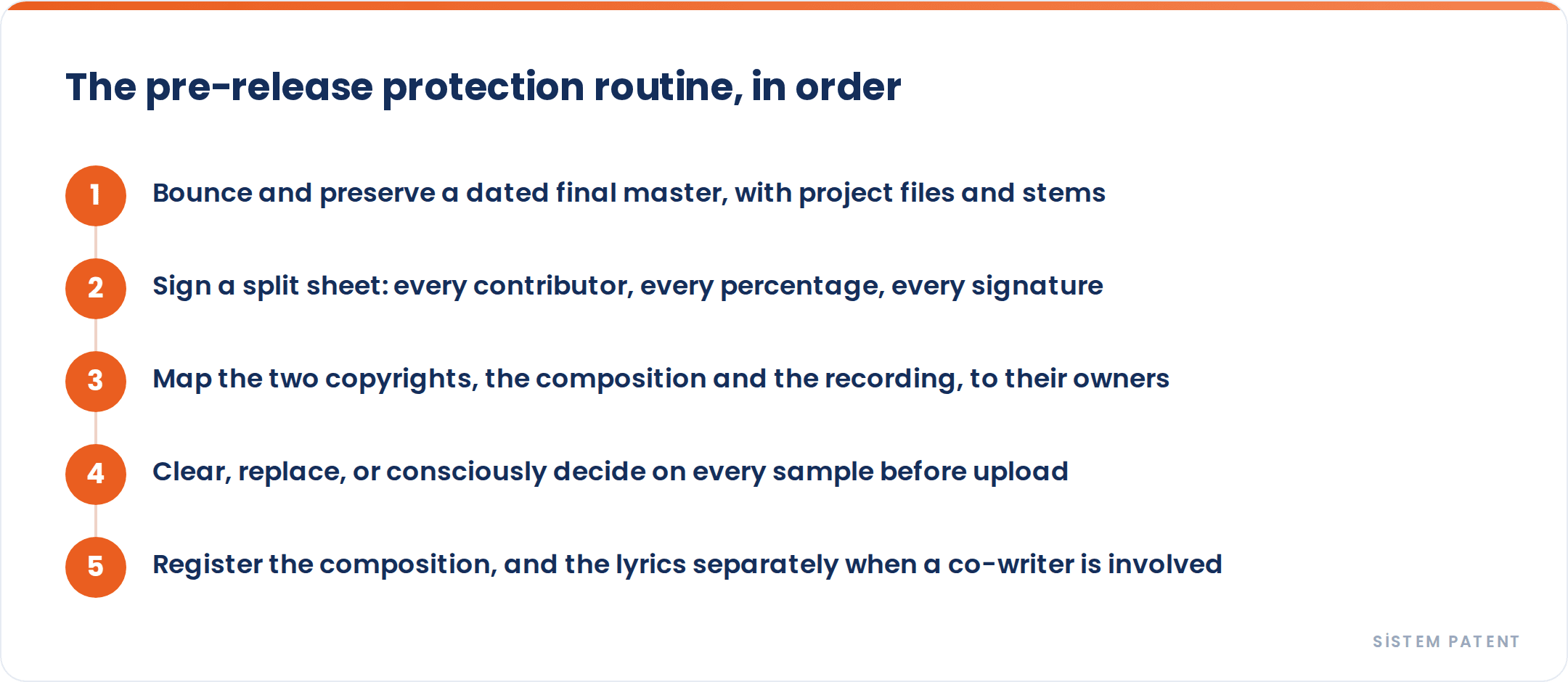
- Fix a dated master. Bounce the final version and preserve it unchanged, with the project files and stems, so you can show exactly what existed and when.
- Sign the split sheet. Every contributor, every percentage, every signature, before anyone has a reason to remember the numbers differently.
- Map the two copyrights. Write down who owns the composition and who owns the recording, because they are not always the same people.
- Resolve every sample. Cleared, replaced, or a documented decision. No open question travels past the release date.
- Register the version that matters. Lodge the formal record for the composition, and separately for the lyrics where a co-writer is involved, so the proof predates any claim.
Run in that sequence, the routine costs an hour and a small fee. Skipped, the same protection costs a dispute, a frozen royalty stream, and sometimes the song itself. A musician who is about to release should treat the formal record as part of finishing the track, not as a thing to handle if trouble shows up. If you want the composition and the words protected cleanly before you publish, our team handles copyright registration for musical works and the separate registration of song lyrics as a routine pre-release step, so the dated record is in place before the first stream rather than after the first dispute.
Picked for You
Related Articles

Who Owns Your Reels: A Creator's Guide to Copyright, Music and Brand Deals
Read More →
Work-for-Hire and Freelancers: Who Owns the Design, Code or Copy You Paid For
Read More →