
Trademark Strategy for a Rebrand: Protect the New Name Before You Launch
A rebrand usually leaks before it is meant to. A supplier overhears the new name, an agency designer posts a teaser, a domain gets registered under a thin holding company, and somewhere a stranger sees an opportunity. By the time the new identity is ready for its public reveal, someone has already filed it as a trademark, sitting on the one word the whole campaign is built around. The launch does not get delayed. It gets hijacked.
This is the quiet risk in every name change. A rebrand moves all the brand equity a business owns onto a new word, and for a window of weeks or months that word is exposed: chosen, circulating internally, visible to vendors, but not yet protected. The work of a rebrand is not only picking a name that tests well in focus groups. It is sequencing the legal protection so the new mark is locked down before the old one is retired and before the market is told anything. Get the order right and the reveal is a celebration. Get it wrong and the first thing the new brand does is fight for its own name.
The new name has to clear before the campaign starts, not after
The instinct in a rebrand is to fall in love with a name and work backward from a launch date. That is the order that gets brands into trouble. The name a creative team falls for is chosen for how it sounds and feels, with no view of whether it is already owned by someone selling related goods. A name can win every internal vote and still be legally unavailable, and the only way to know is to look before anyone commits.
The first move is a clearance search across the Nice classes that match what the rebranded business actually sells. This is not the quick check of typing the name into a register to see if an identical mark pops up. A proper trademark search looks for marks close enough to be confused with yours: phonetic near-matches, names that share a dominant element, marks in neighbouring classes whose goods overlap with yours. A rebrand is precisely the moment to run the deep version, because the cost of discovering a conflict now is a different shortlist, while the cost of discovering it after launch is the entire identity.
Clearance also has to follow the business, not just the home market. If the rebrand is the moment the company plans to push into export markets or sell online across borders, the name has to be cleared in those territories too. A word that is free and strong in Türkiye can be blocked, or worse already owned, in the markets the new brand intends to enter. Finding that out during clearance costs nothing but a rethink. Finding it out after the signage is printed costs the launch.
File the new mark before the public sees it
Once a name survives clearance, the protection has to be in place before the identity goes anywhere near the public. The reason is structural. Turkey runs a first-to-file system, which means the right generally belongs to whoever files the application first, not to whoever thought of the name or used it earliest. A rebrand that teases the new name in a press release, a careers page, or a launch event before the application is filed hands a roadmap to anyone watching, and in a first-to-file country that roadmap is an invitation.
So the application goes in while the name is still confidential. A trademark registration filed before the reveal does two things at once. It fixes the filing date, which is the date that decides priority against anyone who files later, and it starts the examination clock so the mark is moving through the office while the campaign is still in production. The classes on that application should cover what the business sells now and what it credibly plans to sell over the life of the rebrand, because adding classes later means a fresh application with a later date, not an edit to the old one.
The filing date matters more than people expect. From a Turkish filing, the business also gains a six-month priority window to extend the same date into foreign applications under the Paris Convention. For a rebrand that is also an international push, filing the home application early does not just protect Türkiye. It anchors a date that can be carried into every export market the brand reaches in the following six months. The single act of filing first, before the reveal, is what turns a vulnerable name into a defended one.
Keep the old mark alive through the entire transition
The most expensive mistake in a rebrand is treating the old name as dead the moment the new one is chosen. It is not dead. It is carrying customers, search traffic, contracts, and reputation across the bridge to the new identity, and a registered trademark does not switch off cleanly the day a company changes its logo. Two risks open up if the old mark is abandoned too early.
The first is renewal. A registered trademark has to be renewed on its cycle, and a rebrand does not pause that deadline. If the old mark lapses mid-transition because everyone assumed it no longer mattered, it can fall open for a competitor or an opportunist to pick up, precisely while it still points real customers toward the business. Keeping a trademark renewal on schedule through the transition is cheap insurance against a rival capturing the name customers still type while the new brand finds its feet.
The second risk is non-use. In Turkey a registered mark that goes unused for five straight years becomes vulnerable to cancellation by a third party. A rebrand that strips the old name off everything overnight starts that clock. If there is any chance the old mark still holds value, as a defensive registration, a fallback, or a heritage sub-brand, the genuine-use evidence has to keep accumulating, or the registration quietly weakens until someone challenges it. The disciplined approach is to decide consciously which old marks to keep alive and which to let go, rather than letting the decision happen by neglect.
Run the two marks in parallel before you retire the first
For a real transition window, the old and new marks live side by side. The old mark stays registered and in use while the new one moves through examination and starts appearing in the market. Only once the new registration is secure and the new name is genuinely carrying the business does retiring the old mark become a deliberate choice rather than a gamble. Phasing it this way means the business is never exposed on either side: never trading under an unprotected new name, and never abandoning a still-valuable old one before its job is done.
Time the public reveal to the protection, not the calendar
The reveal is the part everyone wants to rush, and it is the part that should be governed by the legal status of the mark rather than by a marketing date set months earlier. The principle is simple. Nothing about the new name goes public until the application is on file. Not the domain announcement, not the social handles, not the soft internal email that always finds its way outside.
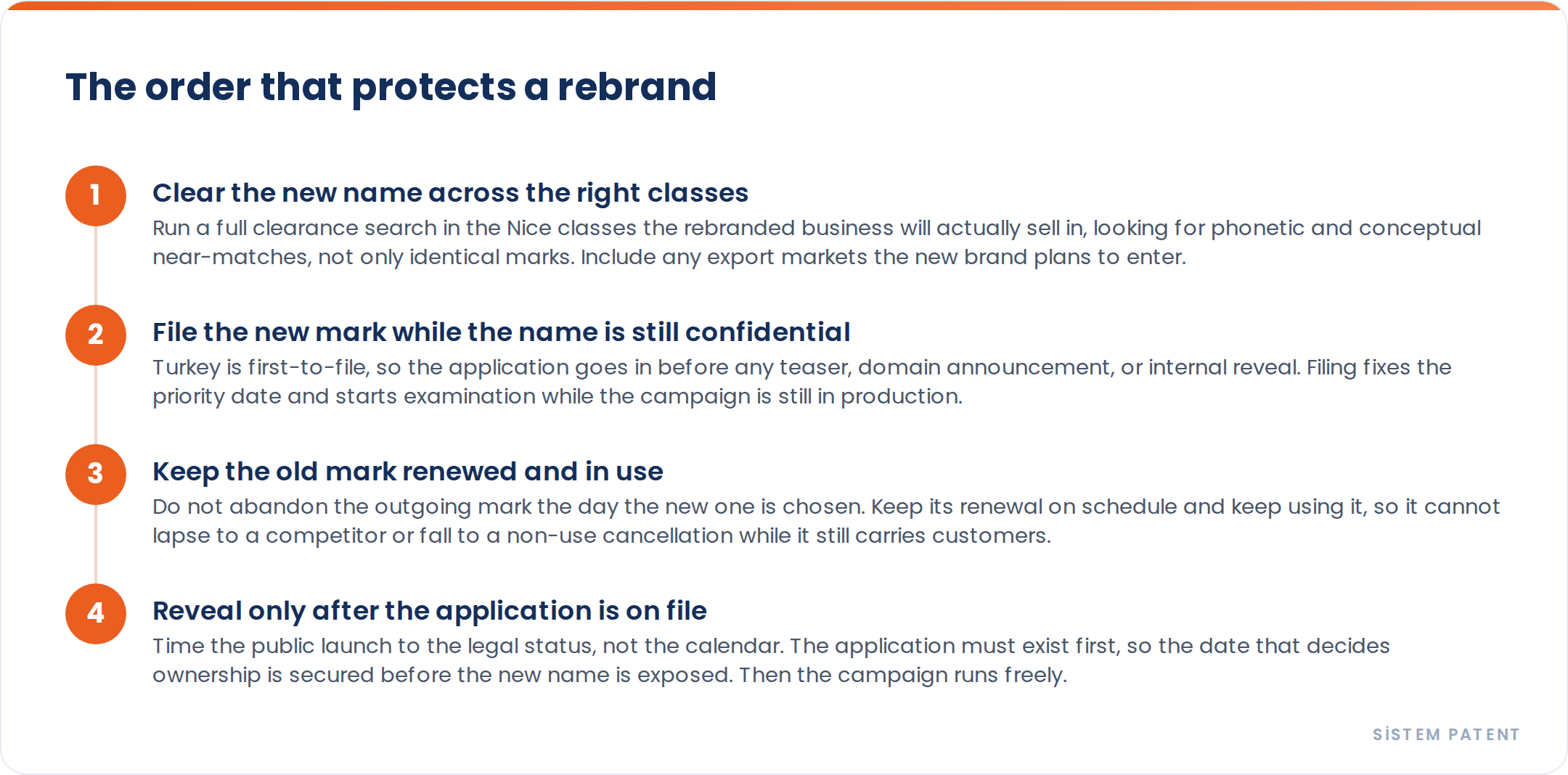
That does not mean waiting for the registration certificate, which can take many months to issue. It means the application must exist first, so the filing date is secured and priority is locked before the name is exposed. With the filing done, the campaign can run on its own schedule, confident that the date which decides ownership already belongs to the business. The sequence that protects a rebrand is therefore fixed: clear the name, file the mark, keep the old registration alive, and only then reveal. A name change built in that order arrives as a launch. Built in any other order, it arrives as a dispute.
If a rebrand is on your roadmap, the cheapest moment to protect it is before the name leaves the room. Start with a thorough clearance search across the right classes, move the cleared name straight into a trademark registration before the reveal, and keep the outgoing mark renewed until the new identity has fully taken over. Our team can sequence the whole transition so the new name is protected the day it goes public, not the day someone else claims it.
Picked for You