

Registered vs Unregistered Design Rights: What You Get for Free and Why It Is Rarely Enough
A furniture maker shows a new shelving system at a trade fair in October. By February, a near-identical unit is on a competitor's website at two thirds of the price. The maker never filed anything, assuming that creating the design first was enough to own it. There is a right that protects them, and it is real, but it is short, narrow and hard to enforce. Most owners discover its limits at the worst possible moment, which is the day a copy appears and they reach for a remedy that was never as strong as they thought.
Turkey gives the appearance of a product two very different kinds of protection. One arrives automatically the moment a design is made available to the public, costs nothing, and asks for no paperwork. The other requires an application, a fee and a public record, but hands you a far stronger and longer monopoly. Treating these as interchangeable is one of the most expensive mistakes a design-led business makes. They protect different things, last for different periods, and put you in completely different positions when someone copies you.
An unregistered design right protects you against copying, and almost nothing else
The instant you disclose a new design to the public in Turkey, whether by selling the product, publishing it, or exhibiting it, an unregistered design right can arise under the Industrial Property Code (Law No. 6769), provided the design is new and has individual character. You did not have to ask for it. You did not have to pay. For a young brand testing a product before committing budget to filings, that automatic cover sounds like a gift, and in a narrow set of cases it genuinely helps.
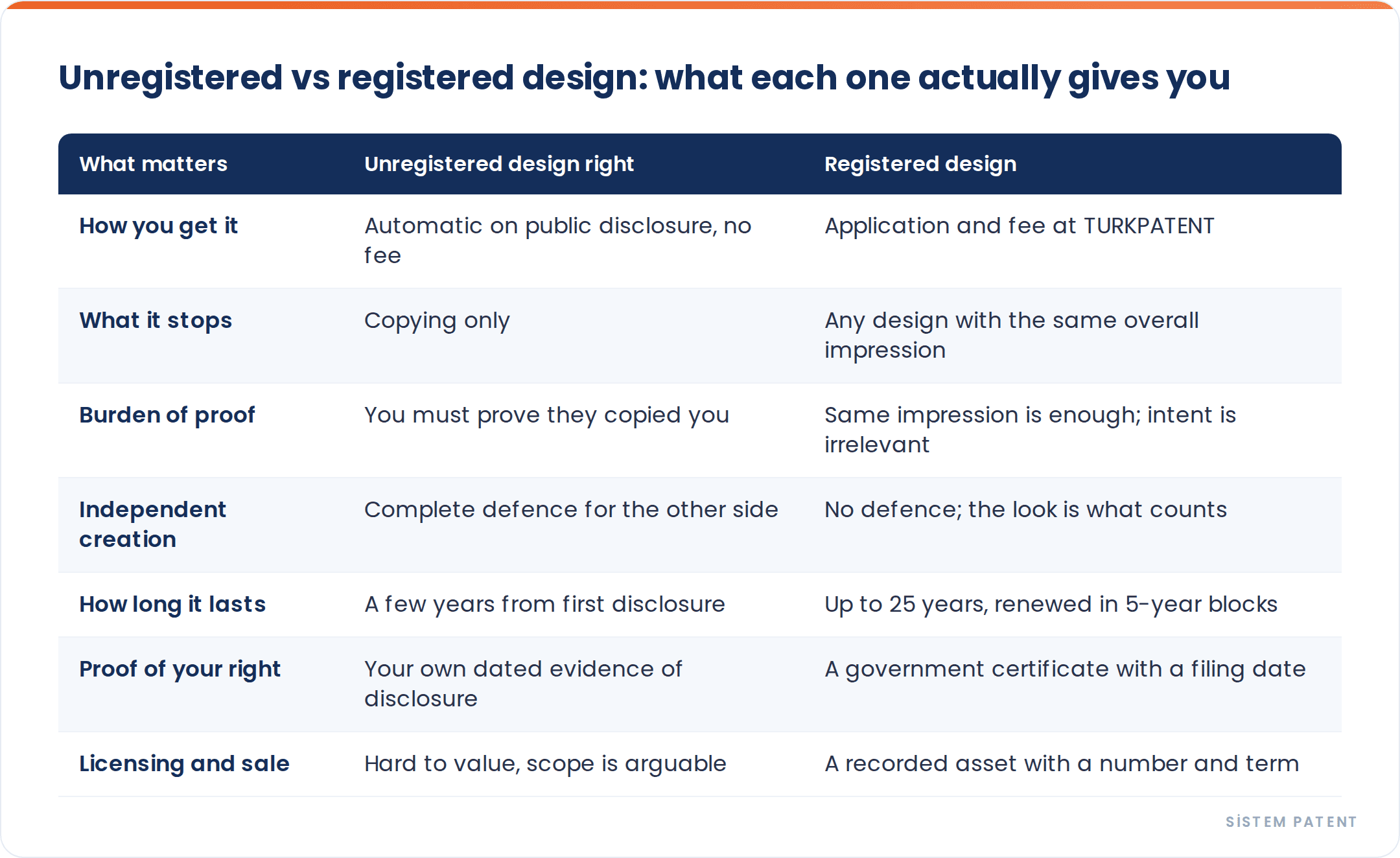
The catch is in what the right actually lets you stop. An unregistered design protects only against copying. If a competitor independently arrives at a similar design without ever seeing yours, they infringe nothing, and the burden sits on you to prove they copied. That proof is the whole battle. You have to show your design was disclosed first, that the other party had access to it, and that the similarity is the result of copying rather than two designers reaching a common solution in a crowded field. Independent creation is a complete defence, and a defendant who can paint a plausible story of arriving at the look on their own will often walk.
Then there is the clock. Unregistered protection is short by design. It is measured in a few years from first public disclosure, not the decades a registration can reach, and once it lapses the design falls into the public domain with no way to revive it. You also carry a quieter problem: proof of the date. To rely on the right at all, you need solid evidence of when and where you first disclosed the design, because that date fixes both the start of your protection and the novelty you are claiming. Dated catalogues, archived web pages, fair records and notarised samples become the evidence file you did not know you were supposed to keep.
A registered design gives you a monopoly, not just a copying claim
Registration changes the nature of the right itself. A design registration at TÜRKPATENT (the Turkish Patent and Trademark Office) gives you an exclusive right to the appearance of the product, enforceable against any later design that produces the same overall impression on the informed user. The other side's intent stops mattering. You no longer have to prove they copied you. If their product creates the same overall impression as your registered design, it infringes, whether they had ever seen yours or invented it in a clean room. That single shift, from a copying claim to a true monopoly, is what most owners are actually paying for when they file.
The term is the other half of the bargain. A registered design in Turkey runs for five years from the filing date and renews in five-year blocks up to a maximum of twenty-five years, so a design you keep current can be protected for a quarter of a century rather than a handful of years. The registration is also a public record with a certificate and a filing date on its face. When you send a demand letter, enrol in a marketplace brand programme, or instruct customs to watch for copies, that certificate is the document that makes the request land. A claim built on an unregistered right asks the other side to take your word for a date and a chain of events. A registration puts a dated government record on the table.
None of this means a registration is unbreakable. Turkish design applications are registered after a formal examination, without a full novelty search up front, so the certificate is not proof your design was genuinely new at filing. If it lacked novelty or individual character on that date, a defendant you try to stop can ask for it to be invalidated. The strength a registration buys is real, but it rests on the same two tests an unregistered right does. The difference is that with a registration you start from a presumption of validity and a fixed date, and your opponent has to do the work of tearing it down.
When relying on the unregistered right is a real risk
The honest way to use the unregistered right is as a thin safety net for designs you are not going to commit to, not as a substitute for registration on the ones that matter. The gap between the two becomes a real exposure in a few recognisable situations, and they are worth naming plainly because each one is where businesses get hurt.
The look is core to the product, and the product has a future
If the design is the reason customers choose the product, a fashion silhouette, a signature bottle, a furniture line you will sell for years, the short term and the copying-only limit of the unregistered right are a poor match for the value at stake. A competitor who reaches a similar look independently is untouchable, and the right expires while the product is still selling. This is exactly the case where the cost of an industrial design registration is trivial against what the design earns.
You expect a competitor to design around you rather than copy outright
Sophisticated competitors rarely clone a design pixel for pixel. They take the idea and rework it just enough to argue independent creation. Against an unregistered right, that strategy often succeeds, because you cannot prove copying. Against a registration, the question is not whether they copied but whether the overall impression is the same, which is a far harder line for a design-around to clear.
You plan to license, sell, or raise money on the design
An unregistered right is awkward to license and nearly impossible to value cleanly, because its scope and even its existence can be argued over. Investors, acquirers and licensees want a registered asset with a number, a date and a term. A design you intend to monetise needs to be a recorded right, not a claim you would have to litigate to establish.
You sell across borders
Unregistered protection is territorial and patchy. The cover you get in one market does not travel, and the rules differ sharply between Turkey, the European Union and elsewhere. A design you are taking abroad needs registrations mapped to your actual markets, because relying on a thin national unregistered right while you sell across several countries leaves most of your footprint open.
The practical rule: use the free right to buy time, not to protect what matters
The unregistered design right has one genuinely good use. It buys you a window. While you test a product, gauge demand and decide whether the design deserves investment, the automatic cover gives you a basic claim against a blatant copyist in the meantime. It was built to fill that gap, and used for that purpose it does its job.
The mistake is letting that window become the plan. The moment a design proves itself, the calculus flips: the cost of filing is small, the term and the monopoly are large, and the date you secure today is the date you will rely on in every dispute that follows. If you are weighing whether a particular design is worth registering, that decision turns on how central the look is, how long you will sell it, and where, and an early read on those factors is the difference between a right you can enforce and a claim you can only argue. Our team handles design clearance and design registration day in and day out, and the question is rarely whether to register the designs that carry a business. It is which ones, and when.
Picked for You
Related Articles

Turn Your Design Investment Into a Tax Position: Design Centres, R&D and IP Incentives
Read More →
Jewellery Design Protection: Securing a Signature Piece Against Imitation
Read More →