
What Happens If You Miss a Trademark Renewal Deadline

A competitor watching your category does not need you to make a dramatic mistake. They just need you to forget a date. Ten years is long enough that the person who registered the mark has changed jobs, the email the reminder went to no longer exists, and the renewal sits in nobody's inbox. The certificate is still framed on the wall, so it feels permanent. It is not. A trademark in Turkey is a renewable right with an expiry date, and the day it lapses is the day the name you built can become available to someone else.
This is the part owners underestimate. Renewal is not paperwork you do because a system insists on it. It is the single recurring act that keeps the registration alive, and missing it does not trigger a warning shot. It quietly removes the legal ground under a brand, often months before anyone on your side notices the floor is gone.
A Turkish trademark lasts ten years, then it depends entirely on you
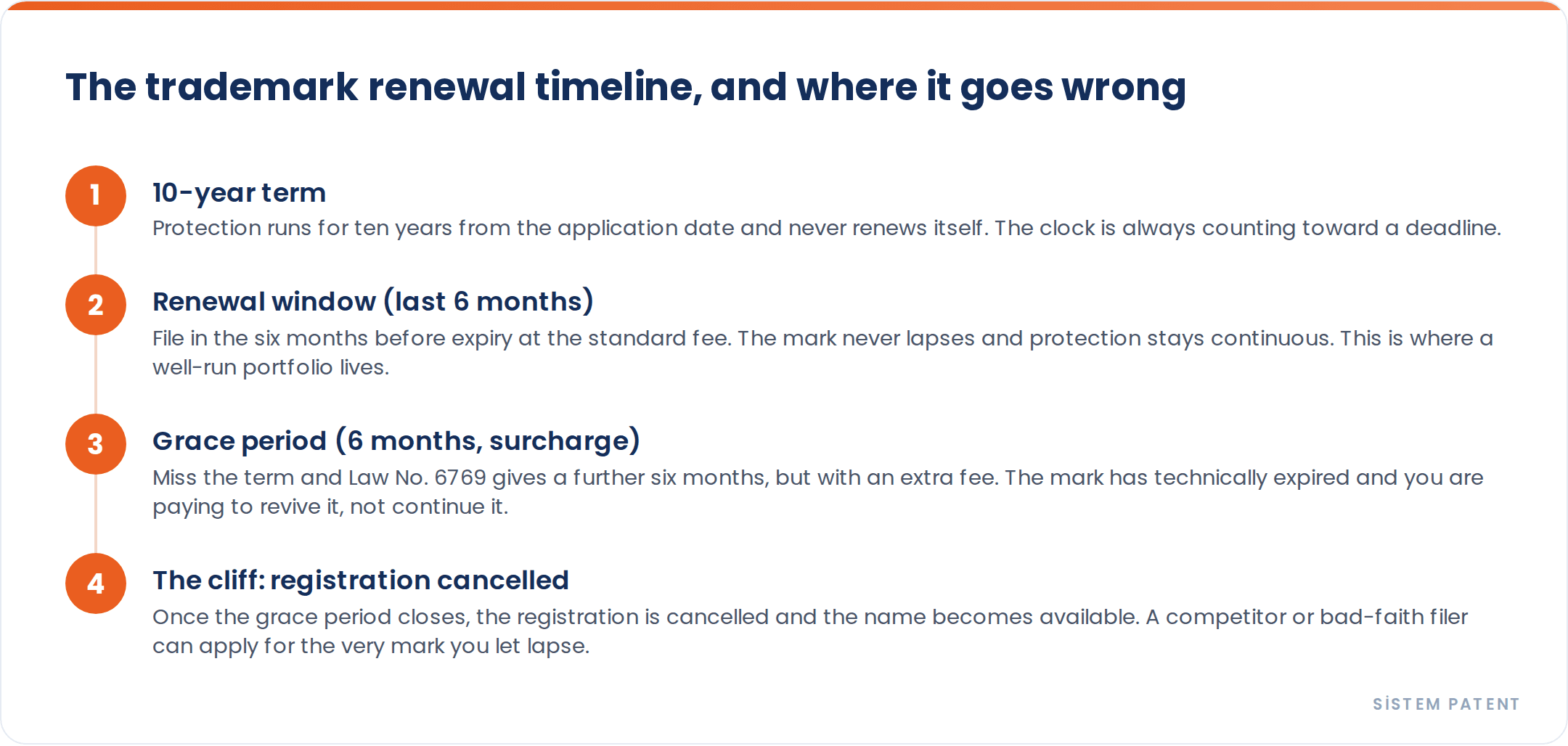
Under the Industrial Property Code (Law No. 6769), a registered trademark is protected for ten years from the application date. At the end of that term the protection does not roll over on its own. You renew it for a further ten years, and you can keep renewing indefinitely, which is what makes a trademark unusual among intellectual property rights: handled properly, it can outlive its owner. The catch is that every one of those ten-year cycles closes with a hard deadline, and the right is only as durable as your discipline in meeting it.
The trademark renewal request is made to TÜRKPATENT (the Turkish Patent and Trademark Office) and carries an official fee that the office sets each year. The amount matters less than the timing. A renewal is not a fresh examination of whether your mark deserves protection. Nobody reassesses distinctiveness or re-opens the file to competitors. You are simply telling the register that the mark is still in use and still yours, and paying to keep the ten-year clock running. Skip that step and the most valuable asset most businesses never put on their balance sheet starts ticking toward expiry.
You get a window before expiry, and a paid grace period after
The law does not expect you to hit the exact expiry date to the day. There are two distinct windows, and knowing the difference between them is the whole game.
The first is the renewal window before expiry. In the six months leading up to the end of your ten-year term, you can file the renewal at the standard fee. This is where a well-run portfolio operates. The mark never actually lapses, the protection is continuous, and the cost is the ordinary one. Nothing about your rights changes because, from the register's point of view, the registration simply carries on.
The second is the grace period after expiry. If the term ends and the renewal has not been filed, Law No. 6769 still gives you a further six months to put it right, but now with an additional fee on top of the standard one. The mark is in a fragile state during these months. It has technically expired, and you are paying a penalty to revive it rather than a fee to continue it. The grace period is a safety net, not a plan. Treating it as your normal renewal moment means paying more every cycle for a thinner version of the same protection.
Past the grace period there is a cliff, not a slope
The dangerous misconception is that a lapsed trademark fades gradually, leaving time to react. It does not. Once the six-month grace period closes without a renewal, the registration is cancelled. The exclusive right is gone, struck from the register as if the ten years of protection had been spent and not continued.
What replaces it is not a grey area you can quietly operate inside. It is an opening. The name that was legally fenced off is now, in registration terms, available, and the people most likely to notice are precisely the ones who have a reason to: a competitor who always wanted that name, a distributor who knows your market, or a bad-faith filer who tracks lapsed marks as a business model. They can apply for the very mark you let expire. If their application clears, you are no longer the owner trying to renew. You are an outsider trying to argue your way back to a right you used to hold, against someone who now appears on the register as the legitimate applicant.
Recovering from that position is not a renewal. It is a dispute. You may be able to rely on your prior use and your years of registration to challenge the new filing, but you have moved from a routine administrative step that costs a known fee into a contested matter that costs legal time, carries real uncertainty, and may not succeed. The asymmetry is brutal. A renewal filed on time is cheap, certain, and boring. A renewal missed past the grace period can turn into the most expensive fight in your brand's history.
The damage is not only legal
Even if you eventually claw the mark back, a gap in protection leaves marks of its own. Any infringement that happened while the registration was lapsed is harder to act on, because for that stretch you did not hold the registered right you would normally enforce. A chain of clean, continuous registration is also what buyers, investors and licensees inspect first. A lapse in the record is a question you will be answering in every due-diligence process for years, long after the mark itself is back in force.
Why renewal is a risk decision, not an administrative one
It helps to stop filing renewal under "paperwork" and start filing it under "risk management", next to your insurance and your contracts. The logic is the same. You are paying a small, predictable, recurring cost to remove a low-probability event that would be catastrophic if it happened. Nobody expects to be the business that loses its own name. The businesses that do lose it almost never decided to. They simply let a date pass.
The exposure is widest for exactly the brands that can least afford it: the ones that have grown. A ten-year-old mark is usually attached to far more revenue, goodwill and recognition than it was at filing, which means the value at stake at renewal climbs every cycle while the cost to protect it stays roughly flat. The gap between what you risk and what it costs to stay safe gets wider with every year the brand succeeds. Letting a successful mark lapse is, in pure economic terms, one of the worst trades a business can make without noticing it is making it.
Make the deadline impossible to miss
The fix is not to try harder to remember. Human memory across a ten-year gap is exactly the wrong tool, and the people relying on it are the ones who end up in the grace period. The fix is to take the date out of memory entirely and put it into a system that surfaces it on time. A managed renewal service exists precisely so the deadline is tracked against the register rather than against whoever happened to handle the filing a decade ago, and so the renewal is prepared inside the standard window instead of scrambled together in the penalty months.
This pairs naturally with watching the register more broadly. The same discipline that keeps your own renewals on schedule through trademark monitoring also tells you when someone files a confusingly similar mark, including the opportunists who circle marks that look like they might be about to lapse. Renewal keeps your right alive; monitoring tells you who is moving against it. Run both and the timeline that quietly ends so many brands becomes a non-event: a fee paid inside the window, a registration that simply continues, and a name that stays yours for as long as you keep using it. If you are not certain when your next renewal falls due, that uncertainty is the risk. Closing it is a single, ordinary step taken now, not a costly one taken too late.
Picked for You