
The Hague System as an Export Strategy: One Filing, Many Markets for Your Design
A ceramics maker in Kutahya lands a distributor in Germany, a buyer in the Gulf, and a trial order from a retailer in Spain, all in the same quarter. The product that won them over is a tableware line with a shape and surface pattern nobody else has. Then a near-identical version turns up on a marketplace listing shipping out of a country the maker had never thought about. The design is registered in Turkey, which protects nothing outside Turkey, because an industrial design right stops at the border of the office that granted it. The question is no longer whether to protect the design abroad. It is how to do it across a dozen markets without filing a dozen separate applications and paying a dozen separate agents.
This is the exact problem the Hague System was built for. Run by WIPO (the World Intellectual Property Organization), it lets the owner of a design file one application, in one place, and obtain protection in any of the countries and regional offices party to the agreement. Turkiye has been a member since 2004, so a Turkish exporter can file directly through this route. For a manufacturer whose growth plan runs through export, the Hague System turns design protection from a country-by-country chore into a single procurement decision: pick the markets, file once, manage the whole basket from one record.
National design rights stop at the border, and that is the gap exporters fall into
Design protection is territorial by default. A registration granted by TURKPATENT (the Turkish Patent and Trademark Office) gives you the exclusive right to your design in Turkiye and nowhere else. The moment your product ships into a market where you hold no registration, a local copyist can reproduce the shape, the pattern, the configuration, and your Turkish certificate does nothing to stop them there. Exporters discover this in the worst way: a knockoff appears in a target market, the customs and platform takedown tools all ask for a local registration, and there isn't one.
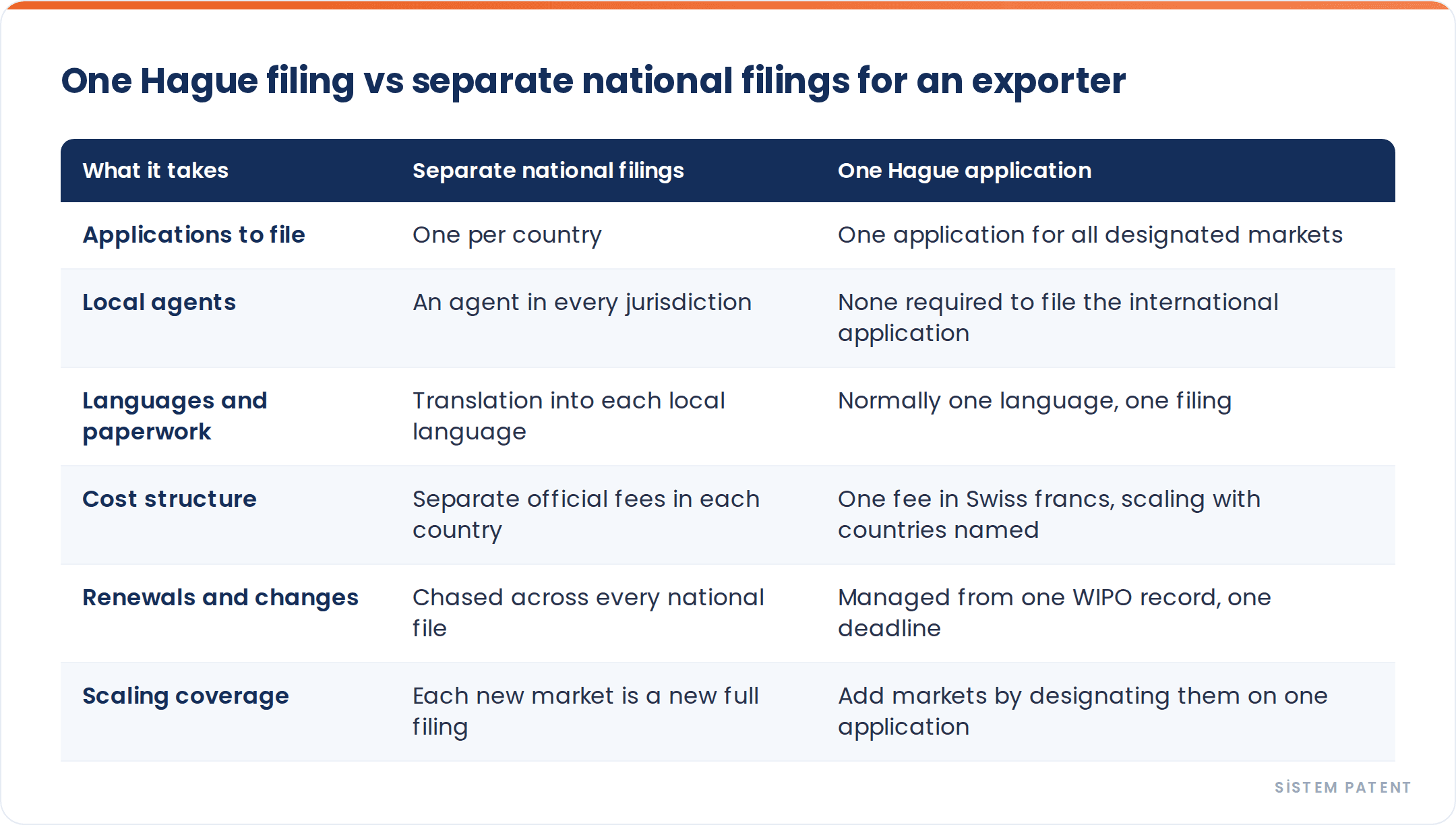
The traditional fix is to file in each country separately. That means a different application in each office, a local agent in each jurisdiction, separate official fees, and often translation of the paperwork into the local language. For three or four markets this is merely expensive. For the ten or fifteen markets a serious export brand actually sells into, it becomes a budget and management problem large enough that most companies simply skip it, and stay exposed. The Hague System exists to remove that friction.
One application, one currency, one renewal date across every market you designate
Under the Hague System you file a single international application, normally in one language and with one set of fees paid in Swiss francs to WIPO, and in it you name the contracting parties where you want protection. WIPO checks the formalities and records the international registration, then each designated office examines it under its own law and grants protection as if you had filed there directly. The right you end up with in each country is the same right a separate national registration would have given you. You did not have to instruct an agent in each one to get there.
The mechanics of an international design registration under the Hague System carry several advantages that matter to an exporter specifically. You can include multiple designs in one application, so a whole product family, a plate, a bowl, a serving dish sharing a pattern, can travel together. You can claim priority from your earlier Turkish filing. You can defer publication, which keeps the design confidential for a set period if you are timing a launch. And after registration, the renewals, the address changes, the ownership transfers are managed from one record at WIPO instead of chased across a dozen national files. One registration number, one renewal deadline, one place to look.
None of this dissolves national law. A designated office can still refuse your design on its own grounds, for example if it judges the design to lack novelty under its standard, and a refusal in one country does not sink the others. The Hague System unifies the filing and the administration. It does not give you a single global design right that overrides what each country decides.
Choose the countries by where your product actually sells, not by the size of the list
The list of Hague members is long and tempting, and the instinct is to designate widely because you can. Resist it. Each contracting party you add carries its own designation fee, and some charge an individual fee set by that country, so the cost of the application scales with how many markets you name. Designating thirty countries to feel protected, when you sell into six, spends money on registrations you will never enforce and leaves you maintaining rights that earn nothing.
A sharper way to scope the application is to rank markets by real commercial exposure. Three questions usually settle it.
- Where do you already sell, or have a signed distributor. Live revenue and committed channel are the clearest case for protection, because that is exactly where a copyist has an incentive to follow you.
- Where is the design most likely to be copied. Manufacturing hubs and large marketplace markets attract imitation regardless of where your own sales sit, so a production or transit country can deserve a designation even before you sell there.
- Where will you be in two to three years. The markets in your near-term export plan are cheaper to secure now, on the same application, than to bolt on later once the design is public and a local filer may already have moved.
For many Turkish exporters the European Union is a single designation that covers the whole bloc through one EU right, which makes it one of the most efficient choices on the list. Beyond that, the discipline is the same: name the markets that carry the product, leave off the ones that do not, and revisit the basket as the export footprint grows. The Hague System lets you scale coverage to the budget instead of forcing an all-or-nothing decision.
The priority window is the lever that makes the whole strategy work on time
Timing is where exporters either lock in the strategy or lose it. When you file your design in Turkiye, that filing date opens a six-month priority window. File the international Hague application inside those six months and claim priority, and every designated country treats your application as if it had been filed on the original Turkish date. Anything a competitor publishes or files in the meantime cannot be used against you, because your effective date sits ahead of theirs.
Miss the six months and you lose that backdating. You can still file through the Hague System, but now its effective date is the day you actually file, and the months in between are open ground in which someone else can disclose a similar design or file first in a market you were planning to enter. In countries with a strict novelty bar and little or no grace for prior disclosure, a product you have already been selling abroad can be treated as no longer new, which closes the door entirely. The priority window is what keeps that door open while you decide which markets to fund.
The practical sequence follows from this. Secure the Turkish filing first so the priority clock starts on a date you control. Use the six months to finalise the export plan and the market list rather than to delay. Then file one Hague application naming those markets, with priority claimed, before the window closes. Done in that order, a single procedure protects the design across the whole export map on a date that predates the competition.
What an exporter should do before the design ships
The case for the Hague System is not that it is cheap in absolute terms; naming many countries still costs real money. The case is that it is the only route that scales one design across many markets without one filing, one agent, and one renewal cycle per country. For a manufacturer selling abroad, that difference is what makes protecting the design across the export footprint affordable at a reasonable price instead of impossible to manage.
The groundwork is straightforward and worth doing before the product is on a container. Confirm the design is registrable and still new, file it in Turkiye to open the priority window, and decide which export markets genuinely earn a designation. Our design agents can map your sales and channel plan onto the Hague member list, file the international design registration under the Hague System with priority claimed from your Turkish application, and keep the whole portfolio renewing from one record, so your industrial design registration follows your product into every market you ship to rather than stopping at the Turkish border.
Picked for You
Related Articles
Enforcing a Registered Design Against Copycats: From Warning Letter to Court
Read More →
Protecting a Product Line: One Design Application or Many?
Read More →