
Is Software Patentable in Turkey? Where the Line Really Runs
A founder demos a logistics app that routes delivery vans faster than anything on the market. The algorithm is genuinely clever, and the first instinct is to patent it. Then a friend says software cannot be patented in Turkey, and a forum thread says the opposite, and now the team is paralysed before it has spent a lira. Both claims are half right, which is exactly why this question causes so much confusion.
Turkish law does not give a yes-or-no answer to "can I patent my software." It draws a line, and an invention falls on one side or the other depending on what it actually does. The line sits in the Industrial Property Code (Law No. 6769), and once you can see where it runs, you can usually tell in advance which side your product lands on.
Computer programs as such are excluded, and "as such" is the whole game
Law No. 6769 lists subject matter that is not treated as an invention at all. Computer programs sit on that list, alongside scientific discoveries, mathematical methods, business methods, aesthetic creations, and mere presentations of information. So far that reads like a flat ban on software patents.
The decisive words are "as such." The exclusion only bites when protection is claimed for the program in isolation, for the code or the abstract logic by itself. It does not reach an invention that happens to use software to produce a concrete technical result. That single qualifier is the difference between a refusal and a granted patent, and most of the real argument in software cases is a fight over which side of it a given application sits on.
Read the exclusion in plain terms. A bare algorithm, a piece of pure mathematics dressed up as a method, a spreadsheet formula, a business process that merely runs on a computer: these are excluded, because the contribution is intellectual or commercial rather than technical. A piece of software that controls a braking system, compresses a video signal more efficiently, or improves how a machine uses memory is doing something technical, and the exclusion no longer stands in the way.
The test is whether your invention solves a technical problem
The working question an examiner reaches for is not "is there software here." Almost everything has software in it. The question is whether the claimed invention makes a technical contribution, whether it solves a technical problem with technical means. This is the same approach the European Patent Office applies to computer-implemented inventions, and since Turkey is a party to the European Patent Convention, Turkish practice tracks it closely.
A technical effect is something that happens in the physical or engineering world, beyond the normal fact that any program runs on a processor. Faster image processing, lower power consumption, more secure data transmission, better control of a physical device, more efficient use of computer hardware itself: each of these is a technical effect. Higher profit, a slicker user journey, a smarter way to price a loan, a more persuasive layout: these are not, however valuable they are commercially.
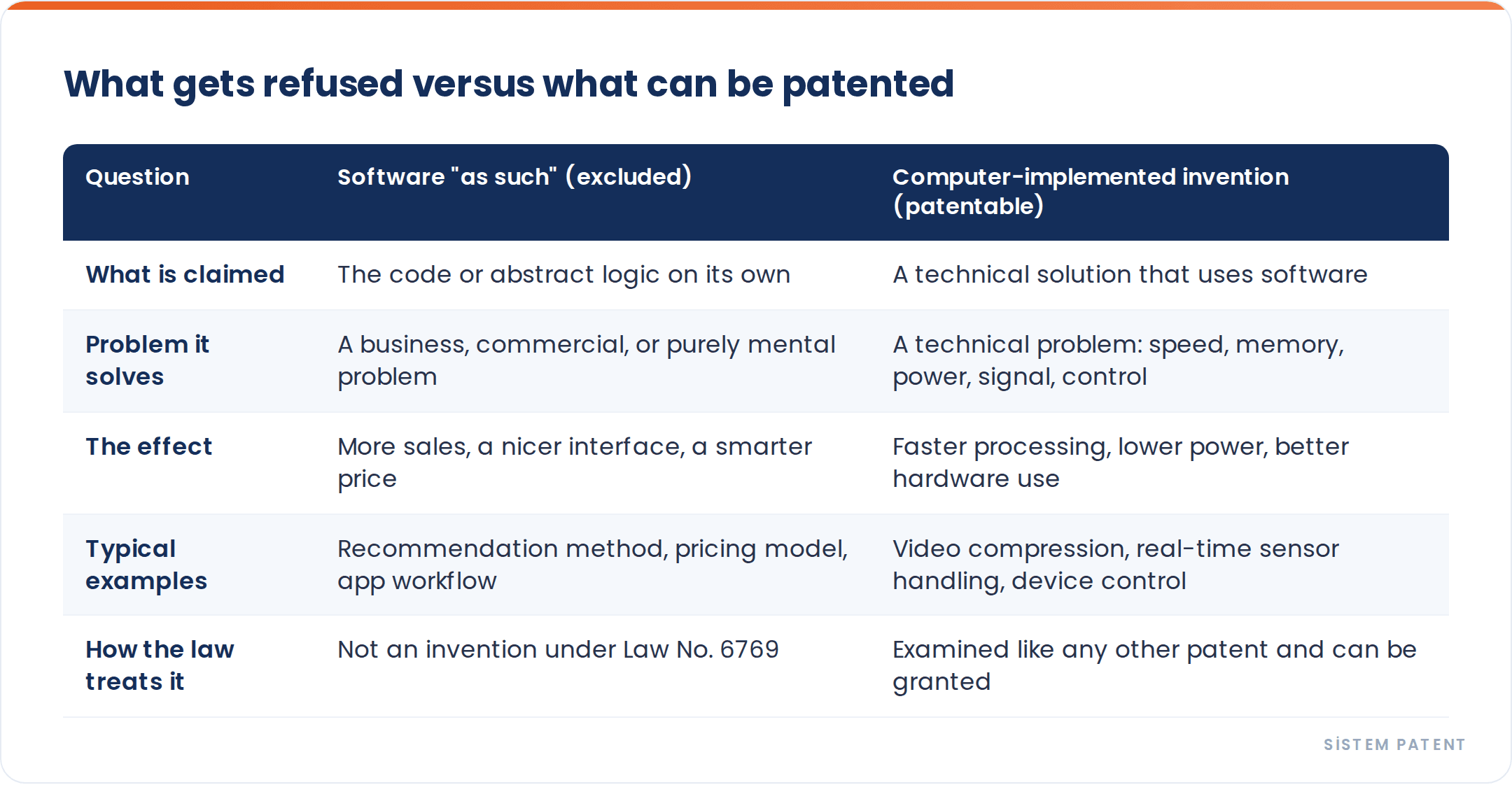
The same underlying code can land on either side depending on how the invention is framed and what it genuinely achieves. An application described as "a method of recommending products to increase sales" reads as a business method running on a computer, and it gets refused. The same engine described and claimed around a specific technical mechanism, for example a way of processing sensor data in real time that reduces the computing load on the device, has a technical problem and a technical solution. The art of drafting a software patent is largely the art of finding and foregrounding that technical core, honestly, where it exists.
Frame the application around the technical problem from the first draft
Because the technical contribution decides everything, the specification has to be built around it rather than around the commercial benefit. An inventor who describes only what the software does for the user has written a marketing document. An inventor who describes the technical problem in the prior art, the technical means the invention uses to solve it, and the technical effect that results, has written the spine of a patent application.
Three habits make the difference when you prepare a patent application for a software invention:
- Name the technical problem. Not "users abandon the checkout," but the engineering problem underneath, for example latency, memory use, bandwidth, signal accuracy, or hardware wear. The problem you state is the problem your claims will be judged against.
- Tie the claims to technical means. Claims that recite a result without the technical mechanism that produces it tend to collapse into the excluded "as such" zone. Claims anchored to how the system achieves the effect, at the level of data handling, hardware interaction, or process control, survive far better.
- Keep the description concrete. Show the architecture, the data flow, the steps the machine performs. Vague functional language invites the objection that there is no real technical teaching, only an idea.
Done well, this is not a trick to smuggle an abstract idea past an examiner. It is an honest account of an invention that genuinely is technical, written in the terms the law actually rewards. Where there is no technical core to find, no amount of drafting will manufacture one, and a good adviser will tell you that before you spend on a filing rather than after a refusal.
Utility model is not a shortcut for software
Turkish inventors sometimes ask whether the utility model route, which has no inventive-step examination, can rescue a borderline software case. It cannot, and for a structural reason. The Utility Model regime under Law No. 6769 excludes the same non-patentable subject matter that the patent regime excludes, and it is also limited in the kinds of inventions it covers. A computer program as such is no more registrable as a utility model than as a patent. If the invention has a real technical effect it may be patentable as a patent; if it does not, switching forms does not help.
Often the right protection for software is copyright, not patent
Here is the point that saves businesses the most wasted effort. Software is protected by copyright automatically, from the moment the code is written, as a literary work. Copyright protects the expression, the actual source and object code, against copying. It does not require novelty, an inventive step, or any registration to exist, and it lasts far longer than a patent.
What copyright does not protect is the idea or the functional method behind the code. A competitor who reads what your program does and writes their own independent implementation to achieve the same function does not infringe your copyright, because they have not copied your expression. That gap is precisely where patents matter: a patent on a genuinely technical invention can stop even an independently written competitor, while copyright cannot.
So the two rights do different jobs, and for most software the honest answer is that copyright is the workhorse and a patent is the exception reserved for a real technical advance:
Match the right to what you are actually protecting
If your concern is someone lifting your codebase, cloning your product, or shipping a pirated copy, copyright is your tool, and registering the work creates dated, official proof of authorship that makes enforcement far easier. Recording the work through a software copyright registration gives you an evidence file you will be glad to have the day you need to prove what you wrote and when.
If your concern is a competitor reverse-engineering a genuinely novel technical method, a clever compression scheme, a new way of securing a transaction, a control technique that makes hardware perform better, and you can show a technical effect, then a patent is the right instrument and worth the heavier examination it demands. Many software businesses end up using both: copyright across the whole codebase, and a small number of patents on the few innovations that clear the technical-effect bar.
The mistake is to assume the categories without testing them. Plenty of money has been spent trying to patent a business method that was never going to clear examination, and plenty of genuinely technical inventions have been left exposed because the team assumed software could not be patented at all. Before you commit, it is worth having the invention assessed against the technical-effect test and, if it qualifies, having the patent registration drafted around its technical core. Our team can tell you honestly which side of the line your product sits on, and protect it with the right right.
Picked for You
Related Articles
Turning University Research Into Patents and Revenue
Read More →
The One Disclosure That Kills a Patent: Novelty and the Grace Period Before You File
Read More →