
Filing a Patent Abroad: Paris Priority, PCT, or Direct National Filings
A Turkish manufacturer files a patent at TURKPATENT in March, lands a distributor in Germany in June, and gets a purchase enquiry from a buyer in the United States in September. The product is selling. The question that should have been answered in March is now urgent: where, outside Turkey, is this invention actually protected? The honest answer at that moment is usually nowhere, and the clock that governs the fix is already half spent.
Almost every business that takes an invention abroad faces the same three doors. You can file directly in each foreign country, one national application at a time. You can file an international application under the Patent Cooperation Treaty and keep your options open. Or you can use the twelve-month priority right from the Paris Convention to anchor every later filing to your original Turkish date. These are not three competing products you pick one of and discard the rest. They interlock, and the real skill is knowing which to use for which market and in which order.
The twelve-month priority window decides everything that follows
Before comparing routes, fix one date in your mind: the day you first filed in Turkey. Under the Paris Convention (an international treaty Turkiye has long been part of), that first filing gives you a twelve-month priority right. For one year, any application you file for the same invention in another member country is treated as if it had been filed on your original Turkish date. Anything a competitor files in between, and any disclosure that happens in between, cannot be used against you in that country.
This is the single most valuable timing lever in the whole system, and it is the one most often wasted. Miss the twelve months and you do not lose the right to file abroad, but you lose the priority date. Your foreign applications then stand on their own later filing date, behind anything published in the meantime, including your own product launch. Every route below either uses this window or is shaped by it, so the first planning question is never "which route" but "how many of these twelve months are left."
Direct national filings give you the most control and the steepest early cost
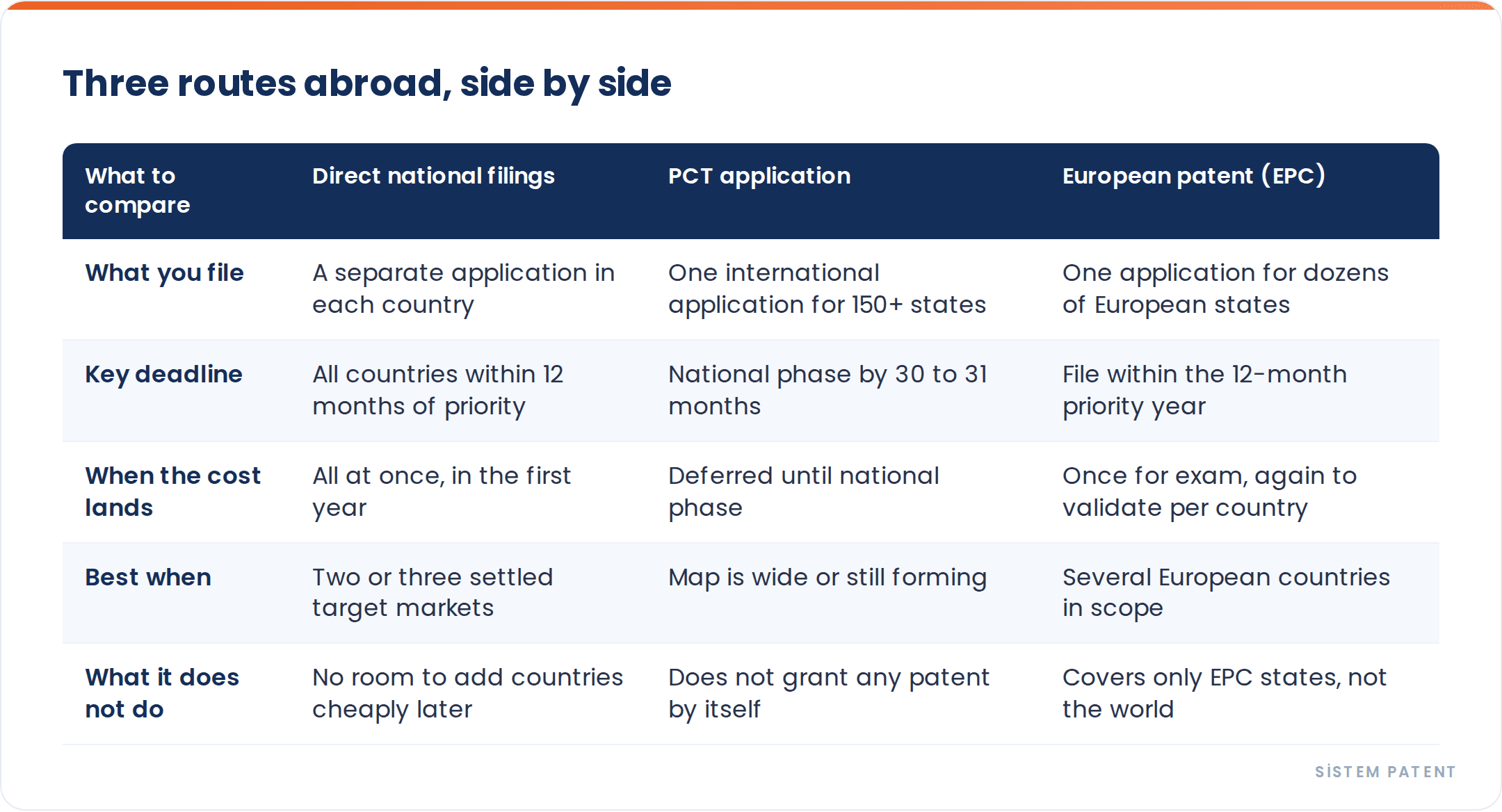
The most direct path is to file a separate national application in each country where you want protection, through a local agent in each, before the twelve months run out. File in Germany, file in the United States, file in Turkiye's neighbouring export markets, each as its own case under that country's law and language.
The advantage is precision. You protect exactly the countries you choose and nothing you do not pay for, and each application can be tailored to local practice from the start, the same way a well-prepared domestic patent application is built around the local examiner's expectations. For a business with two or three clear target markets and no intention of expanding the list, direct filing is often the cleanest and, over the full life of the patents, the cheapest option, because you are not paying for an international layer you do not need.
The drawback is that all the cost arrives at once. Within that first year you must commission translations, pay official fees, and instruct an agent in every single country, all before you have any examination result telling you whether the invention is even patentable. You are spending heavily on faith. If your list of countries is short and settled, that is a reasonable bet. If you are unsure how many markets the product will reach, paying for all of them inside twelve months is the wrong shape of risk, and that is exactly the problem the next route was built to solve. Whichever countries you choose, a clear-eyed international patent registration plan should map filings to real commercial markets rather than a wish list.
The PCT route buys time, not a patent
The Patent Cooperation Treaty does not grant an international patent. No such thing exists. What a single PCT application does is reserve your filing date in over 150 contracting states at once and postpone the moment you must split into separate national applications and pay for them.
You file one international application, in one language, with one office, within the twelve-month priority window. That single filing holds your priority date everywhere in the PCT system. Then, instead of deciding on every country within twelve months, you generally have until thirty or thirty-one months from your priority date to enter the "national phase", the point where the case breaks into individual countries and the local costs begin. That deferral, roughly an extra eighteen to nineteen months, is the whole value of the route.
What you gain in that window is information and time. The PCT process produces an international search report and a written opinion on whether your invention looks novel and inventive. You read that assessment before committing to expensive national filings. You also get a year and a half longer to see which markets the product actually sells in, to raise investment, or to find a licensee, before you spend country by country. A founder who is confident the invention matters but unsure where it will sell is the natural candidate for a PCT patent application, because it converts an irreversible early choice into a paid-for delay.
The cost of that delay is real. The PCT layer carries its own fees on top of the national costs that still arrive later, so for a fixed and already-known short list of countries it can be more expensive overall than filing direct. The one deadline that cannot slip is national-phase entry. Thirty or thirty-one months sounds generous until it arrives with several countries to file in at once, and a missed national-phase deadline forfeits protection in that country with no general second chance.
Europe is one filing inside whichever route you pick
For the European market, neither extreme of "one country at a time" nor "the whole PCT world" is the natural unit. The European Patent Convention lets you file a single application at the European Patent Office and have it examined once for dozens of member states, Turkiye among them. A single examination, one granted European patent, then a post-grant step where you validate it in each country where you actually want it in force.
This sits neatly inside both routes above. You can file the European application directly within the priority year, or you can designate the European route when you enter the national phase from a PCT application. Either way it replaces dozens of separate national examinations across Europe with one. For a Turkish applicant whose real target is several European countries, a single European patent application is usually far more efficient than filing in each European state on its own, and it leaves the final choice of which countries to validate in until after grant, when you know what the patent is worth.
How to choose, in the order the decisions actually arrive
The routes are not really rivals; they are layers you assemble around your priority date and your map of markets. In practice the decision unfolds as a short sequence.
- Start from the filing date and the twelve-month clock. Everything is timed off your first Turkish filing. Know exactly how much of the priority year remains before you weigh anything else.
- If your target markets are few and settled, file direct. Two or three countries you are certain about, with no plans to expand, usually point to direct national filings (with a single European application covering the European ones), because you avoid paying for an international layer you will not use.
- If your map is wide or still forming, file a PCT application. When you cannot yet name every market, or you need the extra eighteen months to fundraise, license, or watch sales, the PCT route buys that time and hands you a search report before you commit country by country.
- Fold Europe in as a single application either way. Whenever several European countries are in scope, run them through one European patent rather than separate national filings, and validate only where the patent earns its keep.
The most expensive mistake is not picking the "wrong" route. It is letting the twelve-month priority window close while you decide, because that forfeits the original filing date that every route depends on. The second most expensive is filing direct in a long list of countries on faith, then watching most of them turn out to be markets the product never reached. Map the filings to where the business is genuinely going, then choose the route that fits that map. If you want that mapping done properly against your real export plan, our patent team can lay out the routes and deadlines for your invention before the clock decides for you.
Picked for You