
Economic Rights vs Moral Rights: What You Are Really Selling in a Copyright Assignment
A founder sells the rights to a logo she paid a designer for, signs a clean assignment, pays the agreed sum, and assumes the matter is closed. Two years later the same designer demands that her name be credited on every use of the mark and objects to a colour change as a distortion of the original. The founder is stunned. She bought the rights. How can the creator still be giving instructions about a work that is now, on paper, entirely hers?
The answer is that copyright is not one right. It is two distinct sets of rights bundled into a single creation, and only one of those sets is for sale. A copyright assignment in Turkey transfers the half that earns money and leaves the other half permanently attached to the author. Buyers who do not understand the split overpay for an illusion of total ownership. Sellers who do not understand it sign away more than they meant to. Getting the line right, in the contract itself, is what separates a transfer that holds from one that unravels.
Economic rights are the half you can actually buy
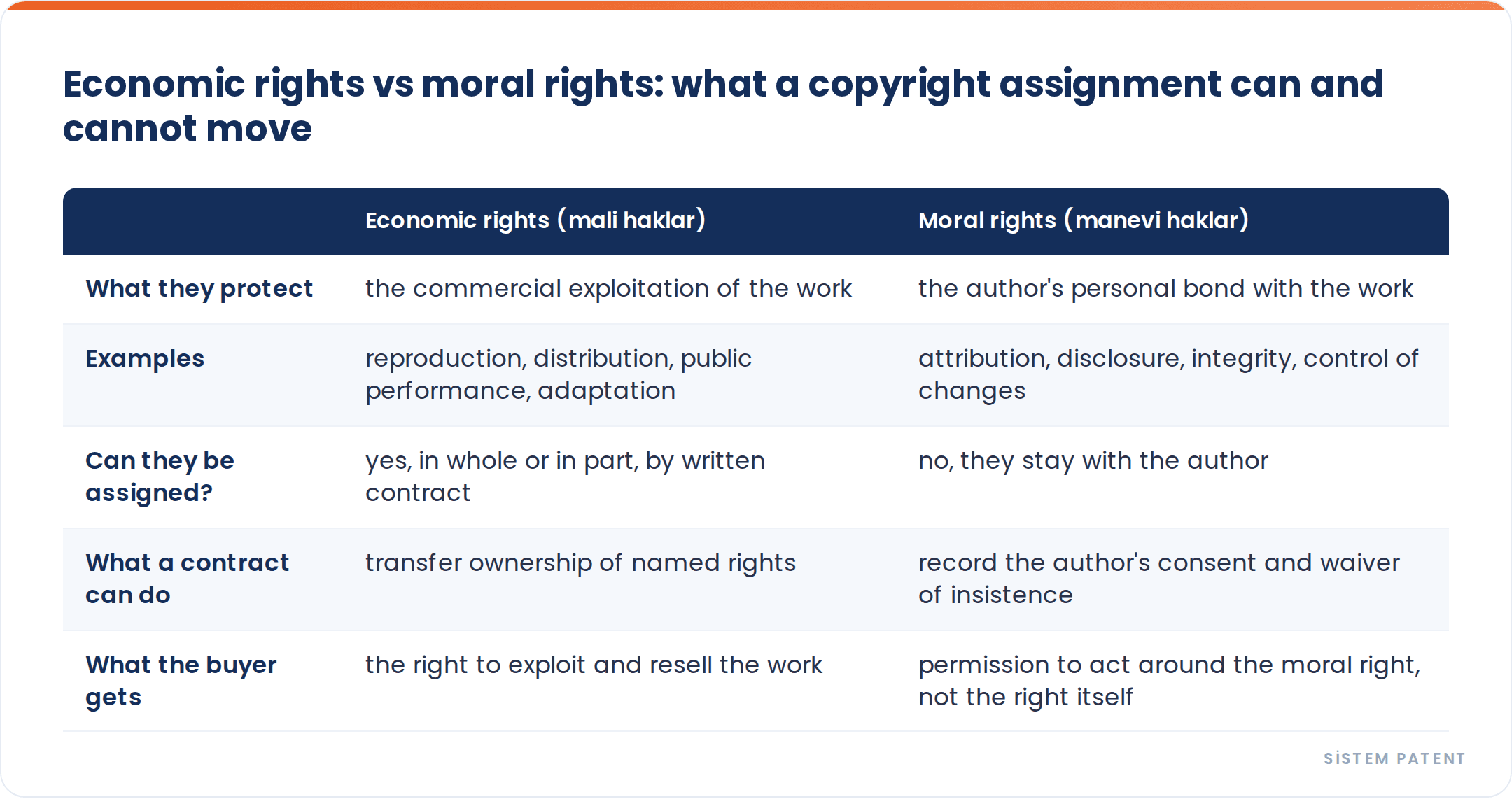
Under the Law on Intellectual and Artistic Works (Law No. 5846), the economic rights, the mali haklar, are the commercial engine of a work. They are the rights that let someone exploit the creation for money, and Turkish law lists them with precision: the right to reproduce, the right to distribute, the right to perform or communicate the work to the public, and the right to process or adapt it into a new form. When a publisher prints a book, a label streams a song, or a studio turns a script into a film, it is exercising one of these economic rights.
These rights are property. They can be sold outright, split apart, licensed for a territory or a term, inherited, and pledged. When you take an assignment of copyright, what you are actually acquiring is some or all of this economic bundle. A well-drafted assignment does not say "all rights" and stop there. It names the specific economic rights being transferred, the modes of exploitation they cover, the territory, and the duration, because under Law No. 5846 a transfer reaches only as far as its written terms describe. Anything the contract leaves unsaid tends to stay with the author by default, which is the first trap a buyer walks into.
This is also why a dated record of the work matters before any deal is signed. Economic rights you cannot prove you hold are economic rights you will struggle to enforce or resell. Securing a work registration record for the creation establishes, on an official footing, what the work is and who deposited it, so that the asset changing hands in the assignment has a documented identity rather than an asserted one.
Moral rights stay with the creator, and no contract removes them
The second half of copyright is where buyers get surprised. Moral rights, the manevi haklar, protect the personal and intellectual bond between an author and the work, and Turkish law treats that bond as something money cannot sever. Law No. 5846 recognises a defined set of moral rights: the right to decide whether and when the work is disclosed to the public, the right to be named as its author or to remain anonymous, the right to object to distortion or mutilation that harms the author's honour, and the right to control modifications to the work.
Here is the part that catches people out. These rights cannot be assigned. You cannot sell your moral rights the way you sell economic rights, because they are tied to your person, not to your wallet. The designer in the opening scenario was not bluffing. Even after a full economic assignment, she retained the right to be credited and the right to object to a distortion of her work, because those rights never left her in the first place. The contract sold the commerce and could not have sold the rest, no matter how broadly it was worded.
What the law does allow is narrower and easier to miss. An author can authorise another party to exercise certain moral rights on his behalf, or agree by contract not to insist on some of them in defined situations. A creator can waive the right to be credited on a particular product line, or consent in advance to specific modifications. That permission is contractual and bounded, not a transfer of ownership. The moral right itself stays with the author. What changes is whether, and how, he has agreed to let you act around it.
An assignment and an exclusive licence are not the same purchase
Buyers often use the words interchangeably, then discover at the worst moment that they bought something other than what they thought. An assignment is a sale: the economic rights leave the author and become yours, and you stand in the owner's shoes for whatever rights the contract names. An exclusive licence is a rental with the door locked behind you: you get the sole right to exploit the work within the agreed scope, but the author remains the owner and the rights return when the licence ends.
The practical differences are real. An assignee can usually sub-assign or license onward, can enforce the right in its own name, and holds an asset it can put on a balance sheet. An exclusive licensee operates inside a permission that can expire, may need the owner's involvement to sue, and never owns the underlying right. Neither is automatically better. A business that wants the work permanently, plans to build on it, or intends to resell it should pay for an assignment. A business that needs the work for a defined campaign, market, or period is often better served, and better priced, by an exclusive licence. The error is paying assignment money for licence rights, or assuming a licence gives you ownership it never conveyed.
Future works and unknown uses need their own words
Two gaps recur in copyright assignments, and both reward careful drafting. The first is future works: an assignment generally covers the work in front of you, not creations the author has not yet made, so an arrangement meant to capture an ongoing stream of output has to say so in terms the law will honour. The second is future modes of exploitation. A transfer is read against the uses known when it was signed, so wording that does not contemplate later forms of distribution can leave a meaningful gap, the kind that surfaces years on when a new channel or medium appears and nobody is sure who holds the right to use the work there.
The wording that stops a creator clawing rights back later
Most assignments that fall apart do so for the same reason: the contract was too thin to carry the weight the buyer leaned on it for. A transfer that simply says the author "assigns all rights" invites later argument about what "all" included, which economic rights were actually named, and what was promised on the moral-rights side. The fix is specificity, written in while everyone is still cooperative.
A durable assignment does several things at once. It enumerates the economic rights being transferred rather than gesturing at them. It states the modes of exploitation, the territory, and the duration so nothing is left to be filled in by default. On the moral-rights side, where outright transfer is impossible, it records the author's consent: an undertaking not to assert the attribution right against agreed uses, and advance consent to defined modifications, so that legitimate edits and adaptations are not later recast as distortions. It confirms the author's authority to grant what is being granted, and it documents the consideration paid. Each of these closes a door that a vaguer contract would leave open.
None of this is exotic, but it is easy to get wrong without someone who drafts these transfers for a living, and the cost of getting it wrong is asymmetric: the buyer discovers the gap only when it tries to rely on the right, often in front of a court. If you are acquiring rights to a logo, a piece of software, a manuscript, or any creative work, the safe sequence is to fix the work's identity with a dated record, then assign the economic rights in language that names them. Sistem Patent can put the record in place through a work registration record and handle the underlying copyright application, so the rights you pay for are the rights you can hold, and the half that stays with the creator is handled by consent rather than discovered by surprise.
Picked for You
Related Articles
Moral Rights in Turkey: Why You Can't Sign Away the Right to Be Named as Author
Read More →
Protecting an Online Course or E-Book From Piracy and Resale
Read More →