
Who Owns Your Reels: A Creator's Guide to Copyright, Music and Brand Deals
A skincare brand pays a creator a flat fee for three reels. The reels go viral, the brand cuts them into paid ads, runs them for a year across four countries, and never pays again. The creator assumes the videos are still hers. They are not. The contract she signed quietly handed the brand every right to the footage, and now her own face is selling product on terms she never agreed to. Nobody stole anything. She gave it away in a clause she did not read.
This is the part of creator life nobody covers on the way up. You learn lighting, hooks, posting times and brand outreach long before anyone tells you that the videos you make are copyrighted works, that a brand deal can transfer them, and that a thirty-second clip of borrowed music can get your whole channel struck. The law treats your content as intellectual property whether you think about it or not. The only question is whether you understand what you own, what you have signed away, and what you can actually protect.
You own your videos the second you record them, until a contract says otherwise
Under the Law on Intellectual and Artistic Works (Law No. 5846), an original video is a protected work from the moment you create it. You do not register to own it. The footage you shoot, the edit you build, the script you write and the voice-over you record are all your expression, and the rights are yours by default. This is the strong position most creators start from without realising it.
The default is also fragile, because rights move by contract. The instant you sign a brand agreement, the wording decides who walks away owning the content you made. There is a wide gap between three arrangements that look similar on the surface and are worlds apart in law. A licence lets the brand use the video for a defined purpose, time and territory, and you keep ownership. An exclusive licence locks even you out of using it elsewhere for the agreed term, though you still own it. An assignment, often buried under a heading like "work product" or "all rights", transfers ownership outright, and once it is gone it is gone.
Most disputes between creators and brands are not really fights about money. They are fights about which of those three a contract actually was, discovered far too late. A creator who signed an assignment has no standing to complain when the brand reuses the footage, recuts it, or runs it for years, because legally it stopped being hers at signature. Reading for that single distinction before you sign is worth more than any rate negotiation. Intellectual property rights in your own work are only as strong as the clause you agree to give them up under.
Music is the fastest way to lose a video you legally own
Here is the trap that catches creators who do everything else right. You can own every frame of a video outright and still have it muted, blocked or taken down because of the song playing underneath it. The footage is yours. The music almost never is. A track is a separate work with its own owner, and dropping it into your reel without a licence is using someone else's intellectual property, no matter how short the clip.
The in-app music library a platform hands you is not a blanket permission slip. Those catalogues are licensed for organic, personal posting on that specific platform. The moment a brand is paying you, the use becomes commercial, and most of that library falls outside what you are cleared to use. This is why creators are baffled when a sponsored video gets flagged while the same audio on a casual post sat untouched for months. The audio did not change. The commercial context did, and so did the licence you needed.
For anything you genuinely cannot afford to have pulled, a brand campaign, a signature intro, a series you are building a channel around, the safe path is music you have the right to use commercially: properly licensed library tracks, or original audio. If music becomes part of your identity rather than background, a custom piece you commission or compose can itself be registered as a music work copyright, so the sound that signals your channel is an asset you own outright rather than a liability waiting to be claimed.
Who owns the audio when a brand commissions the sound
The same assignment-versus-licence question returns the moment a brand pays for custom music in your content. If a sponsor commissions a jingle for a campaign you star in, the contract decides whether you can ever reuse that sound on your own channel. Creators routinely assume that because they performed or featured it, the audio is theirs to keep. It is not, unless the paperwork says so. Settle the ownership of commissioned sound in writing at the same time you settle the footage, or you inherit a signature audio you are not allowed to use again.
Reposting, stitching and duets are governed by licences you accept without reading
Creator culture runs on building over each other's work. You stitch a clip, duet a reaction, repost a trend, sample a few seconds of someone else's video. Every one of those acts touches a copyrighted work, and the only reason most of it does not end in a claim is the platform terms everyone taps through. When you upload, you grant the platform a broad licence, and you accept the rules that allow features like stitching and duetting to function. That is the permission layer holding the whole ecosystem together.
The mistake is assuming the platform's licence extends to you off-platform, or to commercial use. A creator who stitches another video and keeps it inside the app is usually operating within the granted terms. The same creator who exports that combined video and sells it as part of a brand package has stepped outside what the platform licence covers and is now using someone else's footage commercially without their permission. The boundary is not the edit. It is where the content goes and whether money is attached.
This cuts both ways, and it is where knowing your rights pays off. When another account lifts your video wholesale, re-uploads it as their own and monetises it, that is not a stitch or a homage, it is infringement of a work you own. A creator who understands the line can act against the genuine theft instead of wasting energy on every harmless repost, and can answer a baseless claim against their own fair commentary with confidence rather than panic.
Registering signature content turns a viral moment into a defensible asset
Copyright exists automatically, so creators reasonably ask why they would ever register anything. The answer is the same reason any business documents its assets: proof and date. A registration creates an official, dated record that you authored a specific work on a specific day. You do not need it to own your content. You need it the day someone disputes that you do, because then the argument is no longer your word against theirs, it is their word against a dated official record.
Registering every reel would be pointless. The content worth the effort is the content that defines and earns for the channel: a format you originated and others are copying, a signature video that became your calling card, a series or character the brand of your channel is built on, the original music that opens every upload. For those works, a dated copyright application is cheap insurance. When a brand later claims your format was their idea, or a larger account copies the series wholesale, you are holding documented authorship from a known date instead of scrolling for old posts to prove you were first.
Registration also changes the conversation when money is involved. A creator pitching a licensing or merchandising deal around a recognisable character or format negotiates from a stronger place when that work is on the record as theirs. The same is true defensively: a documented authorship date is exactly what disarms an opportunist who files a claim over content you have been making for years. The record does not make you the author. It makes your authorship something you can show on paper rather than something you have to reconstruct under pressure.
The protections that actually matter for a working creator
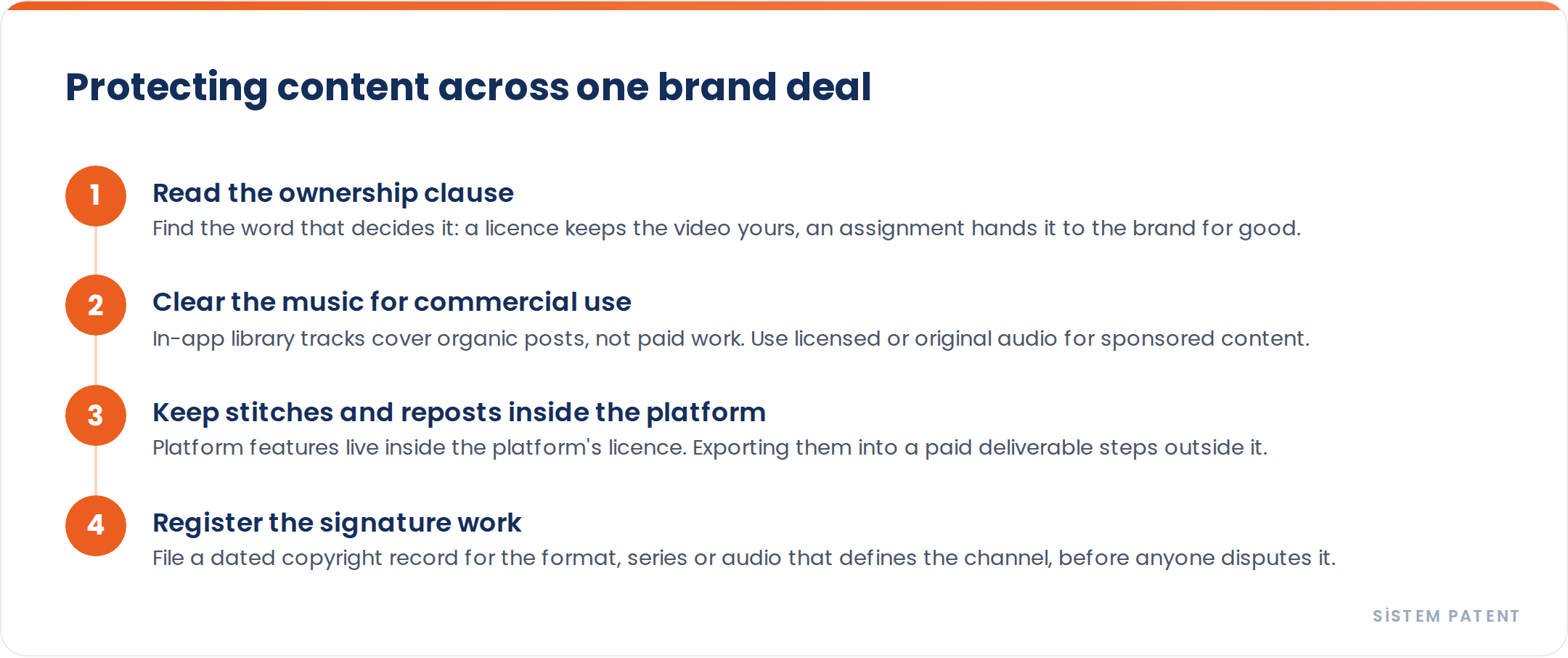
You do not need to register your whole feed or lawyer every collaboration to be safe. A handful of habits cover most of the real risk. Read every brand contract for the word that decides ownership, and know whether you are licensing or assigning before you sign. Treat in-app music as off-limits for paid work and use commercially cleared audio for anything you cannot afford to lose. Understand that platform features like stitching live inside the platform's licence and do not travel with you into commercial use. Register the few works that genuinely define your channel, so your best content is documented rather than merely assumed to be yours.
None of this asks you to stop creating the way creators create. It asks you to know which rights you hold, which ones a signature gives away, and which pieces of your work are worth putting on the record. If you are building a channel into a business, the practical next step is to identify the signature content that carries your value and put a dated copyright application behind it. Sistem Patent can review your brand agreements and your catalogue and help you protect the work that is genuinely yours, before a contract or a copy decides it for you.
Picked for You
Related Articles
Work-for-Hire and Freelancers: Who Owns the Design, Code or Copy You Paid For
Read More →
Photographers' Rights: Proving You Own the Shot and Shutting Down Unlicensed Use
Read More →