

The Spare-Parts Repair Clause: Why You Cannot Always Stop Look-Alike Replacement Parts
A bumper cracks in a car park, a wing mirror snaps off, a headlamp lens clouds over. The owner wants the car to look exactly as it did before, so the replacement part has to be the same shape as the original. Here is the question that keeps independent parts makers in business and frustrates a lot of vehicle manufacturers: if the original bumper was a registered design, can the carmaker stop a third party from producing an identical one to repair the car? Under Turkish law, often the answer is no, and the reason is a single provision written into the design regime on purpose.
That provision is the repair clause, sometimes called the must-match exception. It says that a registered design right does not extend to a part used to repair a complex product so that the product regains its original appearance. The clause was not an oversight. It was a deliberate policy choice to keep the aftermarket for visible spare parts open and to stop a design registration from becoming a back-door monopoly over repairs. If you sell products built from many parts, or if you make replacement parts for someone else's product, this is one of the few places in IP law where a valid registration simply runs out of reach.
The repair clause lives in Article 59 of Law No. 6769
Industrial design protection in Turkey sits under the Industrial Property Code (Law No. 6769), and the appearance of a product, its lines, contours, shape, ornamentation and material, is exactly what a registered design protects. A bumper, a grille, an alloy wheel, a door panel: each can be a design in its own right, and each can be registered. Registration gives the holder the right to stop others from making, selling or importing a product that produces the same overall impression on the informed user.
The repair clause carves a hole in that right. Under Article 59 of Law No. 6769, the protection conferred by a registered design does not cover the use of a part that forms a component of a complex product, where that part is used for the purpose of repairing the complex product to restore its original appearance. Read that sentence slowly, because every clause in it is doing work. The part has to be a component of a complex product, the use has to be for repair, and the goal has to be restoring the product's original appearance. Strip any one of those conditions away and the exception stops applying.
What counts as a complex product
A complex product is one made of multiple components that can be replaced, allowing the product to be disassembled and reassembled. A car is the textbook example, which is why most of the case law and most of the commercial heat sits in the automotive sector. But the logic is not limited to vehicles. Agricultural machinery, industrial equipment, white goods, motorcycles and many consumer machines are complex products too. If your product is a single moulded object with nothing meant to be swapped out, the repair clause does not enter the picture at all, because there is no component to repair.
The exception only reaches parts whose shape is dictated by the whole
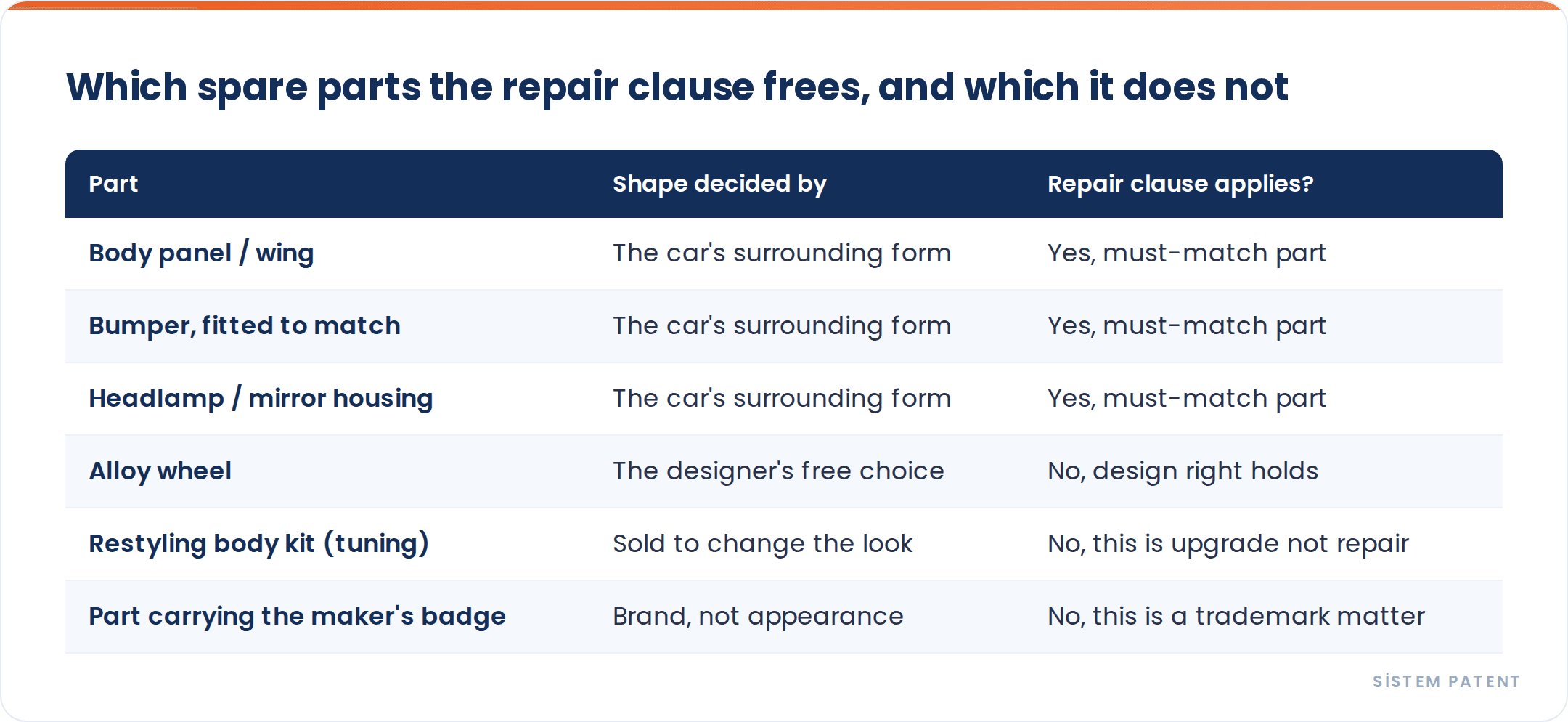
This is the part owners most often get wrong. The repair clause does not free every spare part. It frees a specific kind: the so-called must-match part, whose appearance is dependent on the appearance of the product it belongs to. A front wing has to follow the line of the car or the repair looks wrong and the panel will not fit. The shape of that wing is effectively fixed by the design of the car around it. That is what makes it a must-match part, and that dependency is the whole justification for letting a competitor copy it: there is no design freedom left to protect, because the form is determined by the need to match.
Contrast that with a part the owner is free to style any way they like. An alloy wheel does not have to look like anything in particular for the car to function or for the repair to succeed. A driver can fit a completely different wheel design and the car still works and still looks finished. Because the maker had real freedom over the wheel's appearance, a registered wheel design generally keeps its full force, and the repair clause does not hand it to copyists. The dividing line runs between parts whose shape the surrounding product dictates and parts whose shape the designer chose.
The test is not whether a part is visible or whether it wears out. It is whether the part's appearance is locked to the appearance of the whole. Only the locked ones fall through the gap.
Three more conditions decide whether a copy is really protected
Even when a part is a genuine must-match component, the exception is not a blank cheque. Three further limits shape how far a third party can go.
- Repair, not upgrade. The use has to be repair. Producing a look-alike body kit to restyle a car, or to sell as a tuning accessory, is not repairing the vehicle to its original appearance. That use sits outside the clause and stays exposed to the registered design.
- Restore, do not redesign. The aim is to bring the product back to how it originally looked. A part that changes the appearance, even a visible one, is doing something other than restoring, and the exception does not stretch to cover it.
- Informing the buyer. Courts in this field expect the parts maker to act honestly. A spare part sold to repair a car must not mislead buyers into thinking it came from the original manufacturer. The exception protects the repair, not a free ride on someone else's brand.
That last point matters more than parts makers sometimes assume, because it is where design law hands off to trademark law. The shape of the bumper may be fair game. The badge stamped on it, or the brand name on the box, is not.
What a manufacturer can still protect
If you make complex products and you have watched a piece of your design protection evaporate, the practical question is what remains. The honest answer is that a lot remains, as long as you stop relying on the one right the repair clause weakens.
The design of the product as a whole is untouched. Nobody can copy the entire car, the entire appliance or the entire machine under cover of the repair clause. The exception reaches single must-match components used for repair, not the overall design that earned the registration in the first place. A thorough industrial design registration strategy that protects the complete product and its distinctive non-dependent parts separately is far harder to erode than one that rests on a single panel.
Parts whose shape you genuinely chose stay protected. Wheels, distinctive grilles, interior trim with real styling freedom, accessories that are not dictated by the body: each of these can hold a registered design that the repair clause does not touch, because none of them is a must-match part. Filing those parts as their own designs through separate design registration is where careful portfolio planning pays for itself.
Your trademarks keep working even where your design does not. A copied body panel that carries your logo, your model name or your distinctive part numbering crosses from a design question into trademark infringement and unfair competition, both of which you can act on. The repair clause was written about appearance, not about brand. The same goes for the technical side: where a part embodies a genuine mechanical invention, a patent or a Utility Model protects the function regardless of what the design right does, because those rights answer a different question entirely.
How to plan around the clause before it costs you
The repair clause rewards manufacturers who design and file with it in mind, and it punishes those who assume one headline registration covers everything. A few habits separate the two.
Map your product part by part and sort each component into two piles: shapes the surrounding product forces, and shapes you were free to choose. The first pile is where the repair clause bites, so do not build your enforcement plans on those parts. The second pile is where registered designs hold firm, and it deserves its own filings rather than being folded into the whole-product application.
Layer your protection so no single right carries the weight. Combine the whole-product design, separate registrations for your free-form parts, and trademark protection on badges, model names and part identifiers. An aftermarket copyist who clears the design hurdle on a must-match panel still runs straight into your marks the moment they brand it.
Read the clause from the other side too. If your own business makes or sources replacement parts, the repair exception can be a shield rather than a threat, provided you stay inside its limits: genuine repair, original appearance, no brand confusion. The same provision that frustrates a vehicle maker protects an honest parts supplier, and knowing which side of the line a given part sits on is a commercial decision worth getting right before you tool up.
The repair clause is one of the sharper edges in design law, and it catches manufacturers who treat a registration as a wall when it is really a fence with a deliberate gate. If you are building a product line and want each part placed on the right side of that gate, with the must-match components identified and the genuinely original ones protected, our team handles that mapping as part of design legal services, alongside the registrations that hold up when a competitor tests them.
Picked for You
Related Articles

The Hague System as an Export Strategy: One Filing, Many Markets for Your Design
Read More →
Enforcing a Registered Design Against Copycats: From Warning Letter to Court
Read More →