

Enforcing a Registered Design Against Copycats: From Warning Letter to Court

You launched a product with a look you spent real money to get right. A season later a near-identical version turns up on a marketplace at a fraction of your price, often from a former supplier or a factory two doors down from yours. The first instinct is to send a furious message that same evening. That instinct is usually what weakens a strong case. In Turkey, a registered industrial design is a quietly powerful right, but it rewards the owner who moves in order, builds a clean file, and keeps the courtroom in reserve rather than reaching for it first.
This is the sequence to follow under the Industrial Property Code (Law No. 6769), from the first sighting of a copy through to the decision to sue or settle. Each rung costs less than the one above it, and each one strengthens whatever comes next.
Infringement turns on the overall impression, not on a feature-by-feature checklist
The first thing to get right is the legal test, because it is not what most owners assume. A registered design protects the appearance recorded in your application: the shape, lines, contours, ornamentation and the views you filed. Infringement is judged by whether the copy produces the same overall impression on the informed user, a notional buyer who pays attention to that kind of product and knows the field. Small differences a copier adds to look distinct rarely help if the general impression still reads as yours.
So the first move is a side-by-side. Place the rival product against the views in your registration certificate, not against your latest marketing photos, and ask whether an informed user would see them as creating the same impression. Where your design has genuinely individual features, a near-copy that keeps those features is squarely within scope. Where the only common ground is dictated by the product's function, or is standard for the category, your protection there is thin and a court will read it narrowly.
This comparison is also a quiet audit of your own right. Turkey grants design registrations without a full novelty examination, which means a registered design can still be vulnerable if it was not new or lacked individual character at its filing date. The moment you enforce, assume the other side will fire back with a request to invalidate your registration on exactly that ground. Knowing your design was new when you filed, and that the copy reproduces its individual character, is the foundation everything else rests on. A clean industrial design registration, backed by dated proof of when you first disclosed the design, is what makes the rest of this playbook work.
Gather evidence before the other side knows you are watching
Once you are satisfied there is a real case, resist contact. The moment an infringer senses a dispute, listings come down, stock moves, and the trail goes cold. Build the file first, quietly.
What a usable evidence file contains:
- The product itself. Buy a sample through a normal channel and keep the invoice, packaging and shipping record. A physical unit lets you and, later, an expert compare it against your registered views in three dimensions rather than from a photo.
- Dated proof of sale and scale. Timestamped screenshots of marketplace listings, prices, the seller's identity and stock levels. This shows the copying is real and ongoing, and it feeds any later damages claim.
- The chain to the source. Importer, manufacturer or distributor details wherever you can trace them. The party worth pursuing is often upstream of the seller you first noticed.
- Your own position. The registration certificate, proof the design is in force, and evidence of when your design first reached the public, since that date decides both your validity and the copier's bad faith.
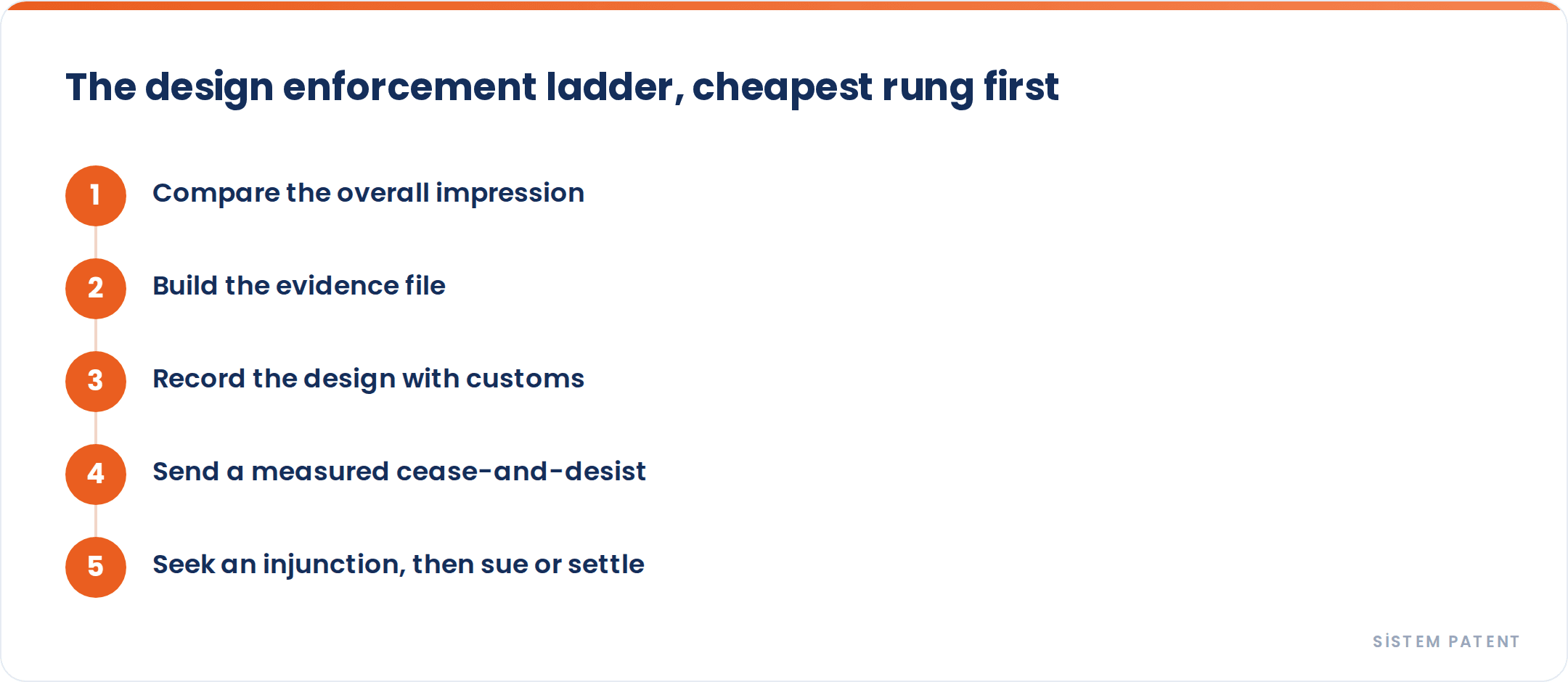
For deliberate, large-scale copying, Turkish procedure offers a determination of evidence (delil tespiti): a court-supervised step that fixes proof before it can vanish. Reserve it for situations where you genuinely expect the infringer to destroy records once notified. A technical comparison report taken at that stage, setting your registered design against the copy through the eyes of the informed user, strengthens your hand at every later step.
Stop the goods at the border before they reach the shelf
For designs, customs is one of the cheapest and most underused levers, and it belongs early in the ladder rather than as an afterthought. A registered design can be recorded with the Turkish customs authority through its IP enforcement application, so that officers can detain suspected infringing goods as they cross the border. For a product copied abroad and shipped in by the container, stopping a consignment at the port is far more effective than chasing each reseller after the goods have already scattered into the market.
The recordal asks you to identify your design and supply images that let officers recognise an infringing item on sight. Once a shipment is held, you are given a short window to confirm the goods infringe and to begin the legal steps, which is exactly why the evidence file and the overall-impression analysis need to exist before, not after, customs calls you.
A cease-and-desist letter resolves most disputes, when it is written with restraint
With a side-by-side comparison and a file in hand, a formal notice (ihtarname), usually sent through a notary, is the next rung. A good notice does unglamorous work: it identifies the registered design, states plainly that the product reproduces its overall impression, demands that the sale and manufacture stop, and sets a deadline. It often opens the door to a withdrawal from the market or a paid licence rather than a fight.
Restraint matters here for a reason beyond tone. An overstated threat against a party who turns out not to infringe, or one built on a design that is itself vulnerable, can rebound. The recipient may move first, asking a court to declare non-infringement or to cancel your design, and putting you on the defensive in a forum and on a timeline you did not choose. Claim what your registration actually covers, no more. A measured letter from a trademark agent or design specialist who has done the comparison carries more weight than a maximalist one, precisely because the other side can tell the difference. This is the point where engaging design legal services early keeps a first move proportionate.
A preliminary injunction can stop the bleeding before judgment
Design cases take time, and a copier can do lasting damage to a product's market, often its most profitable launch window, while a case runs. This is what the preliminary injunction (ihtiyati tedbir) is for. On a sufficient showing, a court can order the infringing sales and manufacture halted, and goods seized, before the merits are finally decided.
Courts do not grant this lightly. You generally need to show a strong likelihood that the design is valid and infringed, and that waiting for final judgment would cause harm money alone cannot repair, a real risk for a seasonal or fashion product whose window closes fast. A court may also require security against the chance the measure later proves unjustified, so the request is a financial decision as much as a legal one. Timing cuts both ways. Ask too early, before the file is ready, and the request can be refused. Wait too long and the damage has already set in. The quality of the evidence file you built earlier is what carries the request.
The choice between suing and settling is a business decision, not a reflex
If the notice is ignored or the copying is deliberate, the matter heads to the specialised IP courts. A design infringement action under Law No. 6769 can ask for several things at once: a ruling that infringement occurred, a permanent halt to the manufacture and sale, seizure and destruction of the infringing goods and the moulds or tools used to make them, and compensation. Turkish law lets the rights holder choose how damages are calculated, which is a meaningful lever in any negotiation.
How the damages are counted is your choice to make
The compensation side deserves thought before you decide, because the design owner picks the method of calculation. You can claim your own actual loss together with the profit you were prevented from earning, or the profit the infringer made from the copying, or a notional licence fee, the amount you could reasonably have charged had the copier asked to licence the design at the outset. Each route suits a different fact pattern. A notional licence fee is often the most straightforward to prove, since it leans on market rates rather than on tracing the infringer's internal accounts. Where the copying was flagrant and the volumes large, claiming the infringer's gain can be the stronger play. Deciding this before you file shapes which evidence you emphasise and what number anchors any settlement talk.
Before committing, weigh the case honestly:
- How strong is the overall-impression read. A copy that an informed user would plainly confuse with your design is a different proposition from one that merely shares a few unprotectable features.
- How exposed is your registration. Assume the defendant will attack validity. If your design was disclosed too early or close prior designs exist, that changes the calculus before you file, not after.
- What you actually want. Removal from the market, a paid licence, damages and deterrence are different goals, and they point to different strategies.
- Cost, time and the counterparty. A well-resourced infringer fights harder. A negotiated licence or a clean exit can sometimes deliver more value than a multi-year case.
Litigation and settlement are not opposites. A credibly prepared lawsuit is often what makes a good settlement possible, because the other side can see where the case is going. The same intellectual property infringement lawsuits that look adversarial on paper frequently end in a licence that turns a copier into a paying licensee, or in a withdrawal that clears your market.
Order beats speed
The owners who enforce a design well are rarely the fastest to react. They check the copy against their registered views, build a file the other side cannot wave away, hold the goods at the border where they can, send a precise notice, and keep litigation in reserve as pressure rather than as a first resort. If you suspect your design is being copied, the most useful early step is an honest comparison tied to a clean registered right, which is exactly where a solid design registration earns its keep.
Picked for You
Related Articles

Protecting a Product Line: One Design Application or Many?
Read More →
Registered vs Unregistered Design Rights: What You Get for Free and Why It Is Rarely Enough
Read More →