
Transferring a Trademark in an Acquisition: What Buyers and Sellers Miss

A company sells for a strong multiple, the lawyers close the share transfer, the money moves, and everyone shakes hands. Eight months later the buyer tries to renew the flagship trademark and the registry will not let them, because as far as TÜRKPATENT is concerned the mark still belongs to the seller, or to a founder who left, or to a holding company that was never part of the deal. The brand the buyer thought they paid for is sitting in someone else's name, and the paper trail to fix it has gone cold.
In most acquisitions the brand is one of the more valuable things changing hands, sometimes the single most valuable. Yet the trademark side is routinely treated as a formality bolted onto the end of a deal built around shares, premises, and accounts. That mismatch is where buyers overpay for rights they do not cleanly receive and where sellers leave value, and liability, on the table. The fixes are not complicated, but they have to happen in the right order and be written down properly.
The deal structure decides whether the marks even move
The first thing both sides get wrong is assuming the trademarks come along automatically. Whether they do depends entirely on how the deal is built. In a share purchase, the company that owns the marks is itself the thing being sold, so the registrations stay exactly where they are, on the company's name, and nothing about the trademark register has to change. The trap there is the opposite one: buyers assume the operating company holds its own brand, when in practice the marks are often registered to a founder personally or parked in a separate holding entity that is not inside the deal perimeter.
In an asset purchase the picture flips. Here specific assets are carved out and moved, and a trademark only transfers if it is named and formally assigned. A brand that everyone in the room treats as obviously part of the sale can be left behind simply because no one listed the registration numbers in the schedule. Before price is even agreed, both sides should know exactly which legal person holds each mark and how the chosen structure moves it, because that answer changes what the assignment paperwork has to do.
Diligence on the marks is about ownership and life, not just existence
Confirming a trademark exists is the easy part and the part most buyers stop at. A registration certificate proves the mark was granted; it does not prove the seller still owns it, that it covers the goods the business actually sells, or that it is in any condition to be enforced. Thorough diligence checks the chain of title back to the current registrant, the goods and services classes against the real commercial activity, the renewal status, and whether anything is recorded against the mark such as a licence, a pledge, or a pending dispute.
This is where a focused trademark search across the register earns its place in the timeline. It surfaces marks the seller forgot to mention, gaps in classes the buyer assumed were covered, and earlier rights held by third parties that could undercut the brand after closing. A target that looks brand-secure on its own letterhead can turn out to own only a word mark while a former designer holds the logo, or to be sitting one missed renewal away from losing its core registration. None of that shows on a certificate. It shows when someone reads the register properly.
The classes and the use are part of the asset, not a detail
Two registrations for the same name are not equal. One filed in the classes that match the business, used continuously and renewed on time, is a live asset. One filed in the wrong classes, or never genuinely used for five years, is exposed to a non-use cancellation that a competitor can bring at any time. A buyer paying for a brand is paying for enforceable scope, so diligence has to test whether the registration actually covers what the company sells and whether it has been used in a way that keeps it alive. A mark that is technically registered but practically vulnerable is worth far less than the certificate suggests.
An unrecorded assignment leaves the buyer holding an invoice, not a right
Here is the gap that bites hardest. In an asset deal the parties sign an assignment agreement, the mark changes hands as a matter of contract, and both sides move on believing the job is done. It is not. Under the Industrial Property Code (Law No. 6769) the assignment is only effective against third parties once it is recorded at TÜRKPATENT. Until the register is updated, the world, including infringers, courts, and the office itself, still treats the seller as the owner.
The consequences are concrete. An unrecorded buyer cannot cleanly bring an infringement action in their own name, cannot reliably license the mark to others, and can find themselves unable to renew it when the deadline arrives, because the registry still expects the seller to act. Worse, if the seller is dishonest or simply careless, a mark that has been sold on paper but not recorded can be assigned again, licensed, or pledged to someone else, and an innocent third party who records first may take priority. Recording the trademark assignment promptly is not housekeeping. It is the step that converts a contractual promise into a property right the buyer can actually use.
What the recordal needs and why timing matters
Recordal at TÜRKPATENT calls for the assignment document and the supporting paperwork that proves who is transferring what to whom, filed by an authorised representative. The principle to hold onto is simple: the deal is not finished when the money moves, it is finished when the register reflects the new owner. Building the recordal into the closing checklist, rather than leaving it as a loose end for after the celebrations, is what keeps a clean transaction from quietly turning into a defective one.
Goodwill, sub-brands, and domains travel with the deal only if you name them
A brand is rarely a single word mark. It is usually a family: the house name, a logo, sub-brands and product lines, a slogan, sometimes a distinctive colour or packaging, and almost always the matching domain names and social handles. Buyers who focus only on the headline mark can close a deal and then discover that a profitable sub-brand was registered separately and never assigned, or that the domain that drives half the traffic still renews on the founder's personal account.
The seller's interest here mirrors the buyer's. A clean, fully scheduled transfer of every mark, application, and associated right is what justifies the price and closes off future claims that something was held back. The goodwill, the reputation the public attaches to the name, moves with the registered rights when those rights are properly transferred and recorded, which is exactly why the schedule of IP in the agreement should be built from the register and the diligence, not from memory. Every mark and pending application identified in diligence should appear in that schedule, and each one should run through the same assignment and recordal path so nothing is stranded behind.
Sequence the brand transfer like the asset it is
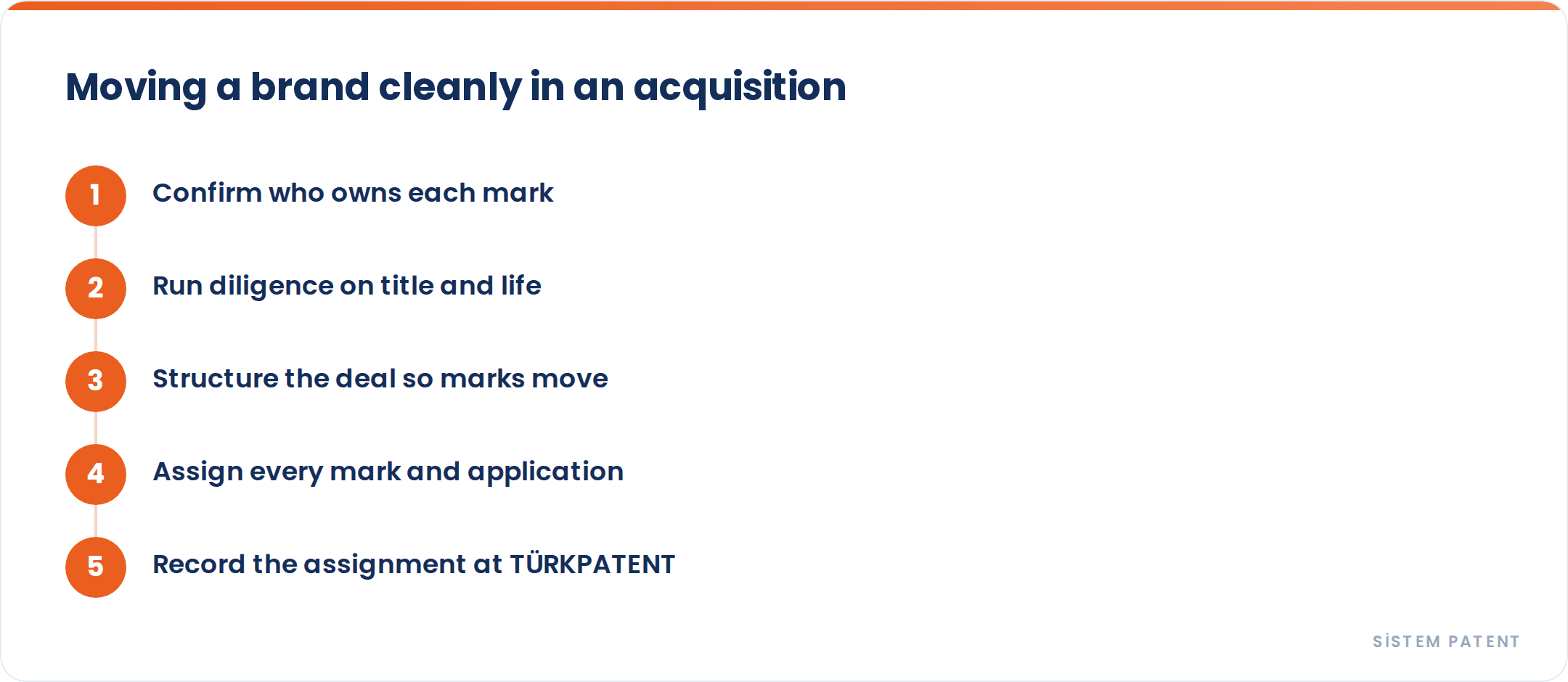
The pattern that protects both sides is straightforward once it is treated as a sequence rather than a closing-day afterthought. Establish who really owns each mark, confirm through diligence that the rights are live and enforceable, structure the deal so the marks actually move, assign every mark and application in a properly drafted agreement, and record each assignment at TÜRKPATENT so the new ownership is real against the world. Skip a step and the brand the buyer paid for can stay legally tethered to the seller long after the deal is signed.
If you are buying or selling a business where the name carries real value, the brand deserves the same scrutiny as the balance sheet. Starting with a proper read of the register through a trademark search and ending with a recorded trademark assignment is what turns a handshake over a brand into ownership you can actually enforce, license, and renew.
Picked for You