
PCT: One Application That Buys You Time to Decide Where to Patent
A Turkish manufacturer files a patent application in Ankara for a new pump seal, and within weeks the sales team is asking the only question that matters commercially: where else do we protect this. Germany is obvious, because the biggest customer is there. The United States might matter if a distribution deal closes. China is a maybe. India and Brazil are wishful thinking that could become real in two years. The Paris route forces an answer in twelve months, country by country, with the bill due in each one. The PCT route lets the same company file a single application and push that decision out by another eighteen months, with far more information in hand when it finally commits.
That trade, time and optionality in exchange for a modest up-front cost, is the whole reason the Patent Cooperation Treaty (PCT) exists. It does not grant patents and it never has. What it grants is a structured delay, a single worldwide search, and a way to keep more than 150 countries open while the business figures out which of them are worth paying for.
The PCT is a filing system, not a patent
The single most common misunderstanding is that a PCT application produces a "world patent". There is no such thing. A patent is a national or regional right, granted by the office of each country or region, enforced under its own law. The PCT (Patent Cooperation Treaty), administered by WIPO (the World Intellectual Property Organization), is the machinery that carries one application through a shared international phase before it splits into separate national applications wherever you decide to pursue it.
Think of it in two halves. The international phase is one application, one set of fees, one search, handled centrally. The national phase is where the application enters individual patent offices, gets examined under local rules, and is granted or refused one country at a time. The PCT governs the first half and standardises the paperwork for the second. The decision that costs real money, entering each national office, is exactly the decision the PCT lets you postpone.
The clock starts at your first filing, and the priority year is the trigger
Most Turkish applicants reach the PCT through priority. You file a first application at TURKPATENT (the Turkish Patent and Trademark Office), and that filing date becomes your priority date. From that date you have twelve months, the Paris Convention priority year, to file abroad and still keep the original date as your effective date for novelty. Anything published by a competitor in those twelve months cannot be used against you, because your priority date sits before it.
At the twelve-month mark you face a fork. Down one path you file directly in each foreign country you care about, paying official fees, agent fees, and translation costs in every one of them, all at once, on incomplete information. Down the other you file a single PCT application that claims priority from your Turkish filing. The PCT application inherits your priority date, so novelty is preserved everywhere, but you have not yet spent a lira on any individual country. You have bought time, and you have done it without giving anything up.
The 30-month deadline is the real benefit, and the real trap
Filing the PCT application opens what is, in practice, an extended decision window. Instead of committing to countries at month twelve, you commit at month thirty, measured from your priority date. Some offices give thirty-one months, and a few have their own variations, but thirty months from priority is the number to plan around. That extra year and a half is not idle waiting. It is the time a business uses to test the market, close the distribution deals that reveal which countries actually matter, raise money, and watch whether the product sells before sinking national-phase costs into a dozen jurisdictions.
The same deadline is unforgiving. National-phase entry is a hard cut-off, and an office that does not receive the entry documents and fees by its deadline is simply closed to you, with very limited and uncertain ways back in. Missing month thirty for a country is, for practical purposes, abandoning that country. This is the single point where PCT strategy most often fails in execution: the application is filed, the deadline feels far away, and the docket is not watched closely enough as it approaches. The benefit of the PCT and its biggest risk are the same date.
The international search report tells you whether to keep spending
The international phase is not only a waiting room. Early in the process an International Searching Authority examines your application and issues an international search report, together with a written opinion on whether your claims look new and inventive. For a Turkish applicant the search is typically carried out by a major authority such as the EPO, and it arrives months before any national-phase money is due.
This report is decision-grade information. A clean search, where the examiner finds little relevant prior art and the written opinion is positive, is a strong signal that national-phase spending is justified and that your claims have room to live. A search that surfaces close prior art is just as valuable, because it warns you before you pay to enter ten countries that your claims may need narrowing or that the invention is weaker than you thought. The same logic that makes a pre-filing patent search worth doing applies here at a larger scale: you learn where you stand before you pay to find out the hard way.
Chapter II: a second look before you commit
If the written opinion is unfavourable, the PCT gives you a second move inside the international phase. By filing a demand for international preliminary examination, sometimes called the Chapter II route, you can amend your claims and argue with the examining authority before national-phase entry. A positive preliminary report does not bind any national office, none of them are obliged to follow it, but it gives you a cleaner application to take into each country and a reasoned view of your prospects while there is still time to adjust.
PCT versus the Paris route versus direct national filings
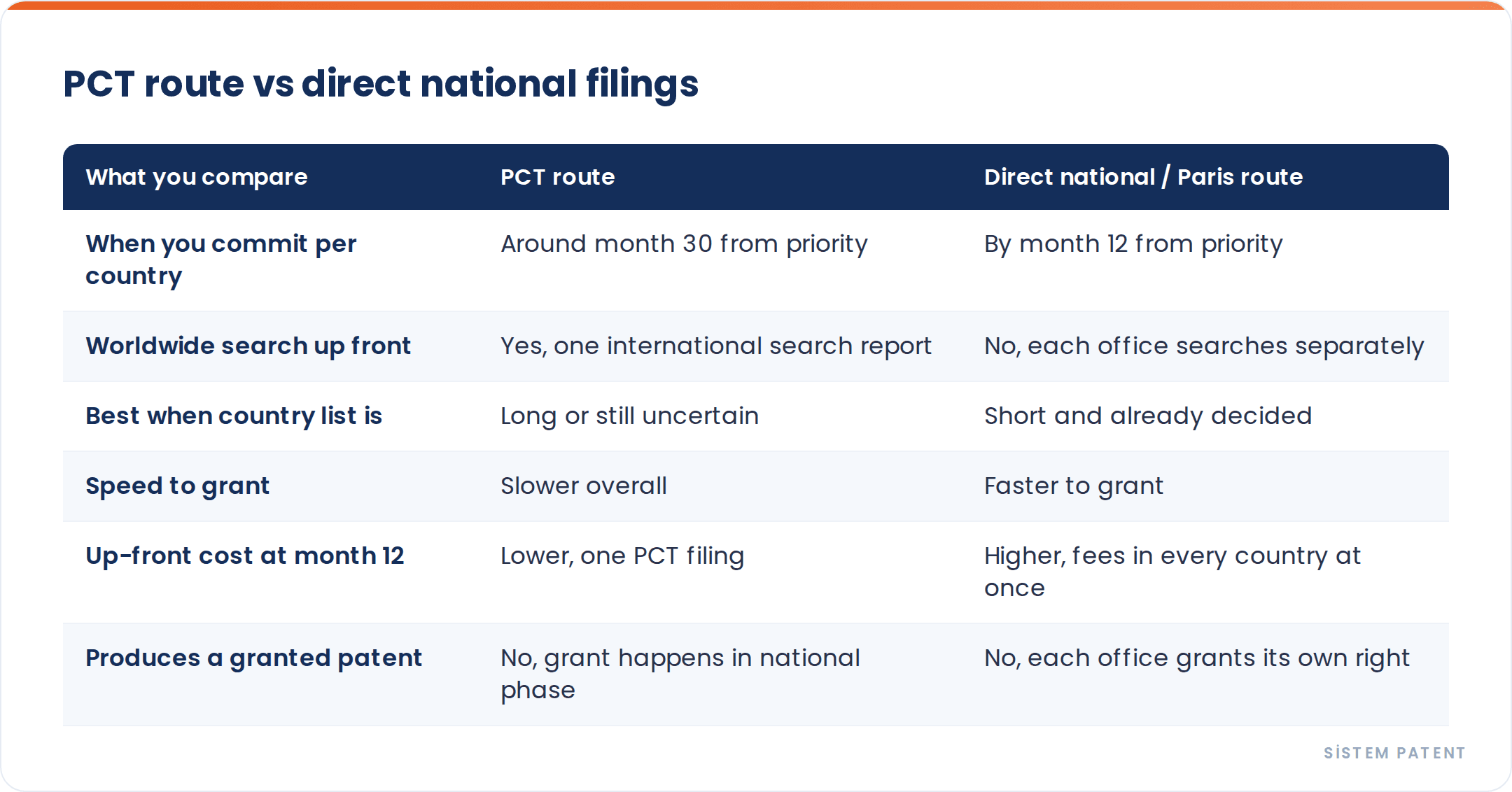
The PCT is one of three ways to take a Turkish invention abroad, and it is not always the right one. The direct Paris route, filing in each target country within the twelve-month priority year, is faster to grant and can be cheaper when you are certain of a small number of countries. If you know you want only Germany and the United States and nothing else, filing directly in those two may cost less and reach grant sooner than routing through Geneva.
The PCT earns its place when the list of countries is long, uncertain, or both. Its strengths are the deferred cost, the single worldwide search, and the ability to keep options open across many jurisdictions while you gather information. Its cost is the extra layer of international fees and a longer overall timeline to grant. The honest rule is that the PCT buys flexibility and information, and you pay for that with time and a layer of cost. For a company entering one or two known markets, direct filing often wins. For one that wants global reach but cannot yet say which markets will pay off, the PCT is usually the disciplined choice. A planned international patent registration strategy normally treats the PCT as the backbone and direct filings as the exception.
What the PCT does not do
It is worth being blunt about the limits, because applicants who expect too much get caught out. The PCT does not examine for grant, does not decide patentability for any country, and does not produce a single enforceable right. Translations, local agent fees, and the bulk of official costs all still arrive at national-phase entry, simply later than they would on the Paris route. And the thirty-month deadline does not pause for a slow business decision. The treaty buys you time and information, nothing more, and that is exactly the point: it converts an early, blind, expensive decision into a later, informed one.
For a Turkish business with international ambitions and an honest uncertainty about which borders matter, that conversion is worth a great deal. The right way to use the PCT is to file the international application before the priority year closes, read the search report as the decision tool it is, and treat the thirty-month national-phase deadline as the most important date in the file. Mapping your target markets and the route to reach them is the part worth doing with a patent agent before the priority clock runs out, and it begins with a sober PCT patent application plan rather than a last-minute scramble at month twelve.
Picked for You
Related Articles
Is Software Patentable in Turkey? Where the Line Really Runs
Read More →
Turning University Research Into Patents and Revenue
Read More →