
Keeping a Trademark Alive: Genuine Use and the Non-Use Cancellation Risk
A company files a trademark, frames the certificate, and moves on. The mark covers a product line that never launched, or a service the business quietly dropped two years in. The registration still sits in the register, renewed on schedule, looking like a protected asset. Then a competitor who wants that exact name files a cancellation action, points out that the mark has not been used for the goods it claims, and asks TÜRKPATENT (the Turkish Patent and Trademark Office) to strike it off. If the owner cannot show real commercial use, the registration that felt permanent disappears.
This is the part of trademark ownership that surprises people. A registration is not a deed you record once and keep forever. Under the Industrial Property Code (Law No. 6769), a registered mark carries a duty to actually use it, and a mark left idle for five years becomes vulnerable to cancellation by anyone with an interest in clearing it away. The certificate is the start of an obligation, not the end of one.
Five years of non-use opens the door to a third party
The rule is specific. Once a trademark has been registered for five years, it must be put to genuine use in Turkey for the goods and services it covers. If, within any continuous five-year period, the mark has not been used for those goods, and there is no proper reason for the gap, a third party can apply to have it cancelled for non-use.
Two features of this rule catch owners off guard. The first is who controls it: not the office acting on its own, but a competitor, an opponent, or anyone who stands to gain from the mark being removed. Non-use cancellation is a weapon other people pick up, usually at the moment it hurts most. A business decides it wants your name, finds your registration in the way, checks whether you have actually used it, and if you have not, files to clear the obstacle. The second is the burden of proof. When the challenge comes, the office does not have to prove you failed to use the mark. You have to prove you used it. An owner who kept no records is defending an empty position.
Non-use also surfaces defensively. If you register a mark, sit on it, and later try to oppose someone else's similar application, that applicant can demand proof that your mark has been genuinely used. No proof, no opposition. A registration you never used cannot be wielded against anyone, which quietly undercuts the whole reason most owners thought they were filing.
Genuine use means real commerce, not a token gesture
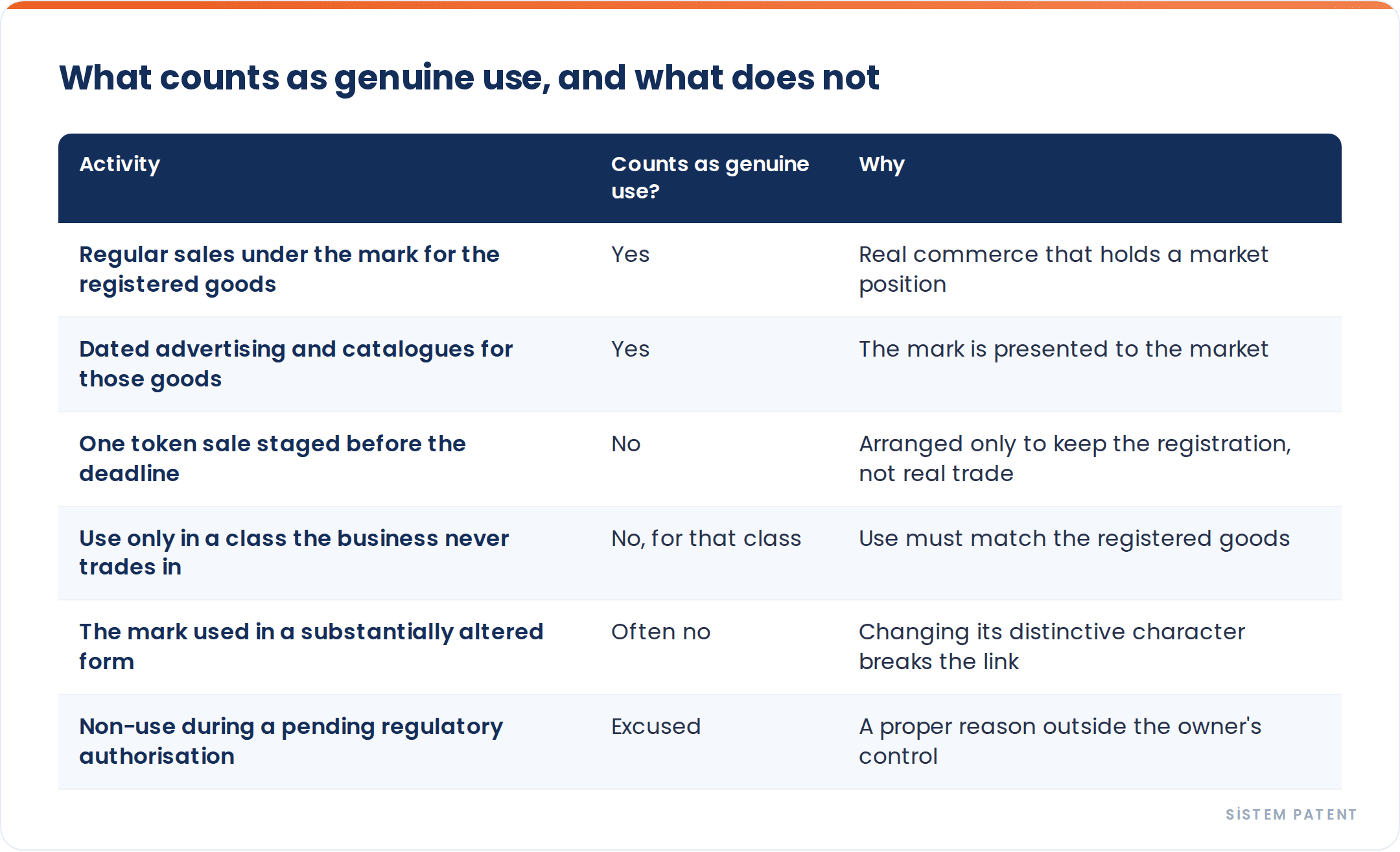
The phrase that decides these cases is genuine use, and it sets a real bar. Genuine use is use of the mark in the course of trade, on the market, for the goods and services it is registered for, in a way that creates or keeps a commercial position. It is the mark doing its job: identifying the source of products or services that are genuinely offered to customers.
What it is not is the trap. Use arranged solely to keep the registration alive, with no real commercial purpose behind it, does not count. A single token sale staged the month before a cancellation deadline, a one-off invoice to a friendly company, a mark printed on a brochure that was never distributed: these are the kinds of gestures that look like use and fail as use. The test asks whether the mark was genuinely exploited to hold a place in the market, not whether the owner can point to one orchestrated transaction.
The use also has to match the registration on two axes. It has to be use for the goods and services actually claimed, so selling clothing under a mark registered only for software does not save the software classes. And it generally has to be use of the mark in the form it was registered, with only minor variations that do not change its distinctive character. Some flexibility exists for a refreshed logo or a slight restyling, but a mark used in a substantially different form may not count as use of the registered mark at all.
Scope matters too. The duty runs class by class and good by good. A mark registered across several classes but used in only one is exposed on the rest, and a non-use action can carve away the unused classes while leaving the active ones standing. Partial cancellation is a real outcome, not a theoretical one.
The evidence file is the thing that actually saves the mark
Because the burden falls on the owner, the registration is only as safe as the proof behind it. When a cancellation lands, arguments are worth little: the office wants documents that show the mark in real use, in Turkey, across the relevant period, for the registered goods. The owner who can produce a dated, organised file walks away with the mark intact. The owner who has to reconstruct five years of trade from memory usually does not.
Good evidence is dated, tied to the mark as registered, and connected to the goods and services in the registration. It is built as the business operates, not assembled in a panic after the challenge arrives. The categories that carry weight are concrete.
- Dated sales records: invoices, order confirmations and delivery notes showing the mark on real transactions, with dates spread across the period rather than clustered around a deadline.
- Marketing and advertising: catalogues, dated ad placements, campaign materials and printouts that show the mark presented to the market for the registered goods.
- Packaging and labels: product packaging, labels, tags and signage carrying the mark, ideally photographed in context and dated.
- Online presence: dated screenshots of the website, product listings and marketplace pages where the mark appears on goods offered for sale.
- Trade activity: photographs from fairs and exhibitions, press coverage and third-party references that place the mark in commerce.
The point of the file is coverage and dating. Evidence that bunches into a single month proves a moment, not continuous use, and a challenger will say so. A file that shows the mark moving through the market steadily, year by year, for the goods it claims, is what answers a non-use action on its own terms.
A genuine reason for non-use can excuse the gap
The rule is not blind to circumstance. If the mark has not been used, but there is a proper reason for the gap, that reason can defeat a cancellation. The bar is high, and not every excuse qualifies. A genuine reason is an obstacle outside the owner's control and independent of their own choices, something that made real use impossible rather than merely inconvenient.
Regulatory delay is the textbook case: a pharmaceutical or medical product held back because marketing authorisation has not yet been granted cannot fairly be penalised for non-use during the wait. Import restrictions or other external legal barriers can fall in the same category. What does not qualify is ordinary business reality. A decision to delay launch, a financing shortfall, a shift in strategy, a market that turned out softer than hoped: these are the owner's own commercial choices, and they do not excuse a five-year silence. Relying on a proper reason is a narrow defence, not a general escape, and it is far weaker ground than simply having used the mark.
Keeping the mark alive is a habit, not a one-time act
Avoiding a non-use cancellation is mostly discipline, and it runs alongside the routine of keeping a registration in force. Renewal and use are two separate obligations that people tend to merge in their minds. Paying for trademark renewal every ten years keeps the registration on the books, but it proves nothing about use, and a faithfully renewed mark can still be cancelled for sitting idle. The two have to be managed together: renew the paper, and keep the underlying use real and documented.
A few habits carry most of the protection. Use each mark for the goods and services it is registered for, and if the business has drifted away from some of those goods, recognise that those classes are now exposed. Keep the evidence file current, filing the invoices, the campaign materials and the dated screenshots as they are generated rather than hunting for them later. Watch the calendar on any mark that has been registered but not yet brought to market, because the five-year clock is running whether or not the product has launched. And register marks you genuinely intend to use, since a defensive filing held with no commercial activity behind it is the easiest kind of registration to lose.
A trademark earns its protection by working. The registration opens the right, and genuine, documented use is what keeps it from being taken back. If you are not certain which of your marks are actively used and which are quietly exposed, the practical move is to map each registration against what the business currently sells, then close the gaps before someone else notices them. Our team handles the trademark registration and keeps the portfolio aligned with how the brand is really used, so the marks you rely on stay defensible.
Picked for You