
Protecting a Product Line: One Design Application or Many?

A homeware brand is about to file for its new kettle. The same launch also brings a matching toaster, a coffee grinder, and three colourways of each, all sharing the soft-edged family look the studio spent a year building. The founder asks the obvious question: do we file one application, or eleven separate ones? The answer shapes the cost of the launch, the strength of the protection, and whether the range can still be defended in three years when a copyist lifts the look. Most product lines get this decision wrong by treating it as a clerical detail rather than a portfolio choice.
Turkey protects the appearance of a product through industrial design rights under the Industrial Property Code (Law No. 6769). A registered design covers the look of the whole or part of a product: its lines, contours, shape, colours, texture and ornamentation. The mechanism that makes portfolio strategy possible is the multiple application: one filing can carry many separate designs, each examined and registered as its own right, provided they sit within the right boundaries. It is the same route behind any well-planned industrial design registration for a range. Used well, it cuts the cost of protecting that range to a fraction of filing each design alone. Used carelessly, it bundles strong designs with weak ones and leaves gaps a competitor walks straight through.
One application can hold dozens of designs, and that is the lever
A multiple application lets you file several designs together and pay a reduced official fee for the additional designs after the first. TÜRKPATENT (the Turkish Patent and Trademark Office) sets those fees annually, and the saving compared with separate filings is the whole reason the route exists. For a product family, this is the difference between protecting twelve variations as a planned set and protecting three because the budget ran out after the obvious ones.
The freedom is real but not unlimited. Each design in the bundle is treated as a distinct right with its own scope, its own validity, and its own renewal. They share a filing date and a single set of formalities, yet they live and die separately afterwards. One design in the application can be invalidated while the rest stand. One can be renewed while another is allowed to lapse. Thinking of a multiple application as a single combined right is the first mistake, because it is really a folder of independent rights filed at the same desk on the same day.
There is a grouping rule worth knowing before you assemble the bundle. Designs filed together generally have to belong to the same class of the Locarno Classification, the international system that sorts products by type, with ornamentation as the usual exception that can ride alongside. In practice this rarely bites a coherent product line, because a kettle, a toaster and a grinder for the same kitchen range tend to fall close together. It does bite the founder who tries to staple an unrelated product, a phone case, say, onto a kitchen-appliance filing to save a fee. Keep the bundle thematically and classificationally tight, and the route does what it is meant to.
A variation earns its own design when it changes the overall impression
The harder judgement is not how to file but what counts as a separate design worth filing. A product line generates endless near-duplicates: the same kettle in five colours, with two handle lengths, in a tall and a short body. Filing every permutation is wasteful; filing too few leaves the distinctive versions exposed. The test that sorts them is the same one that decides validity in the first place, the overall impression a design produces on the informed user.
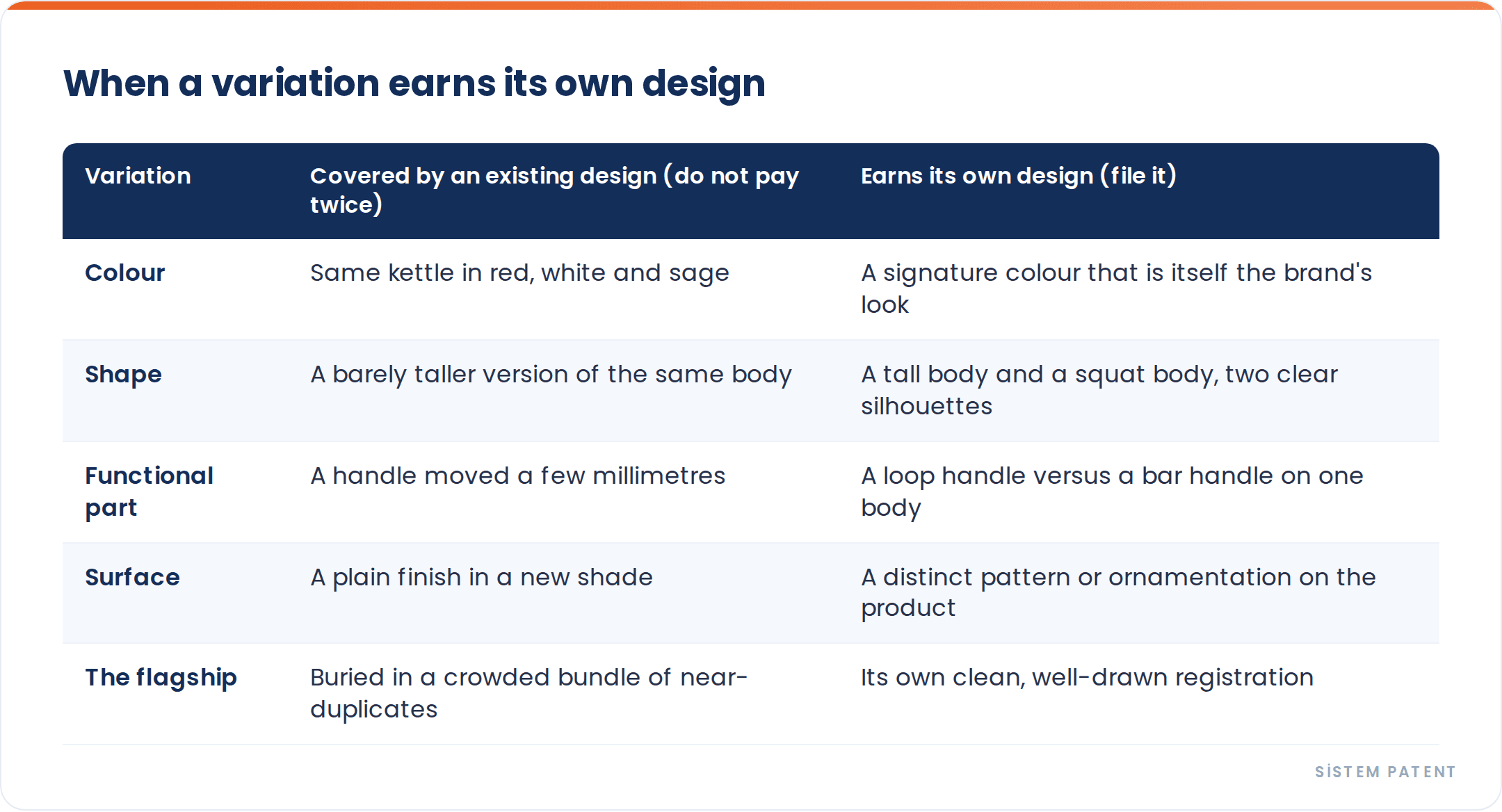
Colour alone usually does not create a new design. A kettle offered in red, white and sage reads, to someone who knows the category, as one design in three finishes, so a single registration of the shape, often filed in a neutral or line form, tends to cover all three. Spending a separate design fee on each colour is the most common way a portfolio budget gets wasted on protection it already had. The exception is the brand whose colour is itself the point, where a specific colour applied to a specific form is part of what makes the look its own. There, the colour version can deserve its own filing.
What usually deserves a separate design
- A genuine shape or silhouette change: a tall body and a squat body are two different overall impressions, not one design in two heights.
- A redesigned functional part that the eye registers: a loop handle versus a bar handle on the same body reads as a different product to the informed user.
- A distinct surface pattern or ornamentation applied to the product, which can stand as its own design even where the underlying shape is shared.
- A flagship or hero version of the product that you will market hardest and most need to defend, which is worth its own clean, well-drawn registration rather than being buried in a crowded bundle.
What usually does not
- Pure colourways of an otherwise identical shape, unless colour is central to the identity.
- Trivial proportional tweaks the informed user would not register as different, the design-law equivalent of immaterial detail.
- Internal or hidden parts that are never visible in normal use, which fall outside what a design protects in the first place.
The drawings carry more weight here than founders expect. Because each design in a multiple application is its own right, the views you submit define the scope of that particular design and nothing else. Using broken-line (disclaimed) views to show the parts you are not claiming lets you register the feature that actually makes a variation distinctive while leaving the shared, generic elements unclaimed, so two designs in the same bundle do not undercut each other. A range filed with sloppy, inconsistent drawings can end up with designs that overlap, contradict, or collectively protect less than the sum of their fees.
A portfolio is a living set, not a launch-day snapshot
The decision does not end on filing day. A product line moves: a colour is retired, the hero kettle gets a mid-cycle refresh, a fourth appliance joins the range, last season's grinder is discontinued. Each of those events has a portfolio consequence that an owner who filed once and forgot will miss.
Renewals are the quiet trap. Design protection in Turkey runs in five-year terms up to a maximum of twenty-five years, and because every design in a multiple application renews independently, a range that was filed as one tidy bundle becomes a set of separate deadlines the moment it is granted. The discipline is to renew what still sells and deliberately drop what does not, rather than paying to maintain a discontinued variation or, worse, letting the flagship lapse because it was lost in a list. A short annual review of which designs still map to live products keeps the portfolio aligned with the business instead of drifting out of sync with it.
Refreshes need the same eye that the original filing did. When the hero product is restyled, the question is whether the new look still falls within the existing registration or produces a different overall impression that the old design no longer covers. A meaningful redesign is a new design, and it needs its own filing on its own date, not a quiet assumption that the original certificate stretches to cover it. Treat each significant evolution of the line as a fresh entry in the portfolio, and the protection grows with the products instead of ageing behind them.
Build the filing around the line, not the line around the filing
The portfolio question has a clean shape once the pieces are in view. Map the range first: list every product and every variation, then sort each one into deserves-its-own-design, covered-by-another, or not-protectable. Bundle what belongs together into a multiple application to capture the fee saving, keep the flagship versions clean and well-drawn, and set a calendar against the independent renewals so nothing strategic lapses by accident.
Done at the start, this turns a scattered set of filings into coverage that maps onto the actual product line and survives the first serious copy. If you are planning a range and want the single-versus-multiple call made against your real products rather than a checklist, our team handles design registration and portfolio planning for product families day in and day out. For a line you intend to manufacture and sell at scale, the same mapping feeds straight into a coherent registered design strategy, filed on the variations that will actually earn their place and renewed on the ones that still sell.
Picked for You
Related Articles
Registered vs Unregistered Design Rights: What You Get for Free and Why It Is Rarely Enough
Read More →
Turn Your Design Investment Into a Tax Position: Design Centres, R&D and IP Incentives
Read More →