
Moral Rights in Turkey: Why You Can't Sign Away the Right to Be Named as Author
A studio sells the full rights to a logo it designed for a fast-growing food brand. The contract is clean, the fee is paid, and the brand owns everything it can buy. Two years later the brand stretches the logo, recolours it, sets it against a busy new packaging system, and runs a campaign that the original designer finds embarrassing. The designer has no economic claim left: the right to reproduce, sell and license the work was signed over in full. Yet the designer can still walk into a Turkish court and object, because one set of rights never left their hands. That is the part of copyright that surprises buyers, and the part that creators most often forget they still hold.
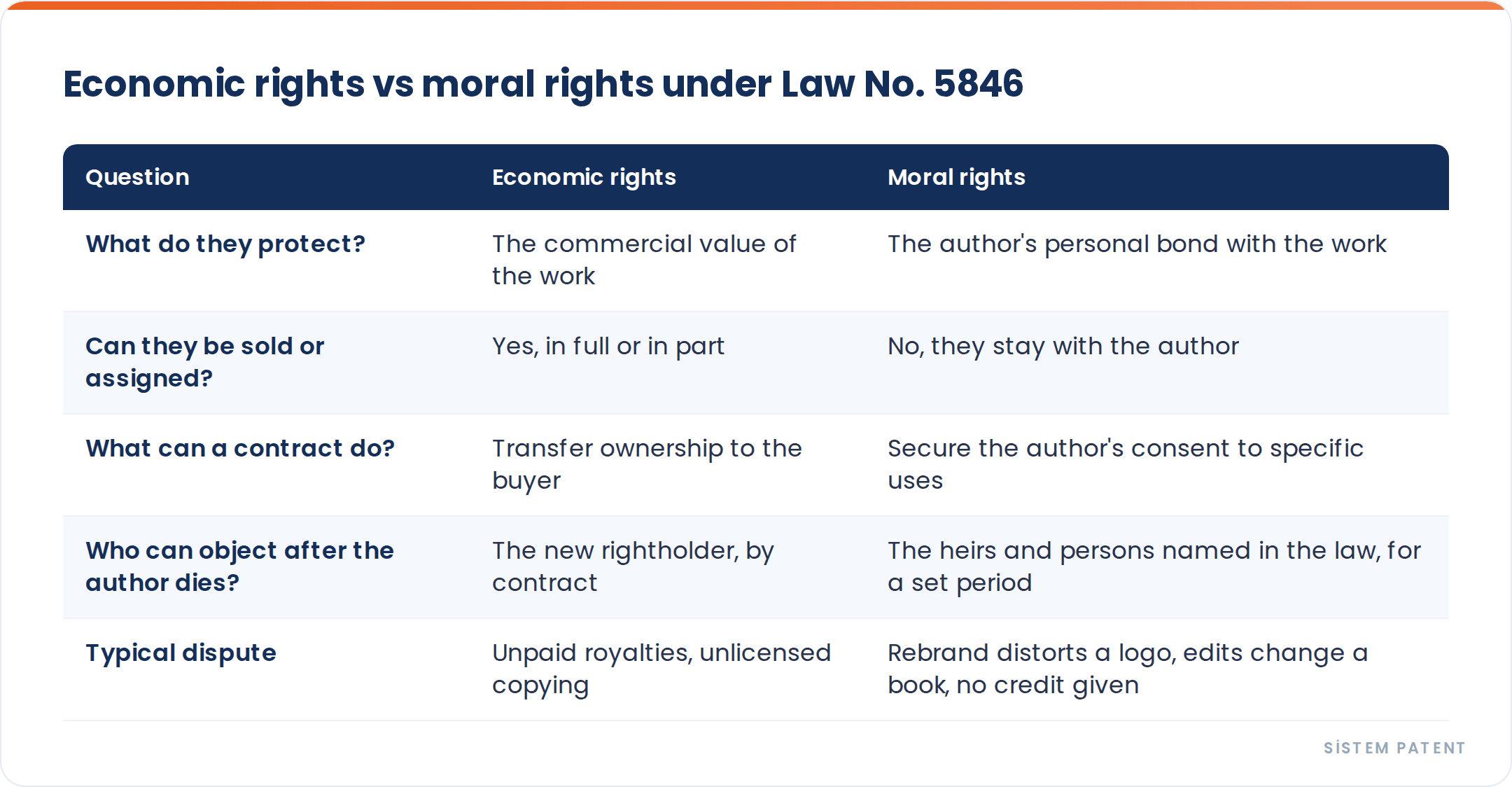
Turkish copyright law splits every protected work into two kinds of rights, and the split is the single most important thing to understand before you sign anything. Economic rights are the commercial layer: the power to reproduce, distribute, perform, adapt and communicate the work to the public. These can be sold, licensed, inherited and carved up by contract. Moral rights are different in kind. They protect the personal bond between a creator and the work they made, and under the Law on Intellectual and Artistic Works (Law No. 5846), they stay with the author even after every economic right has changed hands. You can sell what your work earns. You cannot sell the fact that you made it.
Four moral rights stay with the author no matter what the contract says
Law No. 5846 recognises a defined set of moral rights, and they are not a vague principle. They are specific entitlements a creator keeps for the life of the copyright. Reading them one by one shows how far they reach into deals that buyers assume are final.
The right to decide whether and how the work is first made public
The author decides if a work is disclosed to the public at all, and in what manner and timing that first reveal happens. An unfinished manuscript, an unreleased track, a design that never got past concept: the decision to bring any of these into public view belongs to the person who made it. A client who commissions a work does not automatically acquire the right to publish a version the author considers unfinished or unfit to show.
The right to be named as the author
This is the attribution right, and it is the one creators feel most sharply when it is ignored. The author decides whether the work carries their name, a pseudonym, or no name at all. A buyer who removes the creator's name, or passes the work off as someone else's, breaches this right even if they paid for every economic right attached to the work. Ghostwriting and white-label arrangements work only because the author consents to how attribution is handled, not because the right disappears.
The right to forbid changes that distort the work
This is the integrity right, and it is where most modern disputes land. The author can object to any alteration, mutilation or distortion of the work that harms their honour or reputation. The logo recolouring at the start of this article lives here. So does cutting a film for content it was not meant to lose, rewriting a translation until it misrepresents the original, or reworking a building's facade in a way the architect never intended. The right does not freeze a work in place forever, and ordinary, expected adaptations are a different matter. It bites when a change crosses into damaging the creator's standing.
The right to access the work and to oppose its destruction
The author keeps the ability to reach the original of their work where reasonable, for instance to make copies or reproductions, without imposing undue burden on the owner of the physical object. Turkish practice also protects the creator's interest against the wholesale destruction of an original where that would damage their legacy, particularly for unique works. These entitlements rarely make headlines, but they matter to fine artists, architects and anyone whose work exists as a single physical original.
Economic rights are sold; moral rights are only ever permitted
The cleanest way to hold the distinction in mind is this: economic rights move by transfer, moral rights move only by consent. When you assign economic rights, ownership genuinely changes. The buyer becomes the rightholder and can sue, license and resell as if they had created the work. Moral rights cannot be assigned that way. What a contract can do is secure the author's permission to exercise certain moral rights in a defined manner, for example a clause where the author agrees that the work may be published without their name, or consents to specified modifications. That permission is real and enforceable, but it is consent to particular uses, not a sale of the right itself. The right stays with the author; only its exercise is shaped by agreement.
This is why the wording of a contract matters so much. A blanket line that says the author transfers all rights does not, on its own, sweep the moral rights along with the economic ones, because those rights are not the author's to hand over. A well-drafted agreement does not pretend to buy the unbuyable. Instead it pins down exactly which moral-right exercises the author consents to: that the work may be altered for specific purposes, that it may appear without a credit, that derivative versions are acceptable. Vague drafting leaves both sides exposed, the buyer to a later objection and the author to uses they never actually agreed to. Getting this right is a question of intellectual property law, not boilerplate.
Moral rights outlive the author and pass to a defined circle
The personal nature of moral rights does not end when the author dies. Under Law No. 5846, the power to exercise certain moral rights after death passes to a defined group, the author's heirs and, for some rights, the executor or other persons named in the law, for a set period. A photographer's estate can object to a distorted posthumous use of an image. A composer's heirs can defend the integrity of a work after the composer is gone. For a business that licenses or acquires older works, this means the moral-rights question does not disappear with the original creator. The right to object can sit with people the buyer has never dealt with, which is exactly why provenance and a clean chain of consents matter when you build on someone else's creative work.
The disputes that actually happen: rebrands, edits and uncredited reuse
In practice, moral-rights conflicts cluster around a few predictable moments. A company acquires a brand asset, then modernises it past the point the original designer can stomach, and the designer asserts the integrity right. A publisher reissues a book with heavy edits and the author, or the author's heirs, objects to changes that alter the meaning. A platform reuses commissioned photography without crediting the photographer, and the attribution right surfaces. An agency hands a client a logo built partly on a freelancer's contribution, and the freelancer, never properly credited or consulted, raises a claim the agency assumed was buried in the invoice.
The pattern is consistent: the buyer believed that paying in full and taking an assignment closed the matter, and the creator points to a right that money never touched. None of this means commissioned and acquired works are unusable. It means the deal has to be built with the moral-rights layer in view. For the buyer, that means contractual consent to the modifications and uses they actually plan, secured from everyone who contributed. For the creator, it means understanding that registering and dating the work strengthens their position if a dispute over authorship or integrity ever arises, since a documented copyright application establishes who made what and when. When the work is software or a creative asset built by a team, recording each contributor's authorship through a dated work registration record heads off the later argument about who can object to what.
Moral rights are not a loophole and they are not a trap. They reflect a simple position that Turkish law takes seriously: a work carries something of the person who made it, and that connection cannot be bought out even when everything commercial about the work changes hands. For creators, the practical move is to know which rights you keep and to document your authorship early. For buyers, it is to stop treating a full assignment as the end of the conversation and to secure, in writing, consent for the specific uses your plans depend on. If you are negotiating either side of a deal over a creative work, Sistem Patent can help you separate what is genuinely being sold from what stays with the author, and put both on a clear footing through a proper copyright filing and the right contractual consents.
Picked for You
Related Articles
Protecting an Online Course or E-Book From Piracy and Resale
Read More →
Who Owns Your Reels: A Creator's Guide to Copyright, Music and Brand Deals
Read More →