
Protecting an Online Course or E-Book From Piracy and Resale
You spent eight months building a course. Sixty video lessons, a workbook, a private community, a price tag that finally reflects the work. Three weeks after launch a customer forwards you a screenshot: your entire course, every video and PDF, sitting in a Telegram channel with four thousand members, sold for the price of a coffee. This is the moment most info-product sellers discover that "I made it, so it is mine" is true in principle and almost useless in practice. The law is on your side. The question is whether you can prove it fast enough to act.
Digital courses and e-books are unusually easy to copy and unusually hard to defend, because the same file that delivers value to a paying student is the file a single buyer can redistribute to thousands. Protecting that kind of product is not one decision. It is three separate jobs done in advance: nailing down who authored the work, setting licence terms that make resharing a clear breach rather than a grey area, and having an enforcement path ready before the leak happens instead of scrambling for proof after it does.
Your course is already protected, but protection you cannot prove is protection you do not have
Under the Law on Intellectual and Artistic Works (Law No. 5846), original creative work is protected from the moment it is fixed in a tangible form. Your video lessons, your slide decks, your workbook text, your downloadable templates: each is a work that copyright covers automatically, with no registration step required. Nobody can lawfully sell or redistribute them without your permission. That is the principle, and it is genuinely strong.
The practical problem appears the day you try to enforce it. A platform takedown team, a marketplace, or a court does not start from the assumption that you are the author. They start from a blank slate and ask you to show it. When did this work exist? Who created it? Are you the person entitled to act on it? If your answer is a folder of files on your laptop with no external date on them, you are reconstructing your own authorship under pressure while the pirated copy keeps selling. The copyright was always yours. What you are missing is the evidence that turns a claim into a fact a stranger will accept.
This is the gap a dated record closes. Filing a formal copyright application for the course as a whole, and depositing the underlying materials, creates an official, dated statement that you authored this specific body of work on this specific day. It does not make the work "more protected" in the abstract, since the right already existed. It makes the right provable on paper, instantly, to people who have never met you and have no reason to take your word for it. For a product that can be leaked the week it launches, that dated proof is the difference between a same-day takedown and a months-long argument about who made what.
Register the work, not just the idea
Information products blur a line that matters in copyright: the line between an idea and its expression. Copyright never protects the subject you teach. Anyone is free to make their own course on the same topic, in their own words and footage. What copyright protects is your particular expression of it, the exact wording of your scripts, the structure and design of your slides, the specific examples in your workbook, the recorded delivery in your voice on screen. When you document the work, document the expression. A clear work registration record that captures the actual scripts, slide files, workbook PDFs and lesson recordings gives you something concrete to point at. "They copied my idea" rarely wins. "Here is my dated, deposited script, and here is their identical script" is a different conversation entirely.
The licence is where you decide what a buyer is allowed to do
Selling access to a course is not selling the course. This distinction is the heart of protecting an info-product, and most sellers skip past it. When someone buys your program, you are granting them a licence to use it under conditions you set, not transferring ownership of the content. If you never write those conditions down, you are relying entirely on copyright's defaults, and you lose the ability to point to a specific promise the buyer broke. A clear licence turns resharing from a vague wrong into a named breach of the terms they accepted at checkout.
Good info-product terms are short and concrete. They state that access is personal and non-transferable, granted to one named individual. They prohibit sharing login credentials, redistributing files, and reselling or sublicensing any part of the program. They make clear that the buyer receives a right to use the materials, not to copy or republish them, and that login details and downloads are tied to their account alone. The point is not legalese for its own sake. It is to remove the excuse. A reseller who claims "I didn't know I couldn't" has nothing to stand on when the terms they clicked through said it in plain language.
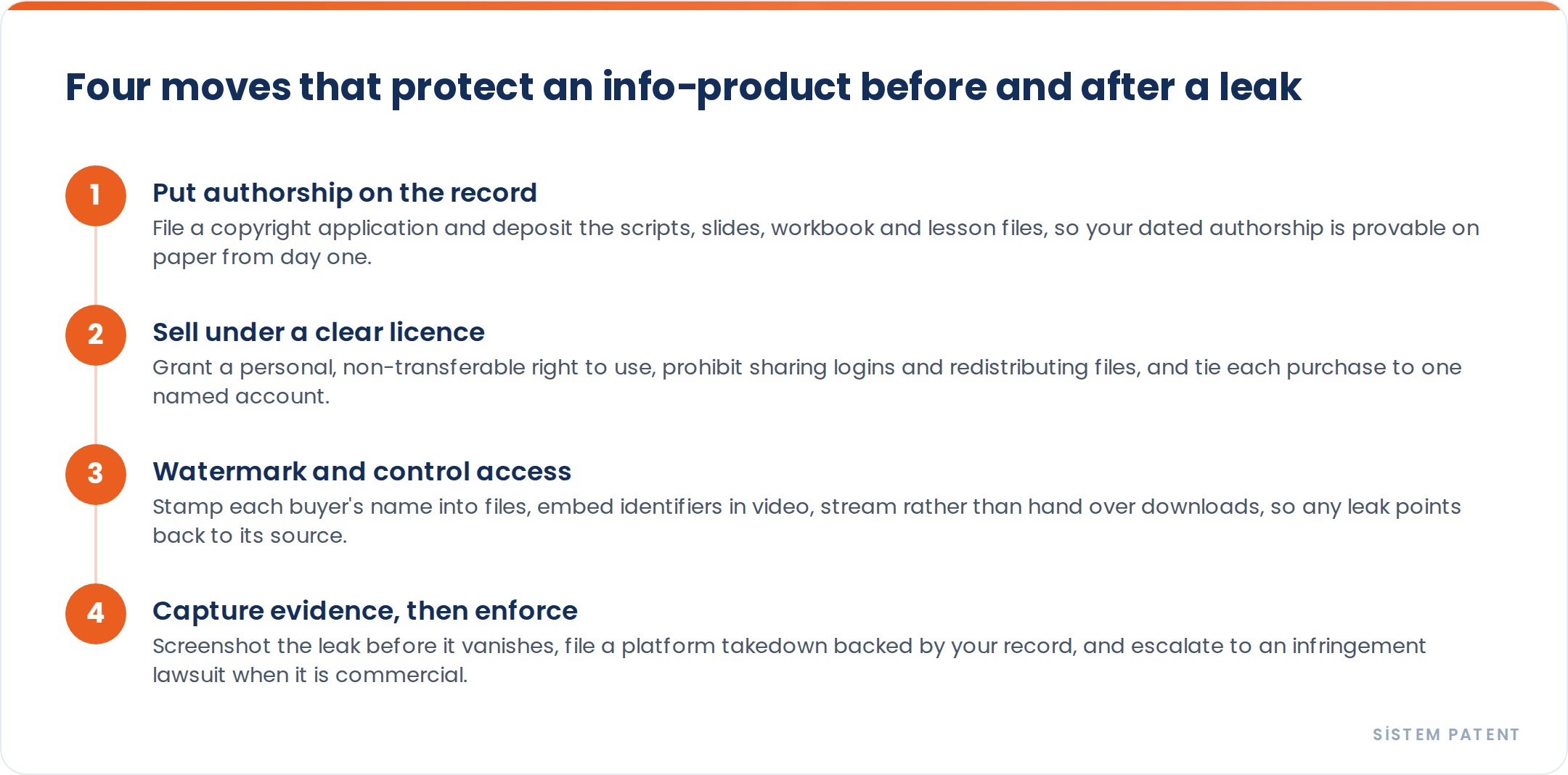
The licence also gives you something pure copyright does not. When a buyer reshares your course, they have done two things at once: infringed your copyright and broken a contract. That second track matters. It lets you act against the specific person whose account leaked the files, not only against the anonymous channel hosting them. Tie each purchase to a named account, keep the record of which account accessed what, and a leak stops being an untraceable event. It becomes a breach you can attribute, which changes both how you respond and how seriously a buyer treats the terms in the first place.
Watermarking and access control do quiet work
Legal terms are stronger when the product itself discourages copying and makes leaks traceable. Personalising each buyer's files, stamping a workbook PDF with the purchaser's name and order number, or embedding a visible or invisible identifier in video, turns an anonymous leak into a labelled one. When a watermarked copy surfaces in a channel, you are not guessing who shared it. Pair that with sensible access control, streaming lessons rather than handing over raw downloads, gating the community behind individual logins, expiring download links, and you raise the effort required to pirate at scale. None of this makes copying impossible. It makes casual resharing inconvenient and deliberate piracy attributable, and both of those meaningfully shrink the problem.
What to actually do when your course turns up on Telegram
The day a leak appears, the sellers who handle it well are the ones who prepared. The first move is evidence, captured before anything is taken down. Screenshot the channel, the listing, the file names, the member count and the date, and save the offending files themselves where possible. A leak can vanish the moment you complain, and if you have not preserved proof, you have lost the case before it starts. Capture first, complain second.
With evidence in hand, the fastest lever is almost always the platform, not the courtroom. Telegram, marketplaces, social networks and file hosts all run notice-and-takedown processes, and a rights holder who can show a dated record of authorship gets a far quicker result than one sending bare assertions. This is exactly where your earlier groundwork pays off: the registration that proves you are the author, and the watermark that ties the leaked copy to a specific buyer, let you file a takedown that is hard to ignore and, often, identify the account that leaked it.
Takedowns treat the symptom. When the infringement is commercial, persistent, or run by someone you can identify, the real remedy lies in court. Turkish law gives copyright owners civil and criminal routes against infringement, and an intellectual property infringement lawsuit can pursue an injunction to stop the distribution and compensation for the damage done. That path is dramatically smoother when authorship is already on the record. A claim backed by a dated registration and watermarked evidence walks in able to prove the essentials immediately, rather than spending its first months establishing that the work is yours at all. The seller who registered early is litigating; the one who did not is still gathering proof.
Piracy will never drop to zero, and chasing every free repost is a poor use of your time. The realistic goal is to make your course expensive to steal and cheap to defend: authored on the record, sold under terms that name what a buyer cannot do, marked so leaks point back to their source, and backed by an enforcement path you can trigger the same day a channel appears. Sistem Patent can help you put that foundation in place, from filing the copyright on your course materials to documenting the work that you would one day want to defend, so that the next time a screenshot lands in your inbox, your authorship is already proven and your response is ready to send.
Picked for You
Related Articles
Who Owns Your Reels: A Creator's Guide to Copyright, Music and Brand Deals
Read More →
Work-for-Hire and Freelancers: Who Owns the Design, Code or Copy You Paid For
Read More →