

Turning University Research Into Patents and Revenue
A materials-science group at a Turkish university spends four years developing a coating that makes industrial filters last three times longer. The lead researcher is proud of the result and does what academics are trained to do: she submits the findings to a high-impact journal and presents the data at an international conference the same month. The science is excellent. The patent that could have funded the next decade of her lab is now worth a fraction of what it should be, because the invention was made available to the public before anyone filed. Nothing went wrong in the lab. The intellectual property simply ran on the academic calendar instead of the commercial one, and on the academic calendar publishing fast is the goal.
This is the central tension of university research commercialization, and it sits at the heart of what a technology transfer office exists to manage. A university produces inventions worth protecting, but its incentives, the pressure to publish, to graduate students, to report results to funders, push in the opposite direction of the discipline a patent needs. Bridging that gap is not a paperwork exercise. It is a structured pipeline that turns an academic result into a protected, licensable asset, and it works only when the rules are understood before the science goes public.
The first public disclosure decides how much the invention is worth protecting
Novelty in Turkey is absolute. Under the Industrial Property Code (Law No. 6769), an invention stops being new the moment it is made available to the public anywhere in the world, in any language, by any means. For a university, the routine outputs of research are exactly the things that count as disclosure: a journal article, a conference poster, a master's or doctoral thesis defended in public, an abstract in a proceedings volume, even a detailed grant report that describes how the invention works. The academic instinct to share early is, in patent terms, the instinct to destroy your own rights.
Turkey provides a twelve-month grace period for disclosures that originate from the inventor, which can rescue a premature reveal at home. It is a safety net, not a plan. Many of the export markets a spin-out will eventually target grant no such grace, so a disclosure that is forgivable in Turkey can still sink patentability in Europe and elsewhere. The rule that protects a research group is one sentence long and hard to enforce inside a culture built on publishing: file before you disclose. A clean patent application filed before the paper goes out anchors the priority date and keeps the grace period in reserve for genuine accidents rather than spending it on a planned conference talk.
The practical fix is not to slow the science. It is to insert a short confidential review between the moment a result is written up and the moment it is submitted anywhere. A few weeks is usually enough for a technology transfer office to assess patentability and file a priority application, after which the researcher publishes freely. The paper still comes out. It just comes out second.
The technology transfer office is the bridge, and it has to enter early
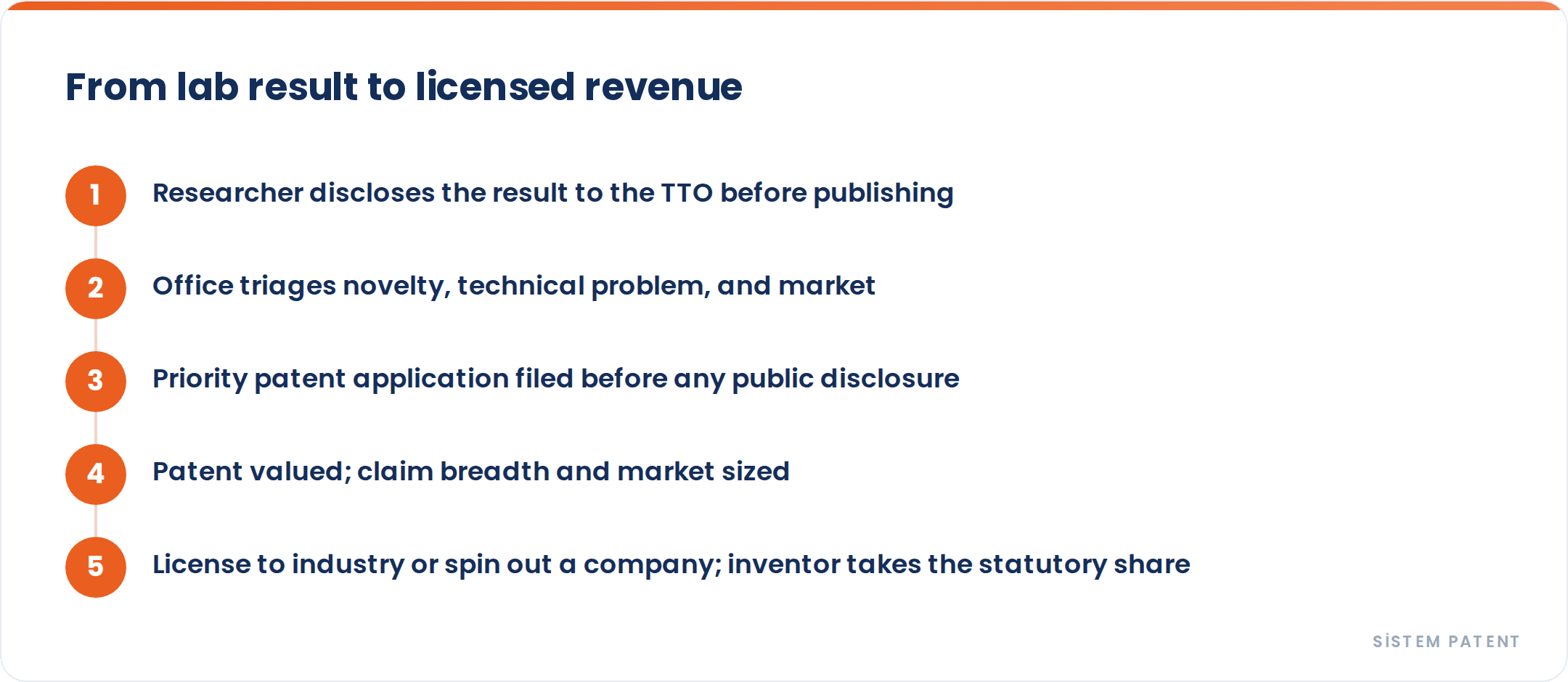
Most universities of any research scale run a technology transfer office, often called a TTO or in Turkey a TTM. Its job is to catch inventions before they leak, decide which are worth protecting, manage the filing, and find the industry partner who will turn the patent into a product. The single biggest determinant of whether a TTO succeeds is timing. An office that hears about an invention after the conference is doing damage control. An office embedded in the research workflow, with a simple invention-disclosure form that researchers actually use, gets the chance to act while the rights are still intact.
A working disclosure habit is what makes the whole system function. Researchers need a named contact and a short, dated form to report a result they think might be commercial, and they need to do it before they submit anything for publication. The TTO then runs a fast triage: is the result novel, does it solve a technical problem, is there a plausible market, and who might pay for it. That triage decides whether the university spends money on protection or releases the result for publication straight away. Not every finding deserves a patent, and a good office is as willing to say no as yes.
Who owns a university invention is set by statute, not by who had the idea
Inventions made by academic staff fall under the service-invention framework of Law No. 6769, but universities sit on a distinct track from ordinary employers. The rights to a qualifying academic invention belong to the institution, and the academic who created it is entitled by law to a defined share of the revenue the invention earns once it is commercialized. That revenue share is statutory. It exists whether or not anyone signed a contract about it, and it is the engine that makes the whole model fair: the university provides the lab, the funding, and the commercialization machinery, and the inventor keeps a meaningful cut of what the invention brings in. The exact percentages and the procedure are particular to the academic regime, so a research team should treat ownership as its own question rather than assuming the rules that apply to a company engineer apply unchanged to them.
Filing strategy for academic inventions answers to a different clock
University inventions tend to be early. They prove a principle rather than a finished product, which shapes how they should be filed. A first national filing establishes the priority date cheaply and starts the protection running. From there the twelve-month priority window under the Paris Convention becomes the lever: it lets the team carry the Turkish filing date abroad once a commercial partner or a clearer market picture has emerged, so an international filing built on that priority preserves novelty in export markets even though the original application went in early and inexpensively. A research group rarely knows on day one which countries matter. The priority window buys the year it takes to find out.
The other reality of academic filing is that the asset is usually a patent on a mechanism, a compound, or a process, and the breadth of the claims decides the licensing value. A narrow filing rushed out to beat a conference deadline can protect the specific embodiment the lab built while leaving the broader principle open for others. This is where the file-versus-publish review earns its place a second time: a few weeks of proper drafting, capturing the invention at the right level of generality, is the difference between a patent a company will pay to license and one it can design around. The goal of a university patent registration is not just to exist but to cover enough that an industry partner needs it.
Knowing what the patent is worth is what makes the deal real
An academic invention only becomes revenue when someone in industry pays to use it, and that conversation stalls without a defensible sense of value. A patent's worth is driven by the breadth of its claims, the size of the market it touches, and the years of protection remaining, and there are established ways to estimate it: cost-based, market-based, and income approaches such as relief-from-royalty. A university does not need a formal number for every disclosure, but before it sits across the table from a manufacturer it should understand what its patent valuation rests on. The number anchors the royalty rate, the upfront fee, and the equity stake in a spin-out, and a TTO that walks in without one tends to leave value behind.
Valuation also disciplines the portfolio. Universities accumulate patents faster than they commercialize them, and each one carries annual maintenance fees that rise over the life of the right. A clear-eyed view of which inventions have a real market and which are scientifically interesting but commercially thin lets the office concentrate its budget where the return is, and let the rest lapse without regret.
Two routes out: license the patent, or spin out a company
A protected, valued invention leaves the university by one of two doors. The first is licensing the patent to an existing company that has the manufacturing, distribution, and capital the university does not. A patent licensing deal can be exclusive or non-exclusive, limited by field of use or territory, and structured around upfront payments, running royalties, and milestones. For a university this is often the cleaner path: the institution keeps ownership, collects a revenue stream, and the academic inventor receives the statutory share, while the partner shoulders the cost and risk of bringing the product to market. The license should be recorded at TÜRKPATENT so the chain of rights is clean if the patent is ever enforced or the deal is ever audited.
The second route is the spin-out, a new company built around the patent, usually with the inventor involved and the university taking equity in exchange for the IP. Spin-outs suit inventions too early or too platform-like for an established firm to license, where the value will only emerge through dedicated development. They demand far more: founders, investment, and a clean assignment of the patent from the university into the new entity, recorded properly so the company actually owns what it was built on. An investor performing diligence will check that chain of title first, and a spin-out that cannot show it owns its core patent is a spin-out that cannot raise money.
Both routes depend on the same foundation laid in the first weeks: an invention disclosed before it was published, filed before it was disclosed, and drafted broadly enough to be worth paying for. The commercialization happens at the end, but it is won or lost at the beginning.
If your university, research institute, or technology transfer office is building the path from lab result to licensed revenue and wants the filing, valuation, and licensing handled so the academic calendar stops eroding the commercial one, our patent agents can structure the pipeline around your research milestones. The work starts with a confidential review and the patent application that protects the result before it goes public.
Picked for You
Related Articles
The One Disclosure That Kills a Patent: Novelty and the Grace Period Before You File
Read More →
How to Answer a Patent Examination Report Without Quietly Killing Your Own Claims
Read More →