

Turn Your Design Investment Into a Tax Position: Design Centres, R&D and IP Incentives

A furniture manufacturer in Bursa runs a real design studio. Six in-house designers, a prototyping workshop, software licences, a budget that grows every year. The company already pays for all of it. What the owner does not know, until an accountant raises it, is that this same activity could carry a corporate tax deduction, income-tax withholding relief on the designers' salaries, and social-security premium support, with the design registrations the firm files each year doubling as the evidence that the work is genuine design and not ordinary production. The investment was always there. What was missing was the structure that turns it into a tax advantage.
Turkey runs two parallel support regimes that matter to anyone investing in product appearance: the R&D centre and the design centre, both built on Law No. 5746 on Supporting Research, Development and Design Activities. A design centre is the version aimed squarely at firms whose value sits in how their products look, fashion houses, furniture and lighting makers, ceramics, jewellery, packaging-led consumer brands. The incentives are real and recurring, but they are not handed out for good intentions. They are paid against documented, qualifying design activity, and a registered-design portfolio is one of the cleanest ways to prove that activity is exactly what you say it is.
A design centre pays you for activity you can prove, not for a department you simply name
The headline supports under the design-centre regime are a deduction of qualifying design expenditure from the corporate tax base, withholding incentive on the income tax of design personnel, a partial employer's share of social-security premiums covered from the budget, and stamp-duty exemption on documents drawn up for the activity. The exact rates and the minimum full-time design-personnel headcount are set by the legislation and revised by the state, so the figures belong in a current assessment rather than a blog post. The principle does not move: the benefit scales with how much real, documented design work runs through the centre.
That word documented is where most claims live or die. A design centre is audited. The Ministry reviews whether the projects are genuine design activity, whether the personnel actually work on them, and whether the outputs exist. A studio that files a steady stream of design applications for the products it develops is producing exactly the paper trail an inspector wants to see: dated applications, named designers, drawings, and granted rights that map onto the projects claimed for the incentive. The registration is not a legal formality bolted on at the end. It is contemporaneous proof that a design project happened, produced an original result, and belongs to the company.
Each design filing is a dated, third-party record that a project was real
Think about what a design application actually creates. It fixes a date. It names the designer. It deposits the views of the product as it looked at that moment. When TURKPATENT (the Turkish Patent and Trademark Office) registers the design, a state register now carries an independent record that your company developed this appearance, on this date, attributable to these people. That is precisely the kind of evidence an R&D or design incentive audit is built to test, and it is far stronger than an internal timesheet or a folder of undated sketches.
The link runs in both directions. The incentive rewards the activity, and the design registration documents it. A firm that treats filing as a routine output of every design project, rather than an afterthought reserved for the one product it expects to litigate, ends up with a portfolio that does triple duty: it protects the products, it substantiates the incentive claim, and it builds an intangible asset on the balance sheet. The same drawings you submit to register the design are the drawings that show the project was genuine design work.
None of this means a registration is a magic key to state money. The design centre has to meet the structural conditions, the headcount, the dedicated space, the project management, the reporting. What the portfolio does is remove the most common point of failure in an audit, the gap between what a company claims it designed and what it can prove it designed. A pile of registered designs, each tied to a dated project and a named designer, closes that gap before the inspector opens it.
What to keep, and how to keep it, so the file holds together
The documentation that ties design activity to an incentive claim is not exotic, but it has to be consistent. The pieces an auditor expects to reconcile against each other are straightforward to list.
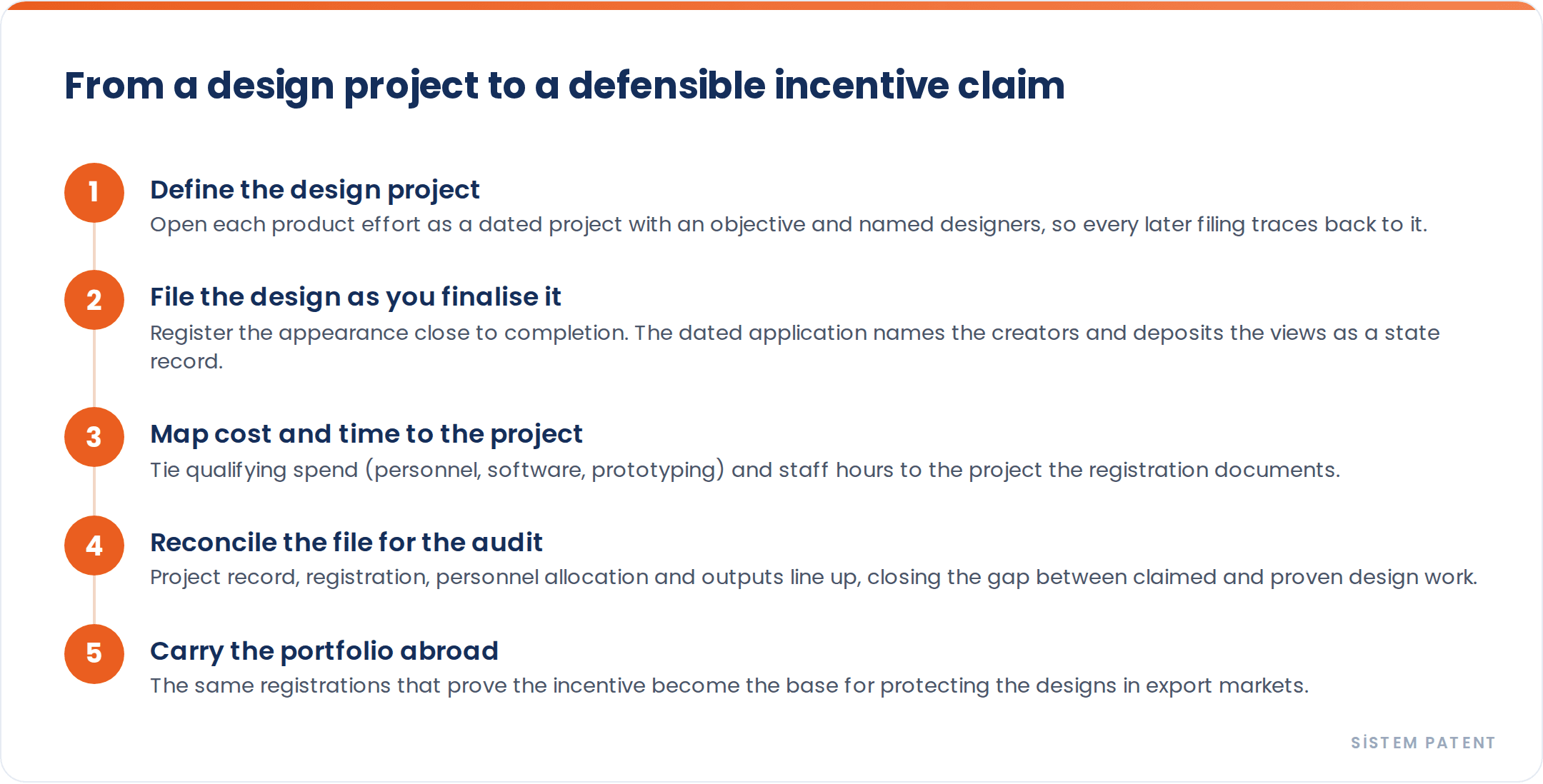
- Project records: a defined design project with a start date, objective, and the personnel assigned, so each registration can be traced back to a project the centre actually ran.
- Design applications and certificates: the dated filing and the granted right for the products the project produced, naming the designers as the creators.
- Personnel and time allocation: records showing which design staff worked on which project, supporting both the withholding incentive and the link between a designer and the registered output.
- Expenditure mapping: the qualifying costs, software, prototyping, personnel, materials, mapped to the projects, so the deduction rests on activity rather than a lump sum.
- Outputs and commercialisation: the products that reached the market, closing the loop between a registered design, a real project, and a commercial result.
The discipline is in keeping these aligned as you go. A registration filed two years after the project, with a designer who has since left and no project record naming them, is far weaker evidence than the same registration filed in the month the design was finalised. Filing close to the design work is good IP practice for novelty reasons anyway, since early disclosure can sink a later application, and it happens to produce the cleanest possible incentive file at the same time.
Sectors where the design-portfolio-to-incentive link pays off fastest
The firms that gain most are the ones whose competitive edge is visual and whose product cycle is fast. A furniture maker refreshing collections every season generates a natural stream of new designs, each one a candidate registration and a documented project. A lighting or ceramics brand iterating on form does the same. A packaging-led consumer business, where the bottle or the box is the product's face, can file design after design and tie each to a measurable development effort. In all of these, the design work is happening regardless. Structuring it as a design centre, with registrations as the spine of the evidence, converts a cost the company was already absorbing into a recurring tax position.
For an exporter, the structure compounds. The designs you register at home to support the incentive are the same designs you will want to protect in your export markets, and an organised Turkish portfolio is the foundation for an industrial design registration strategy that travels abroad through the international system. The incentive funds the design engine; the registrations protect its output at home and overseas; the documentation satisfies the audit. One disciplined filing habit serves all three.
The practical takeaway is that design investment and IP protection should not be run as separate projects on separate calendars. A company spending real money on how its products look is already most of the way to a defensible design-centre position, and the registrations it should be filing for protection are the same records that prove the activity to the state. If you are weighing whether your design spend could anchor a design centre, the first concrete step is an audit of what you have created and what you have actually registered. Our team handles the design registration side and works with the firms that build the incentive structure around it, so the portfolio you file does protective and evidential work in the same motion.
Picked for You
Related Articles

Protecting a Product Line: One Design Application or Many?
Read More →
Registered vs Unregistered Design Rights: What You Get for Free and Why It Is Rarely Enough
Read More →