
How to Answer a Patent Examination Report Without Quietly Killing Your Own Claims
An examiner's letter lands a year into the process, and the first instinct is almost always the wrong one. The applicant reads two paragraphs of objections, decides the examiner has rejected the invention, and rewrites the main claim down to the exact embodiment in the drawings just to make the problem go away. The objection clears. So does most of the commercial value of the patent. Six months later a competitor sells a product that is plainly the same idea in a slightly different shape, and the claim, now welded to one narrow version, cannot touch it.
An examination report is not a rejection. It is the office opening a conversation about scope, and the response you file decides how much ground you walk away with. The applicants who lose protection rarely lose it at the examiner's hand. They give it away themselves, in a panicked amendment that concedes far more than the objection ever demanded. Reading the report correctly, and answering it with restraint, is the whole game.
The report is a negotiation about scope, not a verdict on your invention
Under the Industrial Property Code (Law No. 6769), an application is examined against the patentability conditions, and the examiner issues a written report setting out where the claims, as drafted, fail to meet them. That report is a stage in the procedure, not the end of it. You are given a period to respond, and your response can argue against the objection, amend the claims, or do both. The examiner is not your opponent. The examiner is applying a standard, and your job is to show that a properly framed claim meets it.
This matters because the emotional register of the letter and its legal weight are different things. A report can read like a flat refusal and still be entirely answerable. What it actually says is: on the documents in front of me, these claims reach too far, or are not clearly supported, or overlap with something already public. None of that means the invention is unpatentable. It usually means the claim, as written, has to be brought into line with what you genuinely invented and what the record will support. The skill is hearing the objection precisely, then answering exactly that, and nothing more.
A novelty objection and an inventive-step objection are not the same problem
The most expensive mistake in a response is treating every objection as the same kind of attack. The two most common grounds, lack of novelty and lack of inventive step, are answered in opposite ways, and confusing them wastes your one good response.
Novelty: one document has to show everything
A novelty objection says a single prior document already discloses your invention. The legal test is strict and, helpfully, narrow: to destroy novelty, one piece of prior art must disclose every feature of the claim, together, in one place. If even a single claimed feature is missing from that document, the objection does not hold. So the response to a novelty rejection is forensic, not rhetorical. You read the cited reference closely and identify the feature in your claim that it does not disclose. If that feature is already in the claim, you argue it. If it is in your description but not yet in the claim, you may be able to amend the claim to bring it up, provided the description supports it. A novelty objection is often the easiest to overcome cleanly, because you are looking for one gap, not making a judgement call.
Inventive step: the argument is about whether the leap was obvious
An inventive-step objection is a different animal. Here the examiner accepts that your exact combination is not shown in any single document, but argues that a skilled person, looking at the prior art, would have arrived at it without inventive effort, often by combining two references. This is a reasoned judgement, not a checklist, so the response is an argument rather than a hunt for a missing feature. You show why the combination the examiner proposes is not one a skilled person would actually have made: the references point in different directions, the combination solves a problem nobody in the art had framed, the result is unexpected, or there was a technical prejudice against doing it. Understanding the difference between these two grounds is exactly the kind of read that a properly run prior-art search before filing is meant to surface early, so the claims arrive at examination already drafted around the closest art rather than colliding with it.
Amend to answer the objection, not to escape the examiner
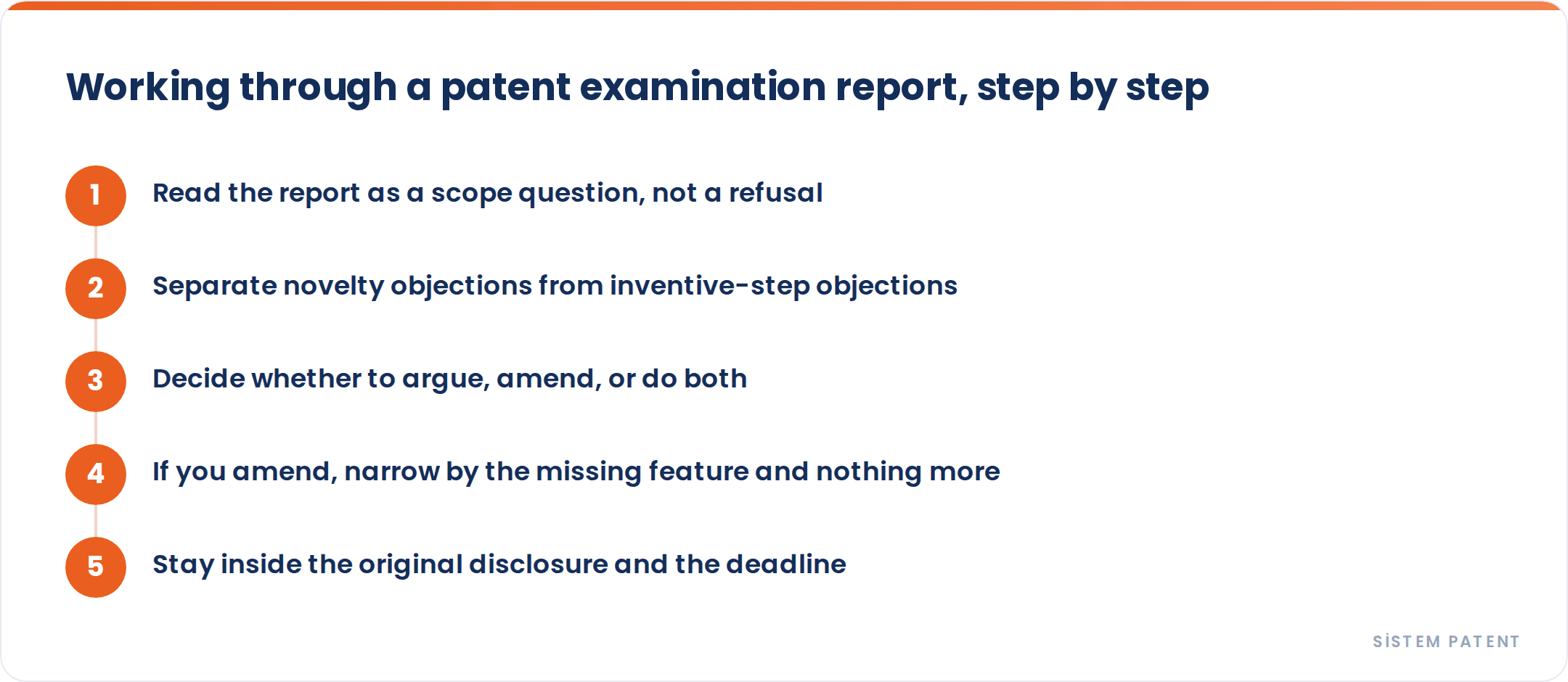
When an amendment is the right move, the rule that protects you is simple to state and hard to follow under pressure: narrow only as far as the objection requires, and not one feature further. Every limitation you add to a claim is a limitation a competitor can design around. If a novelty objection turns on one missing feature, you add that one feature. You do not also import three more details from the preferred embodiment because they happen to be sitting in the same sentence of the description. Each of those extra details hands a rival a lawful way to copy the heart of your invention while staying outside your claim.
There is also a hard outer limit on what you are allowed to do. Under Law No. 6769, an amendment cannot extend the protection beyond the content of the application as originally filed. You can narrow, clarify, and restructure within what you disclosed. You cannot add new subject matter that was not in the application on its filing date. This cuts both ways. It is the reason a thin description is so dangerous: if the supporting detail you need to rescue a claim was never written into the original patent application, you cannot add it now, and the claim may be stuck between an objection you cannot argue away and an amendment you are not permitted to make. The richness of the original filing quietly sets the ceiling on everything you can do at this stage.
Over-narrowing is the silent failure that looks like success
The cruelty of over-narrowing is that it never feels like a loss in the moment. The objection clears, the examiner is satisfied, the patent grants, and the file closes with a clean result. The damage only surfaces later, when the granted claim is so tightly bound to one implementation that any meaningful variation falls outside it. A patent is worth precisely what its broadest valid claim can stop. Trade the breadth away to clear an objection cheaply, and you are left holding a certificate that looks like protection and functions like a trophy.
This is why a response is a drafting decision as much as a legal one. Before conceding any feature, the question is always what that concession costs in enforcement reach, weighed against what the objection actually requires. Sometimes the better path is not to amend at all but to argue the claim as it stands, especially against an inventive-step objection where the examiner's reasoning is contestable. Sometimes it is to amend a dependent claim or add a fallback rather than gut the independent claim. Holding the line on scope while still satisfying the examiner is the difference between a granted patent that defends a market and one that merely decorates a wall. Keeping a claim both valid and broad is the entire craft of the response, and it rewards judgement over speed.
Treat the deadline as real and the one response as precious
The response period in the report is a hard deadline, not a suggestion, and letting it pass can cost the application outright. Missing it is the avoidable way to lose a patent that was otherwise grantable, so the date goes in the diary the day the report arrives, with enough runway to think rather than react. Just as important, you usually do not get unlimited bites. The response you file is your considered position, so it pays to get the analysis right the first time rather than firing off a quick amendment and hoping to fix it later.
An examination report is the moment a patent is actually shaped. Read the objection for exactly what it is, separate a novelty point from an inventive-step point, amend only as far as the objection forces and never past what the original filing supports, and guard the breadth of the independent claim as if the whole value of the patent depends on it, because it does. If a report has landed on an application you care about, our patent team can read the objections, frame the response, and amend the claims to clear examination while protecting the scope you filed for in the first place.
Picked for You
Related Articles

Turning University Research Into Patents and Revenue
Read More →
The One Disclosure That Kills a Patent: Novelty and the Grace Period Before You File
Read More →