
How to Run a Real Prior-Art Search Before You File a Patent
An engineer spends a weekend convinced she has invented something nobody has built: a hinge mechanism that lets a folding crate collapse with one hand. The prototype works, the team is excited, and the obvious next step is to call a patent attorney and file. Two hours on Espacenet would have shown her a 2014 application from a logistics company in Germany describing almost the same hinge, granted, lapsed, and now sitting in the public record where any examiner will find it in minutes. The invention was real. It was just not new, and novelty is the one thing a patent cannot be granted without.
A prior-art search is the cheapest insurance an inventor will ever buy. A Turkish patent application carries official fees, agent fees, drawing costs, and a year or more of waiting, and almost all of that is wasted if a single earlier document already describes the invention. Searching first does not guarantee a grant, because no search is ever complete. It does something more useful: it tells you, before you spend, whether the idea has room to be patented at all, and it shows you exactly which earlier inventions your claims will have to step around.
Prior art is anything public before your filing date, anywhere, in any language
The first thing to understand is how wide the net is. Under the Industrial Property Code (Law No. 6769), an invention is new only if it does not form part of the state of the art, and the state of the art is everything made available to the public, anywhere in the world, before your filing or priority date. That means a granted patent in Japan counts. So does an abandoned application in Brazil, a product manual on a forgotten website, a conference poster, a YouTube teardown video, and a thesis sitting in a university library. Novelty in Turkey is absolute, not local, so a search that only checks Turkish records is barely a search at all.
This is also why the inventor's own disclosures are dangerous. A demo at a trade fair, a crowdfunding page, or a paper published before filing can become the prior art that sinks the application. Turkey allows a twelve-month grace period for the inventor's own disclosure, but relying on it is a fallback, not a plan. The clean approach is to search the public record as it stands today, treat anything you find as a potential obstacle, and file before you add to that record yourself.
Two different searches, and you usually need the first one
People blur two jobs that have different goals. A novelty search asks one question: has my invention, or something very close to it, already been disclosed anywhere. You run it before filing to judge whether the idea is patentable and where it sits against the closest earlier work. A freedom-to-operate search asks a separate question: would selling my product infringe a patent that is still in force in my market. The two overlap in technique but not in purpose, and a document can wreck your novelty while posing no commercial threat, or block your product while doing nothing to your patentability.
For an inventor about to file, the novelty search comes first. It is the one that decides whether spending on a patent application makes sense at all. The honest way to run it is to assume your invention is not new and go looking for the document that proves it. If you cannot find that document after a thorough hunt, you have a reason to file. If you find it in twenty minutes, you have saved yourself a year and a sizeable bill.
Build the search around classification, not just keywords
The most common amateur mistake is searching by keyword alone. Keywords fail because inventors and engineers describe the same thing in different words. Your one-hand folding crate might be filed by someone else as a collapsible container, a knock-down box, or a foldable transport tote, and a keyword search for crate will sail straight past all of them. Patent offices solved this problem long ago with classification: every published patent is tagged with codes that describe what the invention is, regardless of the words used to describe it.
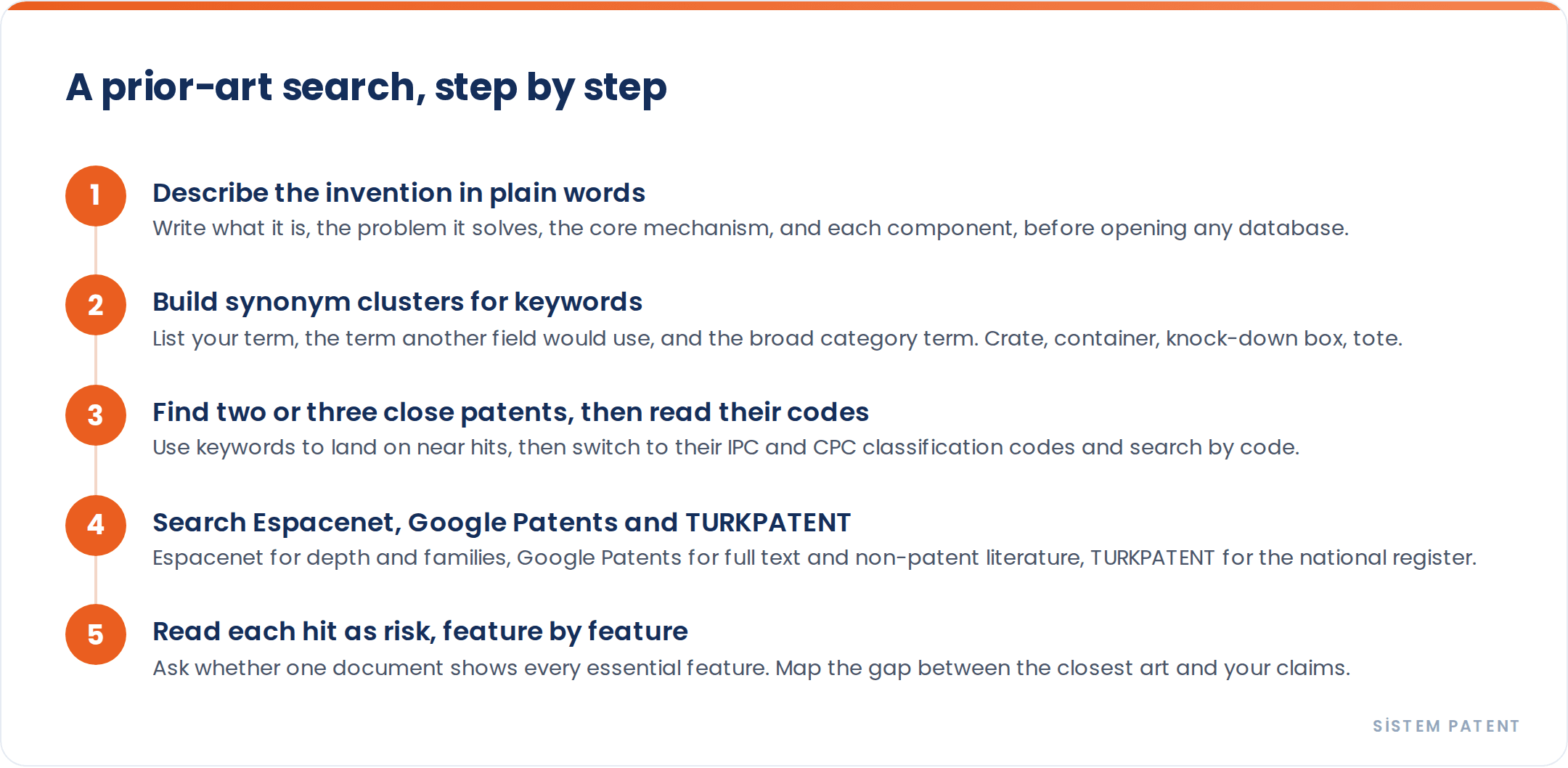
The two systems you will meet are the IPC (International Patent Classification) and the more detailed CPC (Cooperative Patent Classification). The technique that actually works is to start with keywords, find two or three patents that are genuinely close to your idea, then read the classification codes those patents carry and search by code. The codes act like a shelf in a library: once you are standing in the right aisle, you can read across everything filed in that technical area, in every language, no matter what vocabulary each inventor chose.
Turn your invention into search terms before you touch a database
Spend the first hour away from any search box. Write down what the invention actually is in plain technical language, then list the problem it solves, the core mechanism, the components, and the function each part performs. From that, build clusters of synonyms: the term you use, the term an engineer in another field would use, and the broad category term. A folding becomes collapsing, knock-down, foldable, demountable. A search is only as good as the vocabulary you bring to it, and the codes you eventually find depend on the keywords that lead you there.
Where to actually search: Espacenet, Google Patents, and the TURKPATENT database
Three free tools cover most of what an inventor needs before filing. Espacenet, run by the European Patent Office, indexes well over a hundred million patent documents from around the world and is the workhorse for serious searching. Its classification search, its ability to pull the patent family, and its machine translation of foreign documents make it the place to spend most of your time. Search by keyword to find your first close hits, switch to CPC codes to read the whole technical neighbourhood, then follow the cited and citing documents to find the references examiners themselves relied on.
Google Patents is the friendlier front door. Its full-text search reaches into the body of each document, not just the title and abstract, and it surfaces non-patent literature, the journal articles and technical papers that also count as prior art, alongside the patents. It is excellent for a fast first pass and for the moments when you half-remember a product but not its maker. For Turkish national rights, TURKPATENT (the Turkish Patent and Trademark Office) runs its own searchable database of applications and granted patents, which is where you confirm what is already on the national register and check the live status of anything you find. None of these alone is enough; together they give an inventor a genuinely useful picture.
Read the results as risk, not as a yes or no
A search rarely returns a clean verdict. What it returns is a stack of documents, and the skill is in reading how close each one sits to your invention. The question is never whether something vaguely similar exists, because in a mature field it always does. The question is whether a single earlier document already describes every essential feature of your invention. If one document shows all of it, your novelty is gone. If the features are scattered across several documents, novelty may survive, but you have moved into the harder territory of inventive step, where the examiner asks whether combining what was already known would have been obvious to a skilled person.
This is where the closest documents matter most. Line up the two or three references nearest to your idea and compare them feature by feature against what you intend to claim. The gap between them and your invention is, in practice, the space your claims will have to live in. A narrow gap means narrow claims and a hard road. A clear, defensible difference, something your invention does that none of the earlier documents teach, is exactly what a strong application is built around.
What a thorough search changes about the application you file
The point of searching is not only to decide go or no-go. A good search reshapes the application itself. Once you know the closest prior art, you can draft claims that are aimed deliberately at the open space rather than blundering into ground that is already taken, and your patent agent can frame the description to emphasise the genuine difference an examiner will be looking for. Applications written in ignorance of the prior art tend to claim too broadly, draw an early rejection, and get whittled down to something narrow and weak. Applications written after a real search start where they mean to finish.
None of this replaces the formal search the office runs after you file, and a professional patent search before filing reaches places and languages an inventor working alone will miss. But the discipline is the same at every level: assume the invention already exists, go looking for the proof, and let what you find shape the claims. An inventor who searches first walks into the patent registration process knowing where the invention truly stands, instead of paying to find out the hard way.
Picked for You
Related Articles
Turning University Research Into Patents and Revenue
Read More →
The One Disclosure That Kills a Patent: Novelty and the Grace Period Before You File
Read More →