

How to Draft a Strong Patent Specification: Description, Drawings and Enablement
An engineer walks in with a working prototype, a granted-looking idea, and three pages of claims a friend drafted. The claims read well. The description behind them is two paragraphs of marketing copy. Six months later the examiner objects that the claims are not supported by the description, and the parts the inventor most wanted to protect cannot be salvaged because they were never properly explained in the text. The invention was real. The specification was not strong enough to carry it.
This is the most expensive misunderstanding in patent work. The claims define the legal boundary of your monopoly, but the description is what earns the right to draw that boundary. Under the Industrial Property Code (Law No. 6769), a patent that does not disclose the invention clearly and completely enough for a skilled person to carry it out is vulnerable from the day it is filed and can be invalidated later. A strong specification is not a formality you complete after the clever part. It is the clever part.
The description is a contract: full disclosure in exchange for protection
A patent is a bargain with the state. You teach the public how your invention works, in writing, in enough detail that a competent person in the field could reproduce it. In return you receive up to twenty years of exclusive rights. The description is your side of that bargain, and Law No. 6769 holds you to it. If the disclosure is thin, you have not paid for the protection you are asking for.
The legal test is sufficiency of disclosure, often called enablement. The question an examiner and later a court asks is simple to state and hard to satisfy: reading only the application as filed, plus the common general knowledge of the field, could a skilled person actually make and use the invention without inventive effort of their own? If the answer is no, the patent fails on that ground alone, no matter how novel the idea was. You cannot fix a missing disclosure after filing, because adding new technical content later is prohibited as added matter. Whatever the invention is, it has to be fully in the text on day one.
Two failures recur. The first is the inventor who keeps the best trick to themselves, describing the device in general terms while quietly omitting the parameter or step that actually makes it work. That omission does not protect the secret. It guts the patent, because the claim covering that feature is now unsupported. The second is the opposite: pages of background and praise for the invention, with almost nothing on how it is built. Praise is not disclosure. An examiner reads for the embodiment, not the enthusiasm.
Every claim term has to be earned somewhere in the description
The relationship between description and claims is the spine of the whole document, and it runs in one direction. The claims may only reach as far as the description has prepared the ground. A word that appears in a claim but is never explained in the text is a liability, because the examiner can refuse it for lack of support and a later opponent can attack it for the same reason.
Picture the description and the claims as two columns that have to line up. If a claim recites a "resilient coupling member", the description has to tell the reader what makes the coupling resilient, what it is made of or how it is arranged, and how it behaves in use. If a claim recites a numerical range, the description has to show where that range comes from and why its endpoints matter. When the columns line up, every claim term has a home in the text and the patent holds together. When they drift apart, the gaps become the exact places an examiner objects and an opponent strikes.
This is why drafting works best from the inside out. Write the detailed description of how the invention is actually built and used first, in full, then lift the claim language out of vocabulary the description already owns. Claims written before the description, in the abstract, almost always reach for words the text cannot back up. That sequencing discipline is one of the clearest dividing lines between a self-filed application and one prepared with a patent agent, and it is worth getting right before you ever submit. Our team handles the patent application drafting in exactly this order, so the claims never outrun the disclosure that supports them.
What a complete description actually contains
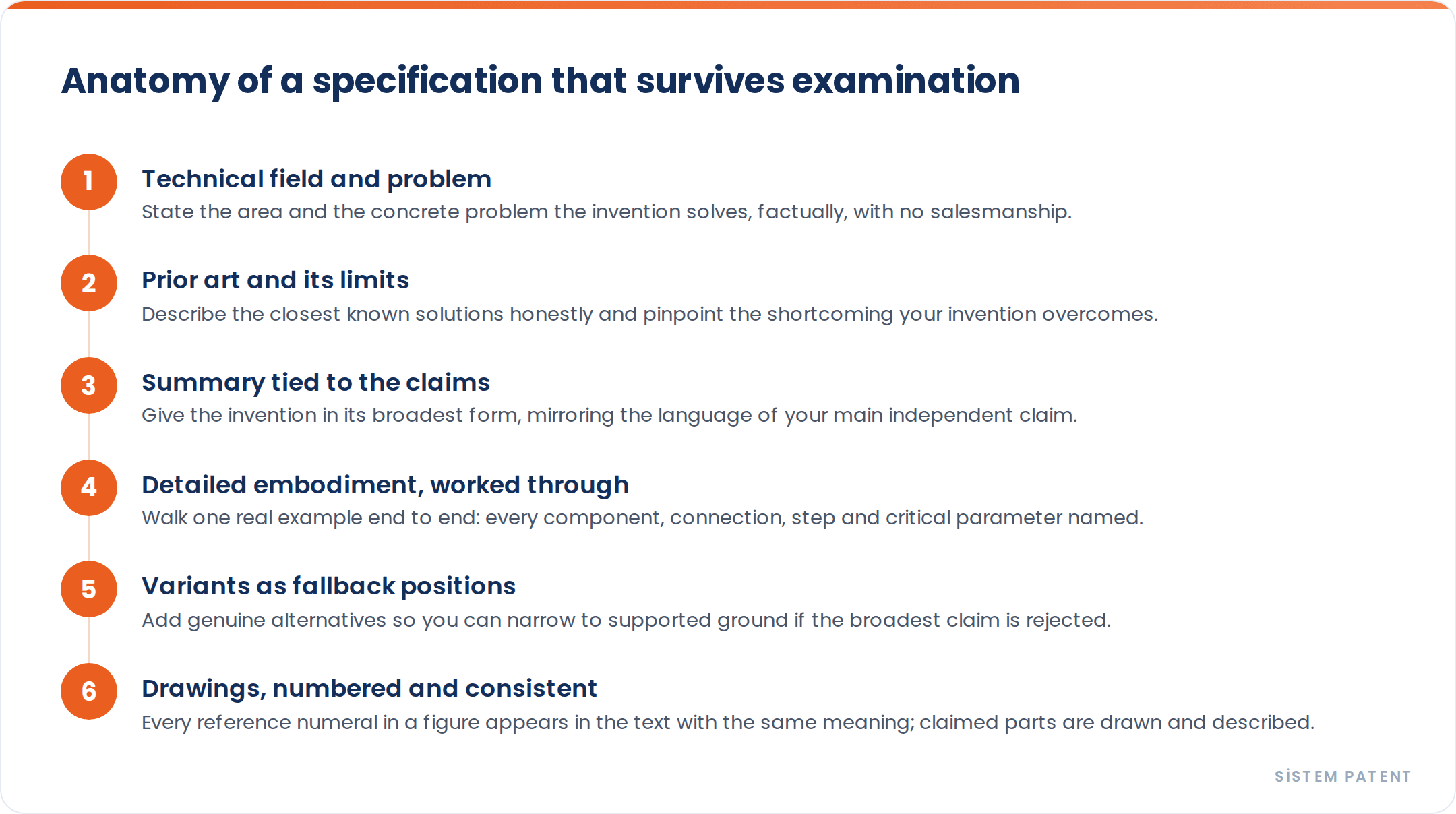
A specification that holds up is built from recognisable parts, each doing a defined job. None of them is decorative.
The technical field and the problem
State plainly what area the invention belongs to and what concrete problem it solves. This frames everything that follows and helps the examiner place your invention against the prior art. Keep it factual. The point is orientation, not salesmanship.
The prior art and what was wrong with it
Describe the closest known solutions honestly and explain their specific shortcomings. This is where you set up the inventive step: the reader needs to understand the limitation your invention overcomes. Hiding unfavourable prior art helps nobody, because the examiner will find it in the search and your credibility carries weight in how borderline objections are resolved.
A summary tied to the independent claims
Give a short statement of the invention in its broadest form, mirroring the language of your main independent claim. This is the bridge between the problem and the detailed embodiment, and it signals to the examiner what you regard as the core of the invention.
At least one detailed embodiment, worked all the way through
This is the heart of the description and where most thin applications fail. Walk through a concrete, real example of the invention in operation, naming every component, every connection, every step, and every parameter that matters to the result. If a value has to fall within a range to work, give the range and a worked example inside it. If there is a preferred way and several alternatives, describe the preferred way fully and then map the alternatives. A skilled reader should be able to close the document and build the thing. That is the standard.
Variants that broaden your fallback positions
A single narrow embodiment can leave you with a single narrow claim. Describing genuine alternatives, different materials, geometries, or sequences that still solve the problem, gives you supported fallback positions to retreat to if your broadest claim is rejected during examination. You can only narrow a claim to something the description already discloses, so the variants you write today are the negotiating room you will have tomorrow.
Drawings carry weight the words cannot
For most mechanical and many electronic inventions, the drawings are not illustrations bolted on at the end. They are part of the disclosure, and the description refers to them by reference numeral so the two read as one. A clear set of figures often communicates structure and assembly faster and more reliably than a paragraph of prose, and a feature shown in a properly labelled drawing and named in the text is far easier to defend than one buried in a sentence.
The discipline is consistency. Every reference numeral in a figure has to appear in the description with the same meaning, and every component the claims rely on should be both drawn and described. Where a process or a data flow is central, a flow diagram does the same work a structural figure does for a device. Drawings cannot introduce subject matter that the words leave out, so they support the text rather than replace it, but a specification with thorough figures consistently survives examination more comfortably than a wall of unbroken description.
Sufficiency is judged through the eyes of the skilled person
Every disclosure test in Law No. 6769 is measured against a specific imaginary reader: the person skilled in the art. This is not a layperson and not a leading expert. It is a competent practitioner in the relevant field who knows the standard techniques and the common general knowledge, but brings no inventive spark of their own. Your description has to be complete enough that this reader, and only the common knowledge of the field, can reproduce the invention.
That standard cuts both ways, and using it well is a drafting skill. You do not have to explain textbook fundamentals the skilled reader already knows, which keeps the document readable. You do have to spell out anything specific to your invention that the field would not simply assume, especially the non-obvious settings, the critical tolerances, and the order of steps that make the difference between a device that works and one that does not. Judging that line correctly is the difference between a tight specification and either an unreadable one or an unsupportable one.
Filing strategy interacts with how the description is written
Drafting does not happen in a vacuum. A serious prior-art search before you write shapes how you frame the problem, where you draw the inventive step, and which variants are worth including, because you want to describe your invention against what is genuinely already out there. Running a proper patent search first means the description is built to clear the closest references rather than colliding with them.
Timing matters too. The application as filed locks your disclosure, so anything you might want to claim later, in Turkey or abroad through later filings that rely on this priority date, has to be present in this text. A description written with international filing in mind carries more detail and more variants from the outset, because the examiners and courts in other systems apply the same enablement logic to the same document. Building toward eventual patent registration is therefore a decision you make at the drafting stage, not after.
A strong specification is the cheapest insurance in your portfolio
The cost of writing the description thoroughly is measured in hours. The cost of a thin one is measured in the protection you thought you had and do not, discovered at the worst possible moment, during examination, during an opposition, or during litigation when a competitor's lawyer reads your patent more carefully than you did. The text you file is the asset. The claims are only as strong as the disclosure standing behind them.
If you are preparing to protect an invention, treat the specification as the work, not the paperwork around it. When you want that disclosure drafted to carry its claims and to survive examination, our patent agents will take it from a working idea to a filed patent application with the description doing its full job.
Picked for You
Related Articles

Turning University Research Into Patents and Revenue
Read More →
The One Disclosure That Kills a Patent: Novelty and the Grace Period Before You File
Read More →