
What Cannot Be Patented in Turkey: Discoveries, Methods, Software and Other Exclusions
An engineer walks in convinced she has a patent. She has worked out a faster way to schedule deliveries, written it up as a clean set of rules, and even coded it. The math is elegant and the savings are real. The hard news is that, framed the way she has framed it, almost none of it can be patented in Turkey. A formula is not an invention, a way of organising a business is not an invention, and a computer program described as such sits on the wrong side of the line. The work is valuable. The category is the problem.
Most rejected filings die not because the idea is weak but because the subject matter was never patentable to begin with. The Industrial Property Code (Law No. 6769) draws a hard boundary around what a patent can cover, and a long list of things that feel like inventions fall outside it. Knowing that boundary before you draft saves the application fee, the agent's time, and the months you would otherwise spend arguing with an examiner about something the statute already settles.
The law lists what it refuses to treat as an invention
Turkish patent law works from a deliberate exclusion list rather than leaving the question to interpretation. Two separate ideas live inside it, and confusing them is where applicants go wrong. The first group is subject matter that is declared not to be an invention at all. The second is subject matter that might be an invention but is barred from patenting for policy reasons. They lead to the same outcome, no patent, but for very different reasons, and the route around each is different.
The first group is the one that catches inventors by surprise, because the items in it are often the cleverest part of the work. Discoveries, scientific theories and mathematical methods are not inventions. Schemes, rules and methods for performing mental acts, for playing games, or for doing business are not inventions. Computer programs, taken on their own, are not inventions. Aesthetic creations, literary and artistic works fall under copyright, not patents. And the mere presentation of information is not an invention either. The thread running through the whole list is the same: a patent protects a concrete technical solution to a technical problem, not knowledge, not a method of thinking, and not a rule for human activity.
A discovery is not an invention, and the difference is everything
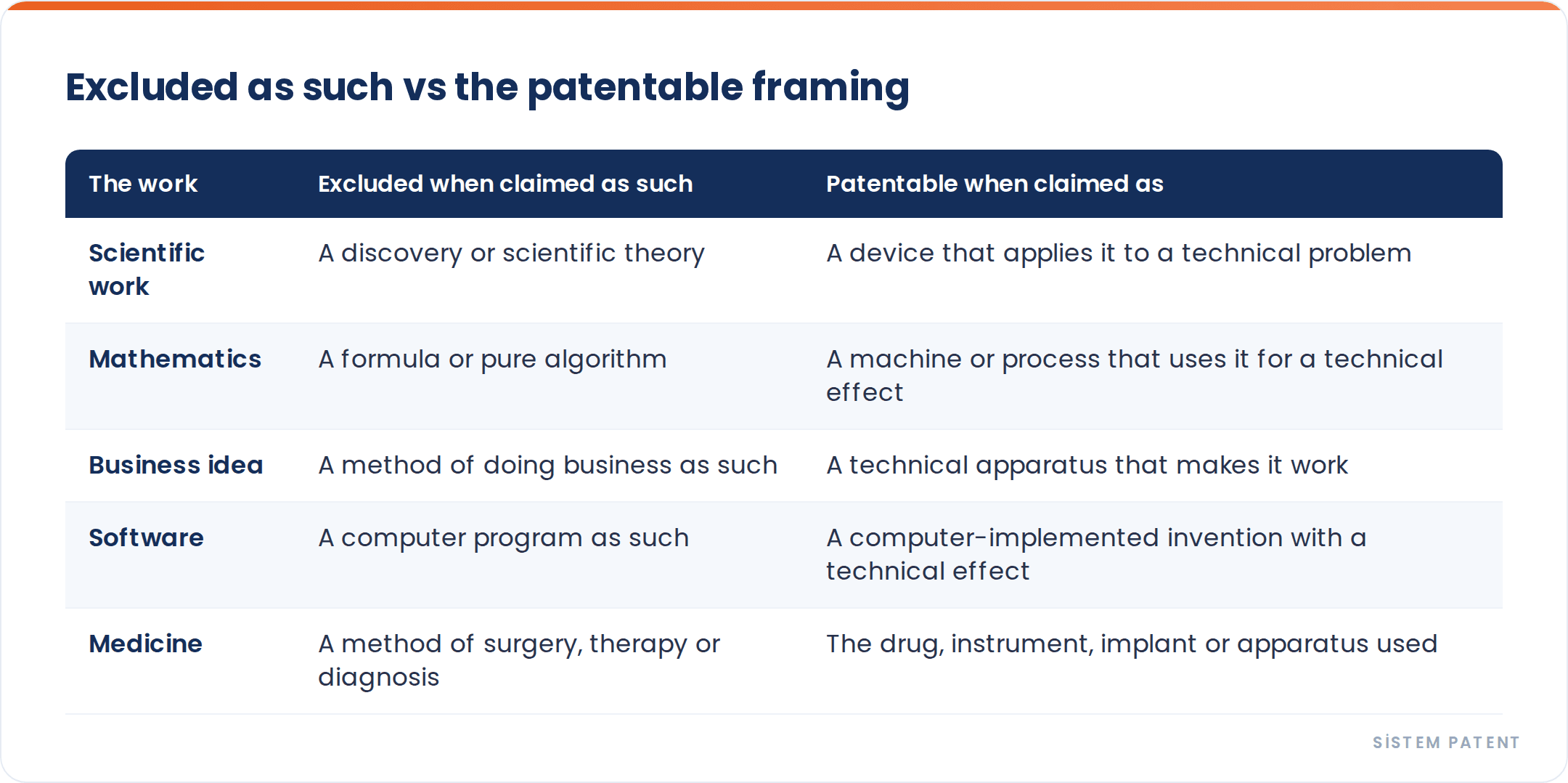
This is the distinction the statute leans on hardest. You discover something that already exists in nature; you invent something that did not exist until you built it. Isolating a previously unknown natural substance and merely describing its properties is a discovery. Finding a new technical use for that substance, and showing how to put it to work, can be an invention. A scientific theory about why a material behaves as it does is excluded. A specific device that applies the theory to solve a real problem is not. The instinct to patent the insight itself is the single most common reason a strong piece of research produces a worthless application. The insight is the discovery. The patent has to attach to what you made with it.
A mathematical method and a business method stay out, but the machine that runs them can come in
The exclusions for mathematical methods and for business methods are written as exclusions of the abstract idea itself. A formula, an algorithm expressed as pure mathematics, or a scheme for running a company, a pricing model, an auction format, a logistics rule, is unpatentable when claimed in the abstract. This is not a Turkish peculiarity. It mirrors the European Patent Convention, and TURKPATENT (the Turkish Patent and Trademark Office) reads it the same way the European Patent Office does.
The important qualifier is the phrase the law attaches to these exclusions: they are excluded only to the extent that the application relates to the subject matter as such. That phrase is the whole game. A claim to a pure algorithm is barred. A claim to a particular machine, process or technical system that uses the algorithm to produce a further technical effect can be allowed, because now you are no longer claiming the maths, you are claiming an invention that happens to rely on it. A new method of trading, by itself, is excluded. A novel technical apparatus that makes the trading possible may be patentable on its own merits. The lesson for drafting is direct: never claim the idea. Claim the technical thing the idea makes work.
Software as such is excluded, and the technical-effect test decides the rest
The software exclusion is the one that causes the most confusion, because Turkey clearly grants patents that involve software every year. Both statements are true at once. A computer program claimed as a program, lines of code, an app, a piece of logic, is excluded as such. A computer-implemented invention that solves a technical problem and produces a technical effect beyond the ordinary running of a computer can be patentable. The dividing line is the technical effect, not the presence or absence of code.
An algorithm that reorders rows in a spreadsheet faster has no technical effect outside the program itself, and stays excluded. Software that controls an antilock braking system, compresses an image by a new technical mechanism, manages memory in a way that makes the hardware run more efficiently, or governs a manufacturing process is doing something technical in the physical or computing sense, and that something can carry a patent. The same invention, described two different ways, can pass or fail purely on how the contribution is framed. Where the technical effect is thin or absent, copyright over the code, and in some cases protection of the surrounding system, is the realistic route rather than a patent that an examiner will refuse. We work through that choice with software clients before a filing rather than after a rejection, because the framing decision is made once, at the start.
Some real inventions are still barred, for reasons of policy rather than category
The second group is different in kind. Here the subject matter could genuinely be an invention, yet the law refuses a patent anyway because society has decided these areas should not be privately monopolised. Inventions whose commercial exploitation would be contrary to public order or to morality are excluded outright. Plant and animal varieties, and essentially biological processes for producing plants or animals, are excluded from patent protection, though plant varieties have their own dedicated breeders' rights regime and microbiological processes are treated differently. Methods of treatment of the human or animal body by surgery or therapy, and diagnostic methods practised on the body, are excluded as well.
That medical exclusion is narrower than it first sounds, and the nuance matters commercially. The treatment method itself, the surgical technique, the way a therapy is administered, cannot be patented, on the principle that a doctor should never be blocked from treating a patient by someone's patent. The substances, devices, instruments and apparatus used in those methods are not excluded. A new drug compound, a surgical instrument, a diagnostic machine, an implant, all of these are squarely patentable. The line runs between the act of treating, which stays free, and the product used to treat, which can be owned.
What to file instead when the patent door is closed
An exclusion closes one door, not the building. Most of the time another instrument fits the same commercial need, and the right move is to match the protection to what you actually have. When an idea fails the patent test for lack of inventive step rather than for being excluded subject matter, a utility model can still protect a new and industrially applicable product, since it does not demand the same inventive step a patent does, which makes it a practical fallback for incremental technical improvements. For software where the value sits in the expression rather than a technical effect, copyright registration over the code is the natural fit. For a product's appearance, an industrial design protects the look. For a brand built around the idea, trademark protection guards the name. The point of understanding the exclusions is not to give up, it is to stop spending patent money on things the patent system will never grant, and to direct each asset to the right register.
Before you commit to a filing, the question worth answering honestly is which side of these lines your idea sits on, because the answer decides everything that follows. If you are unsure whether what you have is a patentable technical solution or an excluded discovery, method or program, our patent agents can assess the subject matter and tell you plainly which route fits. Where a patent is the answer, we take it through to patent registration; where the value is technical but incremental, a utility model often protects it better; and where it is genuinely patentable, getting the patent application framed around the technical contribution from the first draft is what keeps an excluded label off your file.
Picked for You
Related Articles
Turning University Research Into Patents and Revenue
Read More →
The One Disclosure That Kills a Patent: Novelty and the Grace Period Before You File
Read More →