
What Actually Makes an Invention Patentable in Turkey: Novelty, Inventive Step, Industrial Applicability
An engineer in Bursa builds a clamp that holds a workpiece more firmly than anything on his shop floor. It works beautifully, his colleagues are impressed, and he is certain it deserves a patent. Six months later the examiner rejects it, not because the clamp is bad, but because a German catalogue from 2014 already shows the same arrangement of jaw and lever. The clamp is genuinely useful. It is simply not new in the legal sense, and useful is not the test. This gap between a clever product and a patentable one is where most first-time applicants lose money, and it comes down to three questions the law asks of every invention before it grants a monopoly.
Under the Industrial Property Code (Law No. 6769), an invention earns a patent only if it clears all three of these hurdles at once: it must be new, it must involve an inventive step, and it must be capable of industrial application. Fail any one and the application fails, no matter how strong the other two are. Understanding what each test actually measures is the difference between filing with confidence and paying to be told no.
Novelty asks one thing: has anyone, anywhere, shown this before
Novelty is the first gate and the most absolute. An invention is new if it does not form part of the state of the art, and the state of the art is everything made available to the public anywhere in the world, in any language, by any means, before your filing date. There is no geographic limit and no language exception. A thesis defended in Japan, a product sold in Brazil, a patent published in Korea, a forum post, a conference poster: any of these can be the prior disclosure that destroys your novelty, even if you had never heard of it.
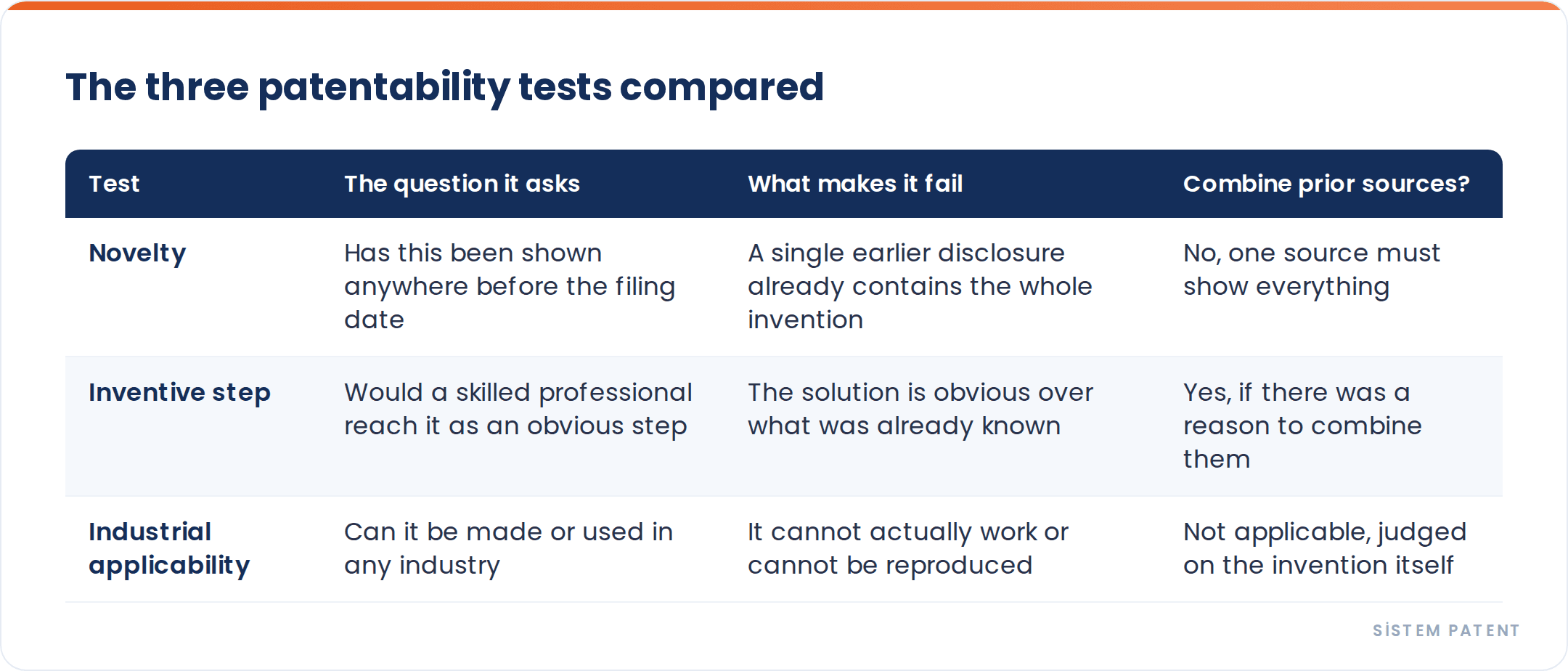
The comparison is strict and mechanical. To defeat novelty, a single prior source has to disclose every feature of your invention in one place. Examiners do not assemble a rejection from three different documents to attack novelty; that is the job of the next test. So an invention is novel as long as no single earlier disclosure already contains the whole of it. The trap most inventors fall into is their own behaviour. Showing a prototype at a trade fair, describing the mechanism in a pitch to investors without a confidentiality agreement, or publishing the design on social media all count as making it available to the public, and your own disclosure can sink your own application.
Turkey does provide a twelve-month grace period for disclosures that came from the inventor, which can sometimes rescue a premature reveal. It is a safety net, not a plan, because many countries grant no such grace and a disclosure that is forgivable in Turkey can still ruin your rights in your export markets. The discipline that protects novelty is plain: file before you tell anyone. A patent search run before filing is how you find the disclosure that would otherwise surface only in the examiner's report, when it is too late to do anything about it.
Inventive step is the test that fails most applications
Clearing novelty is necessary but rarely sufficient. The second question is harder and far more subjective: does the invention involve an inventive step? The legal standard is that the invention must not be obvious to a person skilled in the art, having regard to the state of the art. That phrase carries the whole weight of the test, so it is worth taking apart.
The person skilled in the art is a legal construct, not a real individual. Picture an experienced practitioner in the relevant field, fully aware of everything in the state of the art, competent and methodical but possessing no spark of invention. The question the examiner asks is whether this hypothetical professional, faced with the same problem and armed with the existing knowledge, would have arrived at your solution as an obvious next step. If yes, there is no inventive step, even if nobody had literally done it before. Novelty can survive an obvious combination; inventive step cannot.
This is why an invention can be perfectly new and still unpatentable. Bolting a known sensor onto a known machine in the way anyone in the trade would think to do it is novel in the narrow sense, because no document shows that exact pairing, yet it is obvious, so the inventive step is missing. Unlike novelty, inventive step can be attacked by combining several prior sources, as long as the skilled person would have had a reason to combine them. The arguments that win an inventive-step case usually rest on an unexpected result, the solution to a problem others had failed to crack, or a technical effect the prior art neither achieved nor pointed toward.
Industrial applicability is a low bar, but a real one
The third requirement is the one applicants worry about least and misunderstand most. An invention is capable of industrial application if it can be made or used in any kind of industry, including agriculture. The word industry is read broadly here. It is not confined to factories; it covers practically any field of useful, repeatable activity.
For an ordinary mechanical, chemical or electronic invention this test is almost always met without effort, which is why it gets little attention. Where it bites is at the edges. A device that depends on a physical impossibility, a perpetual-motion machine being the classic example, fails because it cannot actually be made to work. A method whose result cannot be reliably reproduced fails for the same reason. Industrial applicability also marks one boundary between what is patentable and what is excluded altogether: a pure scientific discovery or an abstract method, with no concrete technical use, has nothing to apply industrially.
So while industrial applicability rarely sinks a normal product, it is not a formality you can ignore. It is the reason your application has to describe a workable, repeatable technical solution rather than a theory or an aspiration, and a well-drafted patent application establishes this almost as a side effect of explaining how the invention is built and used.
The three tests work together, and the weakest one decides the case
It helps to read the three requirements as a sequence the examiner runs in order. First, is the claimed invention even the kind of thing the law allows to be patented, and is it capable of industrial application. Then, is it new against the entire state of the art. Then, given what was already known, is it more than an obvious step. An application has to pass all three; the moment it fails one, the rest stops mattering.
That ordering tells you where to spend your effort before you file. Most rejections in practice are novelty and inventive-step rejections, and both turn on the same thing: a clear-eyed view of the prior art. You cannot judge whether your invention is new, and you certainly cannot judge whether it is non-obvious, until you know what already exists in your field. This is the practical case for searching before filing rather than after. The examiner will compare your claims against the state of the art whether or not you have looked first; the only question is whether you find the problems while you can still redraft around them or after you have paid for an application that was never going to grant.
Decide whether you have an invention before you pay to register one
Patentability is not a matter of how impressive or commercially promising an invention is. It is a narrow legal judgement built on three questions: is it new anywhere in the world, is it more than an obvious step to a skilled professional, and can it be applied in industry. A product can be excellent and still fail, usually on novelty or inventive step, and almost always for reasons a proper search would have surfaced early. If you have an invention and want an honest read on whether it clears these three tests before you commit to filing, our patent agents can run the prior-art search and assess patentability first, then move to patent registration only once the invention is on solid ground.
Picked for You
Related Articles
Turning University Research Into Patents and Revenue
Read More →
The One Disclosure That Kills a Patent: Novelty and the Grace Period Before You File
Read More →