

Textile and Fashion Pattern Protection: Registered Design or Copyright for Surface Designs
A small textile studio in Bursa spends a winter developing a print collection: forty original floral and geometric repeats, hand-drawn, then digitised for fabric. The samples go out to buyers in February. By the time the season actually lands on shelves, three of the strongest patterns are showing up on a competitor's fabric at a lower price, the colours shifted just enough to look like a coincidence. The studio owner is sure the prints were copied. The harder question is what right she actually holds, and whether she can prove it fast enough to matter before the season is over.
Surface designs, the prints, motifs and patterns applied to fabric, wallpaper, packaging and fashion, sit in an unusual spot in Turkish IP. They can be protected two different ways at once: as an artistic work under copyright, which arises the moment the design is created, and as a registered industrial design, which you apply for and which gives you a dated entry on a public register. The two rights protect overlapping things but behave very differently when someone copies you. Choosing well, and often choosing both, is what separates a print you can defend from one you merely own on paper.
Copyright exists the instant you draw the pattern, and that is also its weakness
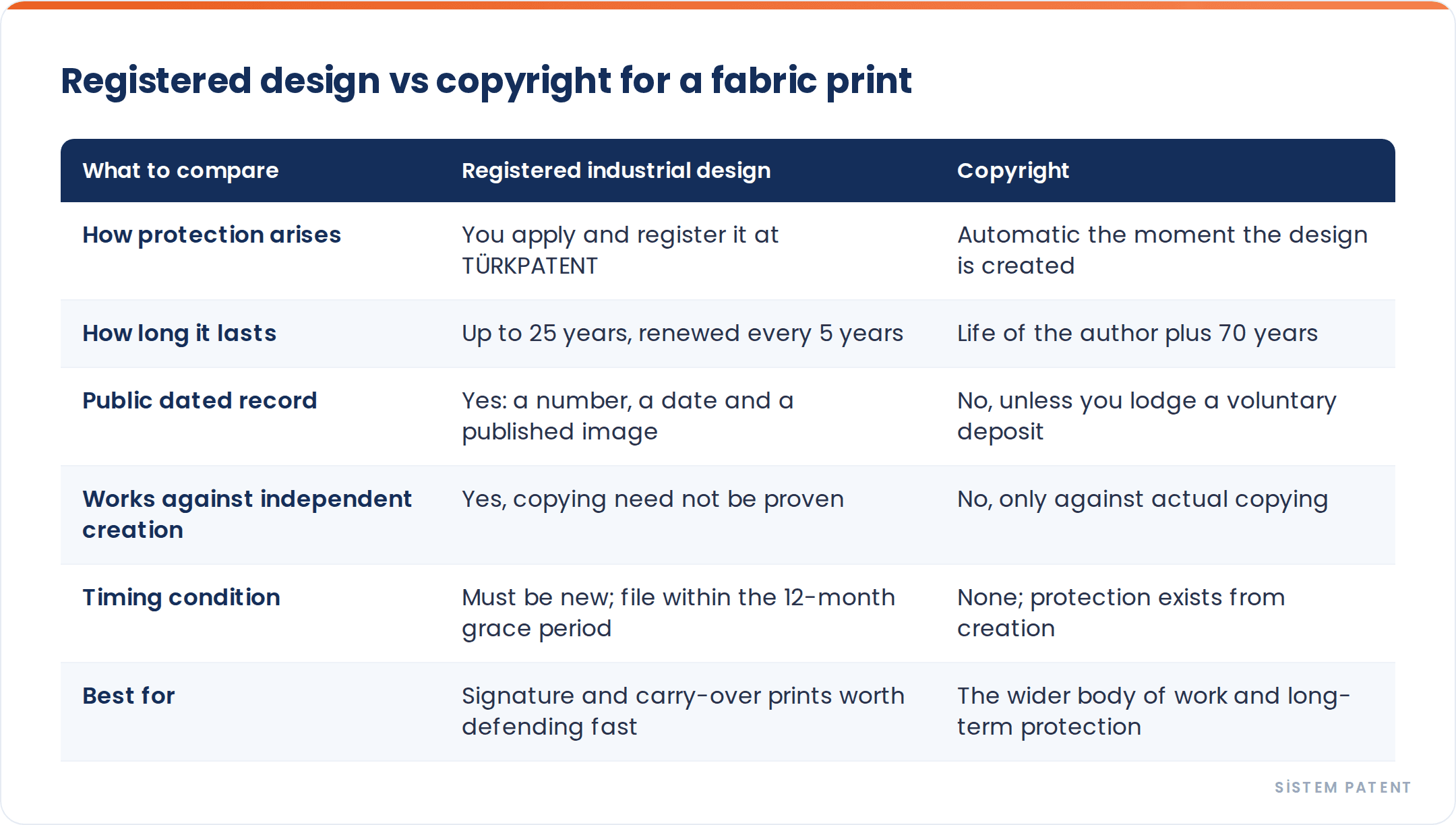
Under Turkish copyright law (Law No. 5846 on Intellectual and Artistic Works), an original surface design is protected as an artistic work from the moment it is fixed, with no registration required. The designer holds the economic and moral rights automatically, and the protection lasts for the life of the author plus seventy years, far longer than any registered design. For a pattern with genuine creative character, this is real protection, and it costs nothing to come into being.
The catch is everything to do with proof. Because copyright needs no registration, it also creates no public record of who made what and when. If you end up in front of a court, the burden falls on you to show two things: that the design is original enough to qualify as a protected work, and that you created it before the other side did. With an undated sketchbook and a folder of files whose timestamps a defendant can pick apart, that is a slow and uncertain fight. This is exactly why a voluntary deposit matters. Recording the work through a fine-art copyright registration does not create the copyright, the copyright already exists, but it fixes a dated, official record that the work was in your hands on a specific day. When the dispute is about who was first, a timestamp you can point to changes the conversation entirely.
There is a second limit worth naming. Copyright protects against actual copying, not against independent creation. If a competitor genuinely arrives at a similar geometric repeat without ever seeing yours, copyright gives you nothing, because nothing was copied. In a field like textiles, where a handful of trend forecasts push every studio toward the same palettes and motifs each season, "we got there on our own" is a defence that comes up more often than designers expect.
A registered design turns your pattern into a right you can enforce on sight
The industrial design route works on a different logic. Under the Industrial Property Code (Law No. 6769), the appearance of a product, including a two-dimensional surface pattern, can be registered as an industrial design if it is new and has individual character. You file the design with TÜRKPATENT (the Turkish Patent and Trademark Office), and once it is registered you hold an exclusive right to that appearance for up to twenty-five years, renewed in five-year terms. A registered industrial design is a property right with a number, a date and a published image, which is precisely what copyright lacks.
That public, dated right changes enforcement. A registered design protects against any later design that does not produce a different overall impression on the informed user, and crucially it does so whether or not the infringer copied you. Independent creation is no defence against a registered right. So in the floral-repeat scenario, a registered design lets the studio act on the similarity itself, rather than first having to prove the competitor saw the original. The certificate is the evidence.
Two conditions decide whether registration is even available, and both turn on timing. The design must be new, meaning no identical design has been made available to the public before your filing, and it must have individual character against what already exists. Turkish law softens the first condition with a twelve-month grace period: a designer's own disclosure, showing the print to buyers, posting it on social media, putting it in a lookbook, does not destroy novelty if the application is filed within twelve months of that first reveal. That grace window is generous, but it is a rescue, not a plan. The disciplined move is to register before the collection goes public, so the right is in place the day the prints hit the market rather than racing the clock afterward.
For a fast seasonal collection, you register selectively rather than everything
Fashion and textiles move faster than the design register was built for. A studio may produce hundreds of prints a year, most with a commercial life of a single season. Registering every one of them individually is neither affordable nor sensible, and this is the practical objection most designers raise the moment registration is suggested.
The answer is to treat registration as a triage decision, not an all-or-nothing one. The patterns that anchor a collection, the signature print that defines the season, the motif that will carry into next year's range, the design already drawing buyer attention, are the ones worth a registered right, because those are the ones competitors target and the ones whose loss actually hurts. Turkish practice helps here: a single application can carry multiple designs in the same Locarno class, which makes protecting a related family of prints in one filing far more economical than registering each alone. The throwaway colourways and the fillers can rest on copyright, where the dated deposit gives you a fallback if one of them unexpectedly becomes a target.
It is also worth knowing that registration is not the only design protection in play. In several markets a surface design enjoys a short period of unregistered design protection against deliberate copying, which can cover the gap for the bulk of a fast collection that never gets formally registered. That unregistered layer is narrower and shorter than a registered right, and it varies by jurisdiction, so for a print you genuinely care about it backstops rather than replaces a filing. Where a Turkish studio sells into the EU, the European unregistered and registered design systems become part of the same plan, and an international design registration through the Hague System lets a signature print be protected across multiple export markets from a single application.
The same fabric print can be protected by copyright and a registered design at once
The most common mistake is treating these as a binary, copyright or registration, when Turkish law lets them stack. A single floral repeat can be, simultaneously, an artistic work under copyright and a registered industrial design, and the two rights reinforce each other rather than cancel out. This cumulative protection is the strongest position a serious print can hold.
The reason to hold both is that they fail in different places. The registered design gives you a fast, clean enforcement right against lookalikes, with no need to prove copying, but it expires after twenty-five years and depends on having filed in time. Copyright gives you a much longer term and reaches situations a registration might not, for instance where the copying is of the underlying artwork rather than its application to a particular product, and the dated deposit shores up its weak point. When a competitor copies a signature print, having both means you can lead with whichever right gives the cleaner path: the registered design for a quick, evidence-light stop, copyright where the registration is unavailable or the conduct is plainly deliberate copying.
One caution keeps this from being automatic. Cumulative protection only delivers if the rights actually sit with the right party. Prints are very often drawn by freelance designers or external studios, and under Turkish law the person who creates the work is the first owner of its copyright unless there is a written assignment. A brand that commissions a print but never takes a signed transfer of rights can find it owns the fabric but not the design on it. Getting the assignment in writing, at the point of commission, is what makes both the copyright deposit and the design registration worth anything later.
How to protect a print collection in practice
The workable approach is neither "rely on copyright and hope" nor "register everything". Treat the collection as a portfolio. Secure written assignments from every designer who contributes a pattern, so ownership is never in doubt. Register the signature and carry-over prints as industrial designs before the collection goes public, grouping related patterns into single applications to keep the cost proportionate. Lodge a dated copyright deposit for the wider body of work so the throwaways are not left entirely undefended. Then, for the prints heading into export markets, extend the registered protection abroad before launch rather than after the copies appear.
If you are building a print or fashion collection and want to decide which patterns deserve a registered right and which can rest on copyright, our trademark and design agents can map the collection and file the ones that matter. Start by protecting your signature prints with an industrial design registration, and keep the dated copyright record behind the rest of the range.
Picked for You
Related Articles

Registered vs Unregistered Design Rights: What You Get for Free and Why It Is Rarely Enough
Read More →
Turn Your Design Investment Into a Tax Position: Design Centres, R&D and IP Incentives
Read More →