

Someone Copied Your Trademark: A Step-by-Step Response Plan

You are scrolling a marketplace and there it is: your brand name on a product you never made, or a logo close enough that your own customers have started asking which listing is the real one. The instinct is to fire off an angry message that night. That instinct is usually the most expensive move available. The owners who come out ahead treat infringement as a sequence, not a reflex, and they decide each step with a clear head and a paper trail behind them.
A trademark is only as strong as the way you defend it. The good news is that defending it rarely starts in a courtroom. Most copying is resolved long before that, by owners who know which lever to pull and in what order. This is the ladder, from the first screenshot to the last resort, so you can answer copying with a response that fits the threat instead of one that overreaches or stalls.
Confirm you actually hold the right before you act
The first question is not what the copier did. It is what you own. An enforcement move stands on your registration, so before anything else, pin down the exact mark you hold, the goods and services classes it covers, and whether the registration is live and current. A registered mark gives you the clean statutory rights under the Industrial Property Code (Law No. 6769) to stop a confusingly similar use. If the mark was never registered, or lapsed, or sits in different classes from the goods the copier is selling, your options narrow and your bargaining power drops, and that changes every later decision.
This is also the moment to be honest about the overlap. Real infringement turns on a likelihood of confusion: similar sign, similar or related goods, the same buyers. A name that merely resembles yours in an unrelated sector may not be infringement at all. Map their use against your registration first, because a demand built on a right you do not actually have is the fastest way to turn a strong position into a weak one. If you are unsure whether the registration covers the goods in question, that gap is exactly what a trademark registration review settles before you spend money escalating.
Build the evidence file before you tip them off
The single most common mistake is warning the copier before you have captured what they are doing. The moment they sense a complaint, the listing changes, the post disappears, the packaging is reshot, and the proof you needed evaporates. Collect first, contact second.
Capture dated screenshots of every infringing use: the listing, the storefront, the social profile, the packaging, the advertisement. Save the URLs and the seller or account identity. Where it matters, buy a sample so you have the physical product and a receipt that ties the goods to a date and a seller. For online uses, a timestamped record or a notarised capture carries far more weight later than a phone photo. The aim is a file that shows, beyond argument, who is using what sign, on which goods, since when, and to whom they are selling.
Most copying ends with a well-judged notice, not a lawsuit
With the right confirmed and the evidence banked, the proportionate first contact in most cases is a formal warning. A cease-and-desist notice tells the other side who you are, what you own, what they are doing wrong, and what you want them to do, by when. Sent well, it resolves the matter quietly: many copyists fold the instant they learn the mark is registered and the owner is paying attention.
Tone and accuracy decide whether the notice works or backfires. Overstate your rights, demand the impossible, or threaten action you cannot bring, and a savvy recipient calls the bluff or, worse, files for a declaration that they are not infringing. A measured, specific demand grounded in your actual registration is far harder to ignore and far safer to send. In Turkey the formal route for this is a notarised warning, an ihtarname, which also creates a dated record that you put the other side on notice, which matters if the dispute ever escalates. A properly drafted trademark cease-and-desist notice is where most infringement stories should both begin and end.
What a notice should and should not promise
State the registration number and the classes, identify the infringing use precisely, set a clear deadline, and name the remedy you want: stop the use, pull the listing, hand over infringing stock, account for sales. Do not invent damages figures, do not threaten criminal consequences you have not assessed, and do not set a deadline so short it reads as a bluff. The letter should sound like the opening of a process you are fully prepared to continue, because sometimes you will have to.
When the copy is a pending application, oppose it inside the window
Not every threat is already on the shelf. Sometimes the copy surfaces as a trademark application working its way through TÜRKPATENT (the Turkish Patent and Trademark Office), published for the world to object to. Here the cleanest defence is not a letter to the applicant but a formal objection to the office itself. Once a mark is published, third parties have a set period to oppose it, and stopping a confusing mark before it ever registers is cheaper and cleaner than unwinding it afterward.
This is why what you do months earlier matters so much. You can only oppose a published application if you know it exists, and applications that collide with your brand appear constantly without anyone telling you. An ongoing trademark monitoring service surfaces these filings while the opposition window is still open, turning a deadline you would otherwise miss into a routine decision. When a watch flags a conflicting application in time, a publication opposition can shut the copy down at the registry, before it becomes a registered right you would later have to attack in court.
Court and criminal action are the top of the ladder, not the first rung
When a notice is ignored, when the copying is deliberate and commercial, when real money or market share is bleeding away, the dispute moves to the specialised IP courts. There the owner of a registered mark can seek an injunction to stop the use, the seizure and destruction of infringing goods, and compensation for the harm done. Deliberate counterfeiting can also carry criminal liability, which is a different and heavier track. These tools are powerful, and they are also slower and costlier than everything below them, which is exactly why they sit at the top of the ladder rather than the bottom.
The discipline that makes litigation succeed is the discipline you applied on the lower rungs. A live registration, a clean evidence file, and a documented notice are the foundation a court case is built on. Owners who reach for the lawsuit first, before confirming their rights or preserving proof, often find the strongest weapon in the room is the one they are least ready to use.
The owner who copies a process beats the owner who reacts
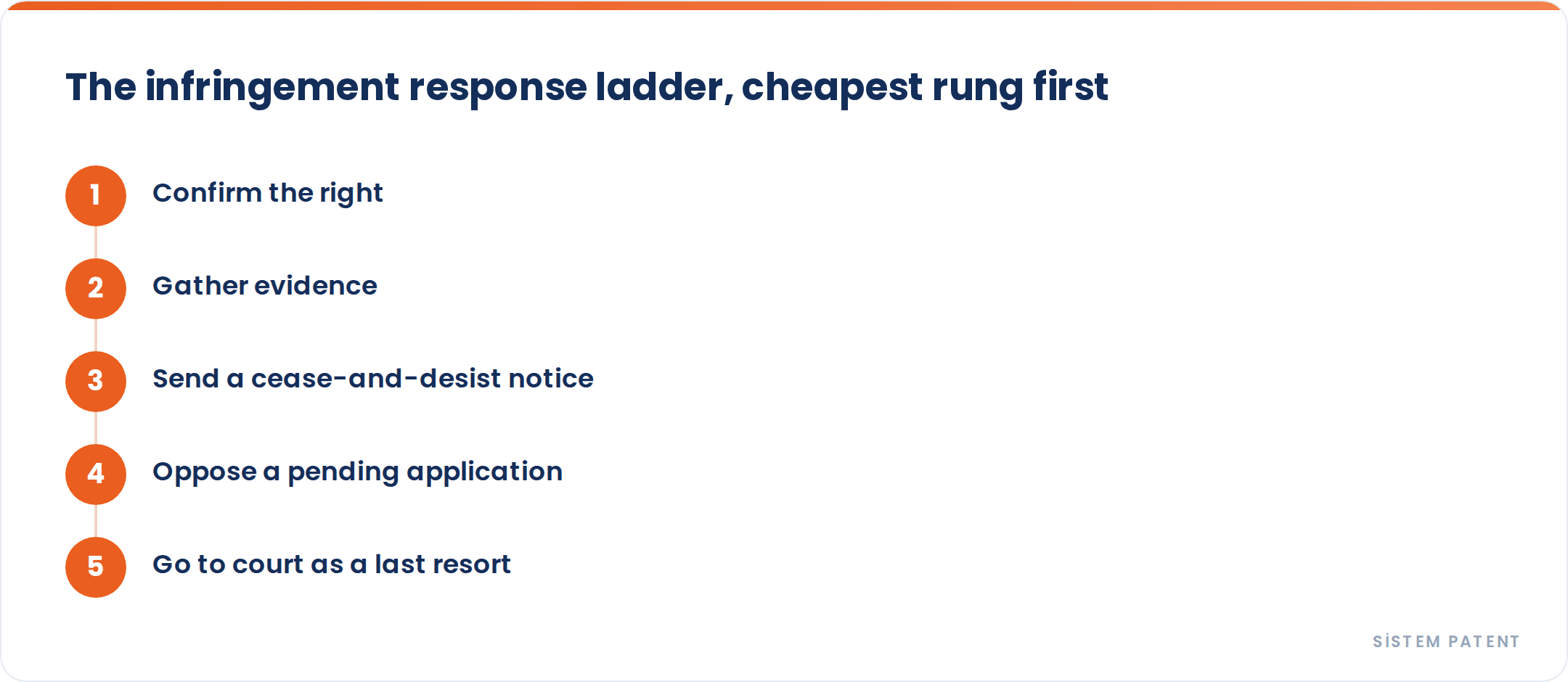
Copying feels personal, and the temptation is to answer it with speed and heat. The owners who win answer it with order instead. Confirm the right, capture the evidence, send a measured notice, oppose at the registry when the threat is still an application, and reserve the courts for the cases that truly need them. Each rung is cheaper and faster than the one above it, and most disputes never have to climb far.
If something is copying your brand right now, the first move is to confirm exactly what your trademark registration covers and to preserve the evidence before you make contact. From there our team can match the response to the threat, from an ihtarname to an opposition to court, so you answer copying with the step that actually ends it.
Picked for You
Related Articles

Trademark Watching Is a Standing Habit, Not a One-Time Check
Read More →
The Two-Month Opposition Window Is a Weapon, Not a Deadline
Read More →