
Shape and 3D Trademarks: When the Form of a Product Becomes a Brand
Picture the contoured glass Coca-Cola bottle with no label on it, or the curved waist of a Toblerone bar. You recognise the brand before you read a single word, because the shape itself does the work a name usually does. That recognition is exactly what a three-dimensional trademark protects: not the words on the package, but the form of the product or its container as a sign of origin. In Turkey these are registrable, and a small but valuable number of brands own the shape of the thing they sell.
The catch is that most shapes do not qualify, and the ones that fail tend to fail for the same two reasons. A shape that is too ordinary tells the consumer nothing about who made the product. A shape that is too useful belongs to engineering, not to one company. Between those two walls sits a narrow lane where a 3D mark is both registrable and worth the trouble. This piece is about finding that lane before you spend on a filing.
A 3D trademark protects form, not function or decoration
Under the Industrial Property Code (Law No. 6769), a trademark can consist of the shape of goods or of their packaging, provided the sign can be represented clearly on the register and is capable of distinguishing the goods of one undertaking from those of another. The three-dimensional shape is treated as the sign itself. So the bottle is the mark, the bar is the mark, the distinctive form of a perfume flacon is the mark.
This is a different right from the two that sit closest to it, and brands routinely confuse them. Industrial Design protects the appearance of a product as something new and individual, for a limited term. A 3D trademark protects a shape as an indicator of commercial source, and like any trademark it can be renewed indefinitely while it stays in use. The two can overlap on the same object, but they answer different questions. Design asks whether the look is new. Trademark asks whether the public reads the shape as your shape.
That distinction drives everything that follows. An examiner at TÜRKPATENT (the Turkish Patent and Trademark Office) is not asking whether your bottle is attractive or original. The examiner is asking whether an average consumer, seeing that shape on a shelf, would treat it as a badge of origin rather than as just one more way to hold a litre of liquid.
Most shapes are refused for being ordinary
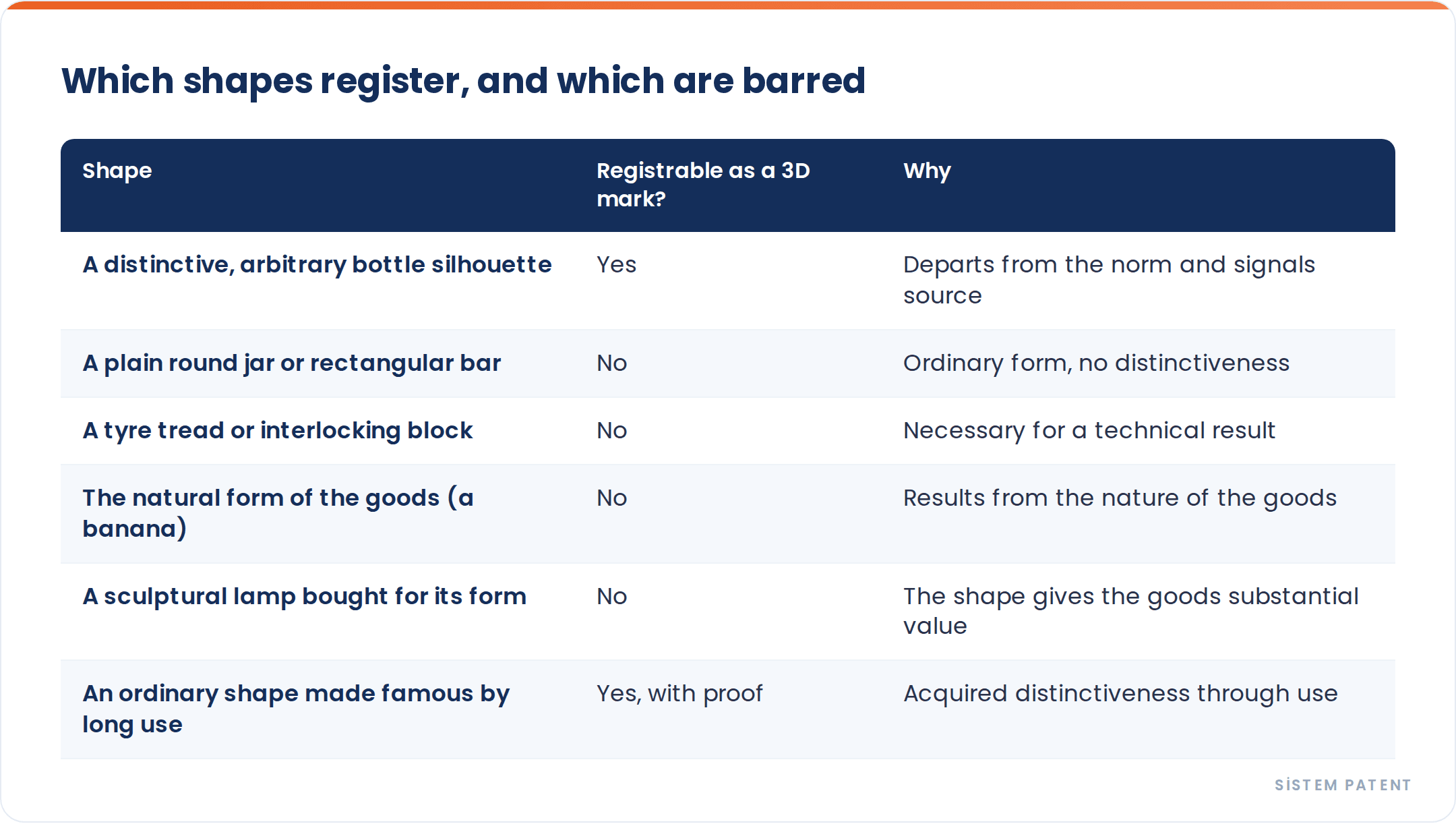
The first wall is distinctiveness. A shape that consumers see as a normal, expected form for that kind of product carries no message about source, so it cannot be a trademark. A plain rectangular soap bar, a standard cylindrical jar, a basic round bottle: none of these tells anyone who made the product, because every producer uses shapes like them. The more your shape looks like the category norm, the weaker it is as a mark.
Turkish practice, like the European approach it tracks, sets a genuinely high bar here. Consumers are not in the habit of assuming the shape of a product, absent any word or logo, signals where it came from. They read the name and the label for that. So a 3D shape usually has to depart significantly from the norms and customs of its sector before an examiner will accept that the public could see it as distinctive on its own.
There is a route through this wall, and it is the same one that rescues a descriptive word mark: acquired distinctiveness. A shape that was ordinary at the outset can earn trademark status if the owner proves that, through long and intensive use, the public has come to recognise that shape as identifying one source. That is how several famous container shapes were eventually registered. It is also slow, evidence-heavy work, and it is far cheaper to start with a shape that already stands apart than to spend years manufacturing the recognition after the fact.
A shape that is purely functional cannot be a trademark at all
The second wall is harder, because there is no way through it. Law No. 6769 bars registration of a sign that consists exclusively of the shape, or another characteristic, which results from the nature of the goods themselves, which is necessary to obtain a technical result, or which gives substantial value to the goods. These are absolute grounds. Unlike ordinariness, they cannot be cured by evidence of recognition, no matter how famous the product becomes.
The logic is straightforward and it is about keeping competition open. If one company could trademark the only practical shape for a product, or the shape that makes the product work, it would hold a permanent monopoly over an engineering solution that the patent system is supposed to govern for a limited time. So the shape of a tyre tread that grips the road, the form of a building block that interlocks, the head of a razor that follows the contour of a face: where the form is dictated by the technical job it does, trademark law refuses to lock it up forever.
The same applies to a shape that results from the nature of the goods. The natural form of a banana cannot be a banana trademark. And a shape that gives substantial value to the goods, where the form is the very thing the customer is buying, such as the aesthetic shape of a sculptural lamp, falls on the design and copyright side of the line rather than the trademark side.
The practical line to hold is this. If the attractive or recognisable part of your shape happens to coincide with the part that makes the product function, you have a problem, and dressing it up as branding will not move an examiner. The shapes that register are the ones where the distinctive form is essentially arbitrary: the product would work just as well in a duller shape, and the company chose this one to be recognised by.
How to frame a 3D application so it is not read as a technical result
Because the functionality bar is fatal, the way you present a 3D application matters as much as the shape itself. A few disciplines separate the filings that survive from the ones that draw an immediate refusal.
First, isolate the non-functional features. Map your shape and ask, feature by feature, which elements exist to make the product work and which exist purely to be distinctive. The grip ridges on a bottle are functional. The unusual sweeping curve of its silhouette may not be. An application built around the arbitrary, recognisable elements stands a far better chance than one that claims the whole object, technical parts included.
Second, get the representation right. A 3D mark is represented on the register through views of the shape, and the set of views defines exactly what you are claiming. Too little detail and the mark is unclear. Too much, or views cluttered with functional detail, and you hand the examiner the argument that the shape is dictated by its function. The representation is not paperwork. It is the legal boundary of the right, in the same way that a trademark registration for a word fixes the exact sign you can enforce.
Third, choose the classes for the goods the shape actually identifies. A bottle shape is a mark for the beverage, or for the bottle as a product, depending on what you sell. Filing in the wrong Nice classes protects nothing useful, and over-claiming invites later challenge. This is ordinary trademark discipline, but it is easy to neglect when the mark is a physical object rather than a name.
Fourth, and most often overlooked, pair the shape with the marks that carry the brand more cheaply. A 3D registration is powerful but narrow and hard-won. For most businesses the workhorses remain the word mark and the figurative mark. Securing the logo through a logo registration and the name through a standard filing usually does more day-to-day protective work than the shape mark, which is best treated as a high-value addition once the form has genuinely become recognisable, not as the first line of defence.
When a shape mark is worth pursuing
A 3D trademark earns its keep in a specific situation: the product or its packaging has a form the market already associates with you, that form is not driven by how the product works, and competitors are starting to borrow it. A signature bottle that knockoffs are imitating, a packaging silhouette that has become shorthand for your brand, a product profile that customers recognise across a crowded shelf. In those cases the shape mark gives you something no other right does, a renewable, potentially permanent hold on the form itself.
For most products, though, the honest answer is that the shape is too ordinary or too functional to register, and the brand is better served by protecting its name through a standard trademark application, securing its logo, and guarding its overall trade dress. The way to know which case you are in is to test the shape against both walls, distinctiveness and functionality, before you file rather than after a refusal. If you think the form of your product or packaging has crossed into being a genuine brand signal, our trademark agents can assess whether it is registrable as a 3D mark and frame the application so the functional elements do not sink it.
Picked for You