

Owning a Single Colour as a Trademark: The High Bar and How Brands Clear It
Picture a hardware brand whose power tools are a specific shade of blue, the same blue on every drill, every charger, every box, for fifteen years. A competitor launches a near-identical product in almost the same blue. The brand wants to stop it, and the first question its lawyers ask is the one most owners never think about: do you actually own that colour, or have you just used it for a long time? Long use and legal ownership are not the same thing, and for a single colour the gap between them is wide.
A colour mark is one of the hardest things to register in Turkish trademark practice, and the reason is not bureaucratic stubbornness. It is a deliberate brake. There are only so many colours, and the register cannot let one company fence off a basic shade for a whole category while everyone else makes do with the rest. So the law sets the threshold high on purpose, and clearing it takes evidence most brands have never bothered to keep.
A colour is not refused for being a colour, but it starts with no distinctiveness
The Industrial Property Code (Law No. 6769) does not list colour among the things that can never be a trademark. A single colour, or a defined combination of colours, can be registered in principle. The problem is the absolute ground that sits in front of it: a sign that lacks distinctive character cannot be registered, and on its own a colour almost never has that character at the start.
The reasoning is simple once you see it from the consumer's side. When someone sees a red box on a shelf, red tells them nothing about who made it. Red is decoration, or it is a category convention, or it is just the colour the designer liked. It does not point to one commercial source the way a word or a logo does. Until a colour does that job, pointing the public to one specific producer, it is not performing the one function a trademark exists to perform.
This is why a colour application cannot lean on the same logic as a word mark or a figurative mark. With those, you can argue inherent distinctiveness from the sign itself. With a bare colour, that argument is closed to you almost every time. You have to prove the public has learned the connection.
Acquired distinctiveness is the real route, and it runs on evidence
The path that actually works for a single colour is acquired distinctiveness, sometimes called secondary meaning. The idea is that a colour which started as plain decoration can, through long and intensive use, come to function as a brand in the public mind. When a relevant share of consumers sees that shade on those goods and thinks of one company, the colour has earned the distinctiveness it lacked at the outset.
Proving that is an evidentiary exercise, and it is where most attempts fall apart. You are not asserting that the colour is distinctive. You are demonstrating it, to an examiner who starts from deep scepticism. The kind of material that carries weight includes the following.
- Duration and intensity of use. How many years the exact shade has been used on the exact goods, consistently, not drifting from one season to the next.
- Market reach. Sales volumes, market share, and the geographic spread of the products carrying the colour.
- Promotional investment. Advertising spend and campaigns that put the colour at the centre of the brand's identity rather than treating it as background.
- Consumer recognition evidence. Market surveys are often the strongest single item, showing that a meaningful proportion of the public links the colour to one source without being told the name.
- Third-party signals. Press coverage, industry references, and the way trade and media already describe the colour as belonging to the brand.
None of this is assembled the week before filing. The brands that win these cases built the record over years, usually without realising they were building it, simply by using one colour with discipline and documenting how the market responded.
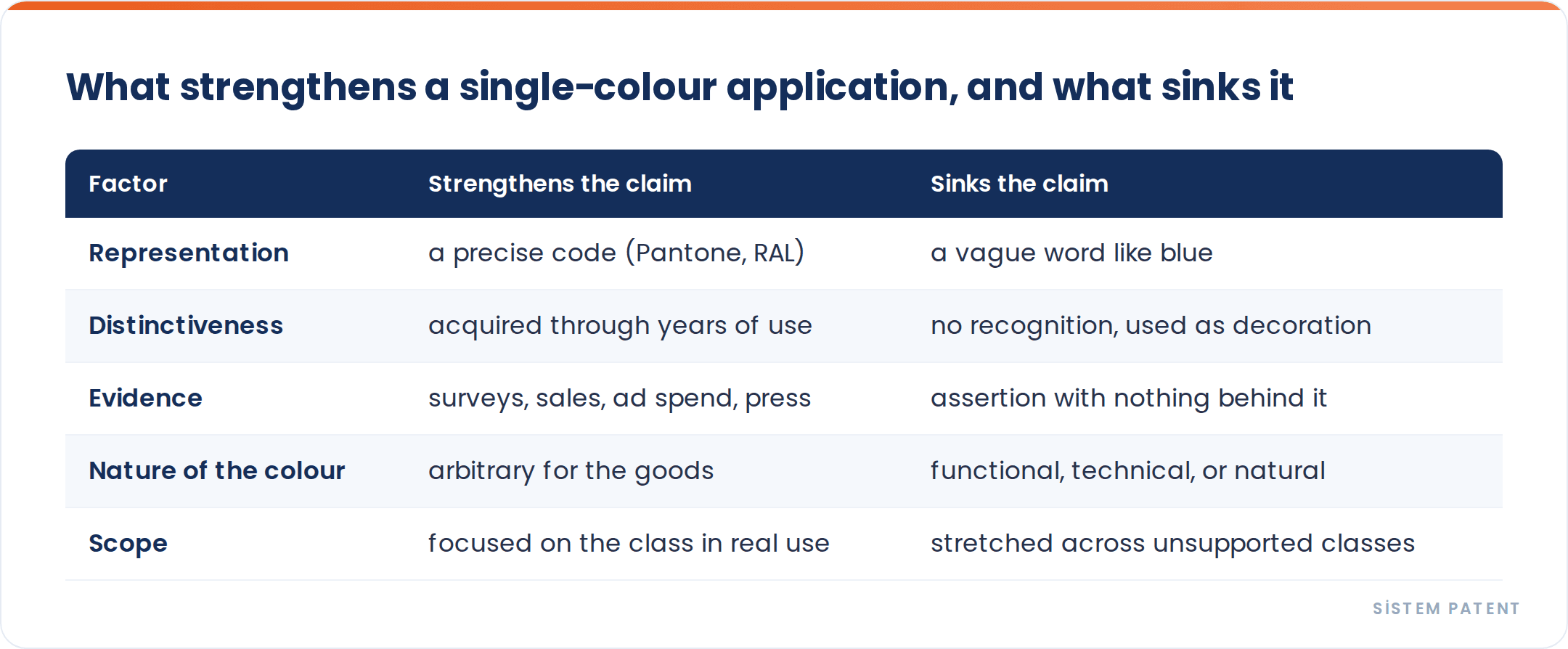
The mirror image is just as important. Some things actively sink a colour application, and knowing them shapes both the filing and the years of brand behaviour that precede it.
A precise colour code beats the word for the colour
One technical point decides more colour cases than people expect: how the colour is represented in the application. Claiming "blue" is hopeless. Blue covers thousands of shades, the scope is impossibly broad, and an examiner will not hand a company a monopoly that wide. The representation has to pin the colour down to a single, objective, reproducible value.
In practice that means an internationally recognised colour code, a Pantone, RAL, or similar reference, so the protected shade is fixed and unambiguous. This matters for two reasons. It satisfies the requirement that a mark be represented clearly and precisely, and it defines the exact boundary you can later enforce. A registration tied to one code protects that shade and shades confusingly close to it. It does not hand you the whole colour family. Getting the code right at filing is the difference between a defensible right and a vague claim that collapses the first time you try to use it.
Functional and natural colours are barred for a separate reason
Even with strong evidence, some colours cannot be monopolised because of what the colour does rather than how well it is known. A colour that results from the nature of the goods, that is technically necessary, or that gives the product a substantial value on its own runs into a functionality bar that no amount of recognition cures. The orange of safety equipment, where the colour exists to be seen and to warn, is the classic example. Letting one firm own a safety colour would put every competitor at a real disadvantage for a reason that has nothing to do with branding. The same logic blocks colours that are simply standard or expected in a sector.
A colour mark protects one class, not your whole business
A registered colour is locked to the goods and services it covers, defined through the Nice classification. The hardware brand's blue, protected for power tools, does not reach into cosmetics or beverages. This is a feature, not a gap. The justification for letting anyone own a colour at all is that the public associates it with one source in one specific market. Outside that market the association does not exist, so the protection does not either.
The practical consequence is that a colour strategy has to be deliberate about scope. You identify the classes where the colour genuinely operates as your brand and where you have the evidence to back it, and you concentrate the claim there. Stretching a colour claim across classes you cannot support invites refusal and, later, cancellation for the parts that were never used. A focused colour registration in the right class, sitting alongside your core word and logo rights, is far stronger than an overreaching one. Because the threshold is so demanding, this is rarely a place to file on your own instinct; a candid read of whether your evidence is actually there is worth more than an optimistic application.
Where a colour fits in a wider protection plan
For most businesses, a colour is the last layer of brand protection, not the first. The name and the logo do the heavy lifting, and those should be secured well before a colour is ever contemplated. A single colour earns a place on the agenda once the brand is established, the shade has been used consistently for years, and the market genuinely reads that colour as yours.
If your brand is built on a signature colour and you are weighing whether it can be protected, the honest starting point is an audit of the evidence rather than a rush to file. A clear-eyed look at your years of use, your market data, and any recognition you can show will tell you whether a colour application stands a real chance or whether your effort is better spent reinforcing the foundations first. Our team can assess that evidence, advise on whether the colour clears the bar, and place it correctly within your trademark registration strategy. Where the shade is already a powerful asset, it can also feed into a case for well-known trademark status, and a proper clearance search first confirms no one else has reached the same colour in your class before you commit.
Picked for You