
The Two-Month Opposition Window Is a Weapon, Not a Deadline
A competitor files a mark that sits one letter away from yours, in the same class, for the same shelf. You only find out because someone on your team happened to scroll the Official Trademark Bulletin that week. You now have a narrow, fixed stretch of time to act, and after it closes the mark you could have stopped will proceed toward registration as a registered right you must then attack in a slower, costlier forum. Most brand owners treat that stretch of time as a deadline to dread. The ones who protect their brands well treat it as the cheapest enforcement lever they own.
Under the Industrial Property Code (Law No. 6769), a trademark application in Turkey is not registered the moment it passes examination. After TURKPATENT (the Turkish Patent and Trademark Office) clears it on formal and absolute grounds, the application is published in the Official Trademark Bulletin, and a two-month window opens in which any third party with a relevant right can file an opposition. That window is the single point in the process where you can block a conflicting mark before it ever becomes a registration. Understanding what it is, how to feed it, and when to use it changes opposition from a fire drill into a standing part of how you defend a brand.
The publication window is your one pre-registration intercept
The opposition period exists because examination alone cannot catch everything. An examiner reviews a new application on absolute grounds, meaning defects in the mark itself, and checks for earlier identical or confusingly similar marks on the register. What the examiner cannot fully weigh is the commercial reality only you know: how close the goods actually sit, how your customers would read the two names side by side, whether the applicant is acting in bad faith, and the reputation your mark has built that no database field records. The publication window hands that judgment to the people who hold the earlier rights.
File an opposition inside the two months and the application is suspended while TURKPATENT weighs your grounds. Miss the window and the application continues toward registration. At that point your remedy shifts to invalidation, a separate and heavier route, generally before the courts rather than a quick administrative filing. The strategic point is blunt: the same conflict costs far less to stop at publication than to unwind after the mark has registered. The window is not a formality you survive. It is the moment your earlier right is at its most powerful and your opponent's at its weakest.
You cannot oppose what you never see, so watching feeds the weapon
An opposition window is worthless if it closes before you know an application existed. This is the link most owners miss. The bulletin publishes a large volume of new applications, the two-month clock starts whether or not you are reading, and nobody at the office calls to tell you a rival has filed near your mark. The only reliable way to be in the room while the window is open is to watch the register continuously.
This is where trademark monitoring stops being optional. A standing watch on your mark and its close variants surfaces conflicting applications the moment they publish, with enough of the two months left to act on them deliberately rather than in a panic on the final day. A single clearance search before you filed told you the landscape on one date. It says nothing about the application a competitor lodges next quarter. Watching converts the opposition window from a deadline you might catch into a feed of decisions you make on your own timetable.
The practical effect is that opposition and monitoring are one system, not two services. The watch produces the alert. The alert gives you the days you need to assess the conflict and choose a response. Without the watch, you are relying on luck to be looking at the bulletin in the right week, and luck is not an enforcement strategy.
Not every conflict deserves an opposition
Treating the window as a weapon does not mean firing it at everything that moves. The skill is triage. When an alert lands, the first question is whether the new application genuinely threatens your rights, and that turns on the same factors an examiner and a court use to judge a conflict: how similar the marks are visually, phonetically and conceptually, how close the goods or services sit, and how likely an ordinary buyer is to be confused about the source.
A mark that is near-identical to yours in the same class is a clear candidate to oppose. A mark that merely shares a common descriptive word, sits in an unrelated class, and would confuse nobody is usually noise you can let pass. Between those poles lies the judgment that earns its keep. Some conflicts are real but narrow, and the right move is to oppose only the overlapping goods or to open a conversation rather than a fight. The grounds available are wider than many owners realise: an opposition can rest on an earlier registered or applied-for mark, on likelihood of confusion, on a well-known mark even outside its registered class, and on bad-faith filing where the applicant is plainly trying to hijack your name.
Oppose when the right is clear, negotiate when the overlap is narrow
Once a conflict is real, the choice is rarely opposition or nothing. The window also buys time to negotiate from a position of strength, because a pending opposition is real pressure the other side feels. A formal opposition is the right tool when the applicant is a clear infringer or bad-faith filer, when the goods overlap squarely, or when letting the mark register would weaken your ability to enforce against others later. Here you want the application stopped, and you want the record to show you defended your mark.
Negotiation earns its place when both parties have a legitimate interest and the overlap is containable. Two businesses with genuinely different products that happen to share a word can often settle through a coexistence arrangement that fences off territory, goods, or presentation, ending the dispute faster and cheaper than a fought opposition. The pending opposition is what brings the other side to the table; the settlement is what closes it without a protracted proceeding. The deadline pressure that feels threatening when you are unprepared works in your favour once you are the one holding the earlier right and the watch that caught the filing in time.
A short decision path when an alert lands
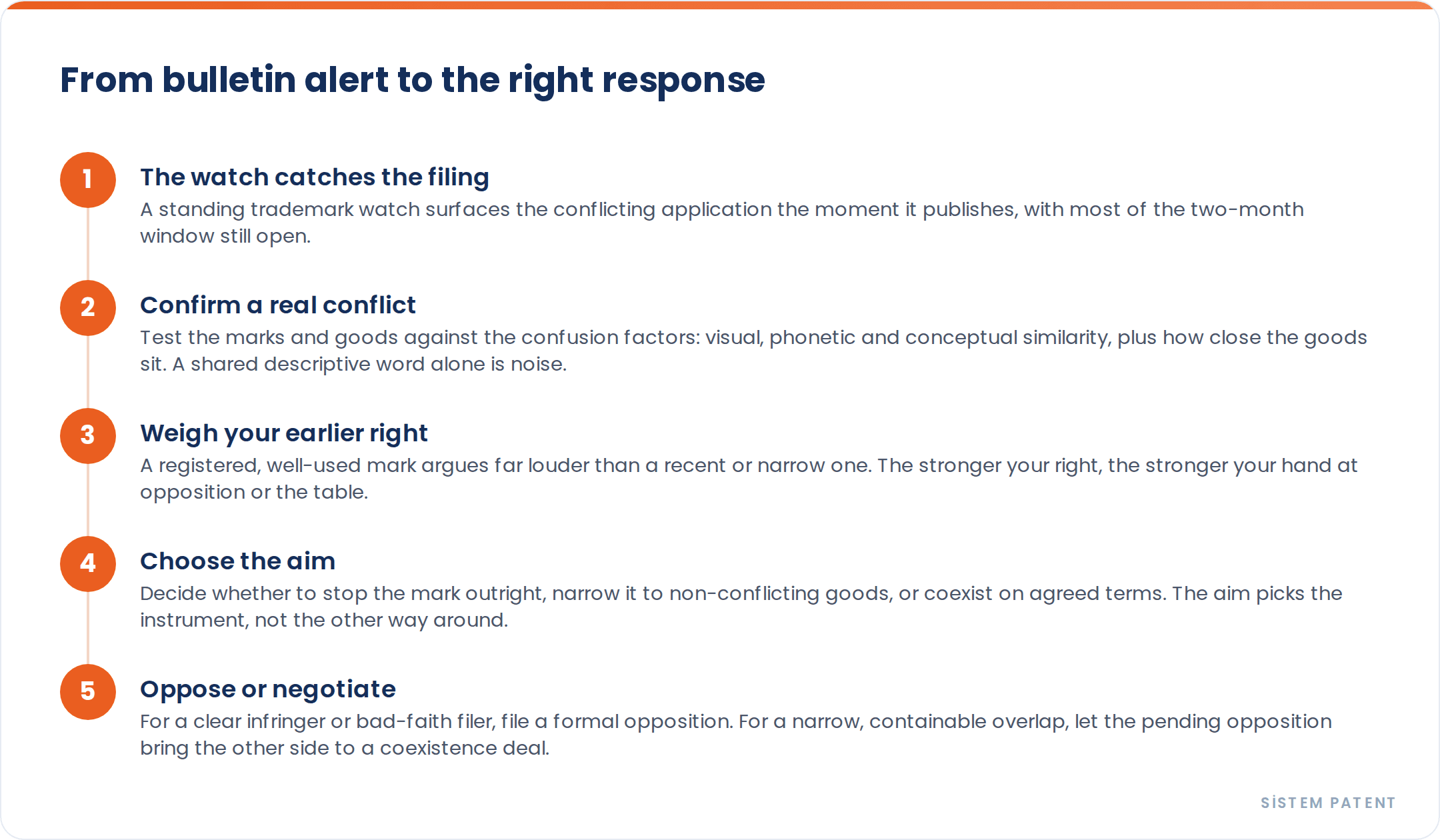
When a watch surfaces a new application, walk it through a fixed sequence so the response is proportionate rather than reflexive. First, confirm the marks and the goods actually conflict under the confusion factors, not just that a word looks familiar. Second, weigh the strength of your earlier right, because a registered, well-used mark argues louder than a recent or narrow one. Third, decide the aim: stop the mark outright, narrow it to non-conflicting goods, or coexist on agreed terms. Only then choose the instrument, an opposition through the publication and opposition process, a negotiated settlement, or, for a borderline filing, a deliberate decision to let it pass and keep watching. The window gives you room to run this path; the watch is what gets you into the window in the first place.
The owners who win at opposition are simply the ones still watching
The two-month period is the same length for everyone. What separates the brand that stops a copycat at publication from the one that wakes up to a registered conflict it must now sue to remove is not legal firepower. It is whether anyone was watching when the window opened. Opposition is a sharp tool, but it only cuts inside a narrow span of time, and that span passes silently for an owner who is not paying attention.
If your brand matters enough to register, it matters enough to watch, because the right to oppose is only as good as your knowledge that there is something to oppose. Pairing a standing trademark watch with a clear plan for the opposition window turns a date on a calendar into real control over who gets to register near your name. Our team can set up that watch and stand ready to act the moment a conflicting application publishes, so the window works for you instead of against you.
Picked for You