
Work-for-Hire and Freelancers: Who Owns the Design, Code or Copy You Paid For
A startup hires a freelance designer to build its brand identity. Logo, packaging, the whole visual system. The invoice is paid in full, the files are delivered, everyone shakes hands. Eighteen months later the company tries to license that identity to a franchise partner and a lawyer asks one question: do you actually own it? The honest answer, far too often, is no. The money changed hands, but the copyright never did. In Turkey this is the single most expensive misunderstanding a business can carry, and almost nobody notices it until the moment it costs them a deal.
The belief sits deep: I paid for it, so it is mine. It feels obviously true. It is also wrong for almost every creative deliverable produced by someone who is not your employee. Paying a freelancer, an agency or a contractor buys you the file and the right to use it for the purpose you agreed. It does not, by itself, make you the owner of the copyright in that work. Ownership is a separate thing, governed by its own rules, and those rules do not move just because an invoice was settled.
Paying the invoice buys the file, not the copyright
Under the Law on Intellectual and Artistic Works (Law No. 5846), copyright is born in the natural person who created the work. The designer who drew the logo, the developer who wrote the code, the writer who produced the copy: each of them is the author, and the author holds the rights the instant the work takes shape. There is no Turkish equivalent of the American work-for-hire rule that automatically vests ownership in the person who commissioned and paid for a creation. The default in Turkey runs the other way. Absent a written transfer, the creator keeps the economic rights and licenses you, at most, to use the result.
That distinction between owning and being allowed to use is where businesses get hurt. When you commission a piece of work and pay for it, what you receive by default is an implied permission to use it for the purpose both sides clearly had in mind. The shop owner who paid for a logo can put that logo on the shop. What the owner cannot safely do is treat the logo as a company asset to license, modify freely, register, transfer in a sale, or stop the designer from reusing elsewhere. Those are owner's powers, and they stay with the author until a written assignment moves them.
The clause that has to be in every freelance and agency contract
The fix is not complicated, which is what makes the failure to do it so frustrating. Law No. 6769 governs industrial property, but for copyright the controlling rule is in Law No. 5846, and it is strict on form. A transfer of economic rights in a work has to be in writing, and it has to specify which rights are being transferred. A verbal promise does not do it. An invoice does not do it. A line in an email that says all rights belong to the client is far weaker than people assume, because the statute wants an express written assignment that names the rights at stake.
A workable assignment clause does a few specific things, and each one matters on its own:
- It names the economic rights being transferred. The rights of reproduction, distribution, adaptation, public communication and the rest are listed in the law as separate rights. A clause that says the author transfers all economic rights under Law No. 5846, including reproduction, distribution, processing and adaptation, communication to the public and broadcasting, leaves nothing ambiguous.
- It covers future modifications and derivatives. The right to alter the work and to create adaptations is a distinct right under the law. Without it, you own the original logo but may need the designer's permission to change it, which defeats the point of owning a brand asset that has to evolve.
- It is unlimited in time and territory where you need that. A transfer can be carved up by duration, place and scope. If you want the asset for good and everywhere, the clause has to say so, because a narrow grant is read narrowly.
- It addresses moral rights. Moral rights cannot be assigned in Turkey. They stay with the author by law. What a contract can do is have the author consent to the exercise of certain moral rights, so the business can modify, publish without attribution where appropriate, and use the work commercially without later objection.
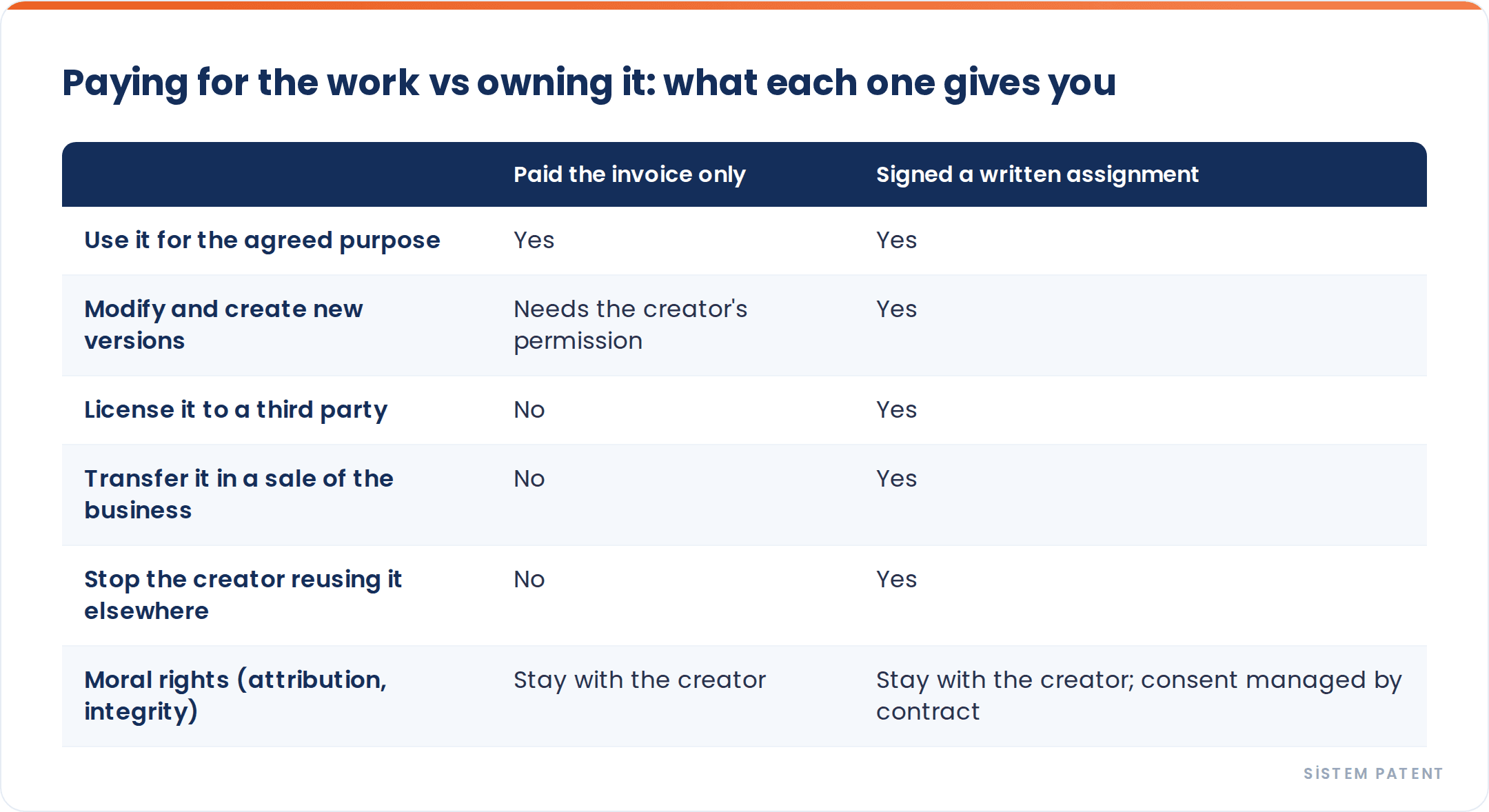
Moral rights deserve a closer look because they surprise people who assume a full assignment means total control. The right to be recognised as the author, the right to decide on disclosure, the right to object to distortion of the work: these are personal to the creator and survive any transfer of the economic rights. You cannot buy them. A designer who assigned every economic right to you still, in principle, retains the moral connection to the work. A careful contract manages this by securing the author's written consent to the specific uses you need, rather than pretending the moral rights were sold.
Employees and freelancers are not the same case
There is one situation where ownership leans toward the business by default, and it is worth separating clearly so it is not over-applied. Work created by an actual employee, within the scope of their duties, falls under a different part of Law No. 5846, and the economic rights there can be exercised by the employer. Even so, this is narrower and more conditional than founders tend to believe, and it does not stretch to cover the freelancer, the agency, the contractor or the friend who designed your logo as a favour. The moment the creator is outside an employment relationship, you are back in assignment territory, and only a written transfer puts ownership where you want it.
This is exactly why the same project can produce two completely different ownership outcomes. The in-house designer's logo may belong to the company through the employment route. The freelance designer's logo, paid for at three times the cost, may still belong to the freelancer because no one signed an assignment. Two near-identical deliverables, two opposite legal positions, decided entirely by the contract that was or was not in place. Treating these cases as the same is how a business ends up confidently using assets it does not own.
What to do about work you have already paid for
Most companies reading this will realise they have a back catalogue of commissioned work with no assignment behind it. Years of logos, website builds, photography, copy and code, all paid for, none of it formally transferred. That gap is fixable, and the time to fix it is before it matters, not during a due-diligence review when an investor's lawyer finds it. A confirmatory assignment, signed now by the original creator, can move the rights retroactively and put the ownership chain back on solid ground. It is far easier to obtain that signature while the relationship is warm than to track down a freelancer years later, when you are about to sell the business and suddenly need them.
Securing the rights is the first layer, and documenting them is the natural second. Once an assignment is in hand, many businesses create a dated work registration record for the deliverables they expect to defend, so that both the authorship and the transfer sit on file rather than living only in a contract folder someone has to find. Where the work is a creative piece in its own right, putting a formal copyright application in place gives that specific work a dated, official footing and pairs naturally with the assignment that made you the owner in the first place.
The pattern across all of this is simple to state and easy to neglect. Copyright in Turkey starts with the human who made the work, an invoice does not move it, and only a written assignment that names the rights, covers modifications, and handles moral rights puts true ownership in your hands. Build that clause into every freelance and agency engagement before the work starts, and close the gap on the work you already paid for. The cost of doing it now is a paragraph in a contract. The cost of skipping it is discovering, at the worst possible moment, that the brand you built belongs to someone else.
If your contracts do not already contain a proper assignment, or you are not sure what your past freelancers actually transferred, this is worth getting right before your next deal depends on it. Sistem Patent can review your engagement terms, draft the assignment language your agreements are missing, and help you put the resulting works on the record under intellectual property law so that what you paid for is genuinely yours to use, license and sell.
Picked for You
Related Articles
Protecting an Online Course or E-Book From Piracy and Resale
Read More →
Who Owns Your Reels: A Creator's Guide to Copyright, Music and Brand Deals
Read More →