
The One Disclosure That Kills a Patent: Novelty and the Grace Period Before You File
A founder spends two years building a new pump mechanism, demos it at an industry fair to gauge interest, collects a dozen warm leads, and goes home thrilled. Six months later, with orders coming in, the company finally sits down to file a patent. The application is refused. Not because a competitor got there first, but because the founder's own fair demo is now prior art against the very invention it was meant to sell.
This is the cruelest way to lose a patent, because the inventor does it to themselves and almost never sees it coming. The rule behind it is one of the oldest in patent law, and it is unforgiving: an invention has to be new on the day you file. Anything that became public before that date, including your own actions, can be held against you. The standard sits in the Industrial Property Code (Law No. 6769), and understanding it is the difference between owning an invention and merely having invented something.
Novelty in Turkey is absolute, and the whole world counts
The first thing to understand is how wide the net is. Turkish patent law uses absolute novelty. An invention is new only if it has not been made available to the public anywhere in the world, in any language, in any form, before the filing date (or the priority date, if you claim one). There is no domestic-only carve-out and no grace for obscure disclosures.
Made available to the public is read broadly. It covers a written description, an oral disclosure, use, a sale, or any other route by which the technical content of the invention reached someone who was free to pass it on. A patent application published in Japan, a doctoral thesis sitting in a university library in Germany, a YouTube video, a product already on a shelf: each can sink novelty in Turkey if it predates your filing and discloses the same invention. The examiner who runs a patent search against your application is looking for exactly this kind of earlier disclosure, and your own pre-filing publicity is fair game.
One nuance matters here. A disclosure destroys novelty only if it actually teaches the invention, enough for a skilled person to understand and reproduce it. A teaser image that shows a closed black box, with no working detail, may not be an enabling disclosure. A demo that lets engineers watch the mechanism operate, or a spec sheet that explains how it works, almost certainly is. The safe assumption is that anything substantive you reveal counts against you.
The disclosures that quietly destroy patentability
The dangerous part is that the acts which kill novelty are the same acts a normal business does to grow. None of them feels like publishing a patent, yet each can do the same damage.
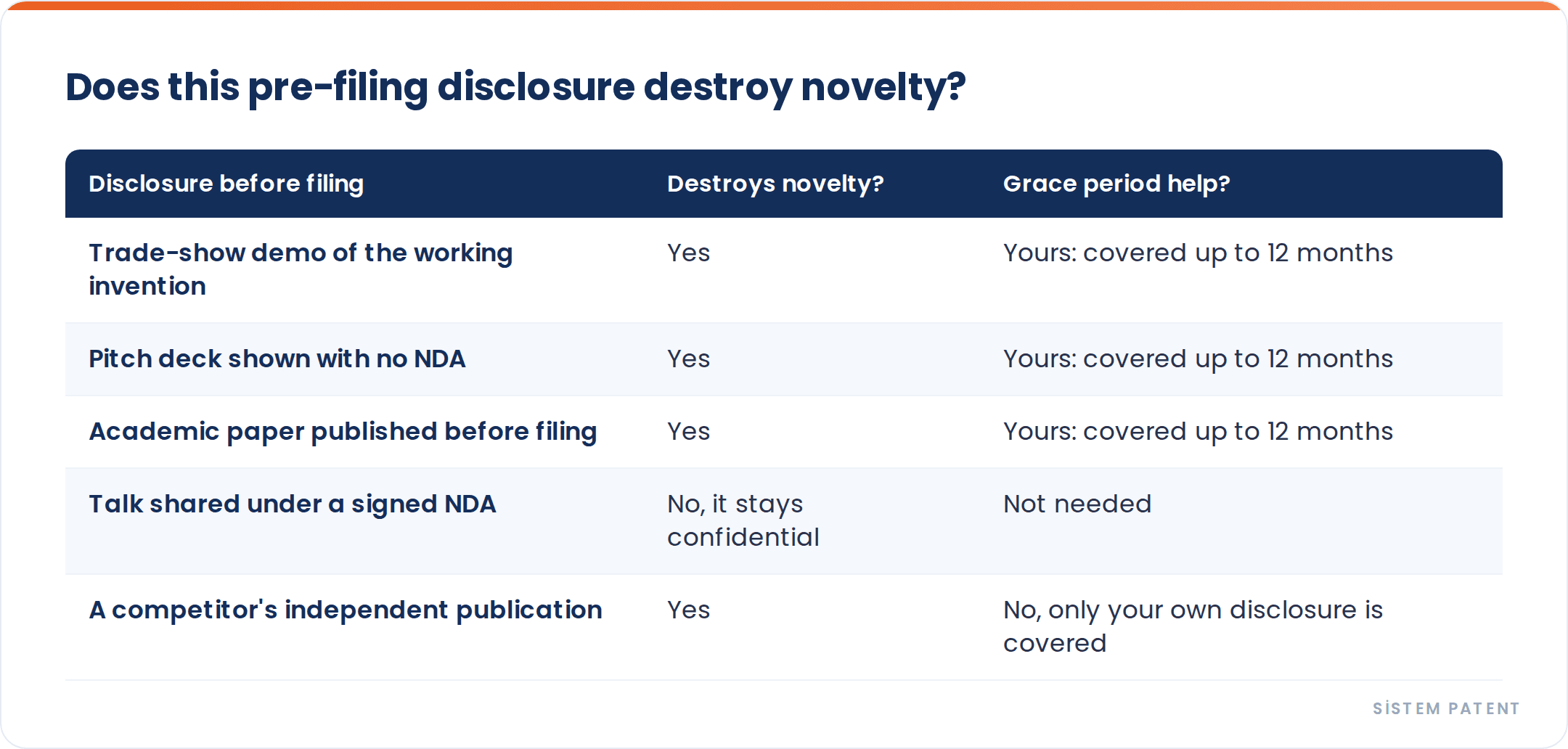
- Trade shows and product launches. Showing the working invention, demonstrating it, or handing out detailed brochures puts the technical content in public hands.
- Pitch decks and investor meetings. Slides that explain how the invention works, shared without a confidentiality agreement, are a disclosure. Pitching to an open demo-day audience is worse than a one-to-one meeting.
- Academic papers and conference talks. The single most common way university inventions are lost. A paper accepted and published before filing is textbook prior art, and the publication date, not the writing date, is what counts.
- Sales and pre-orders. Selling the product, or even offering it for sale in a way that reveals the invention, can start the clock against you.
- Websites, social media, and crowdfunding. A detailed launch page or a Kickstarter campaign that shows the inner workings is published to the entire world the moment it goes live.
What unites these is intent mismatch. The founder means to build a market; the law sees a public disclosure. The invention does not have to be copied by anyone for the harm to land. The mere fact that the information became public, by the inventor's own hand, is enough.
The grace period is a safety net, not a strategy
Turkish law does soften the rule in one important way. Law No. 6769 provides a twelve-month grace period for the inventor's own disclosures. If the invention was made public by the inventor (or by someone who got the information from the inventor, including through an abuse) within the twelve months before the filing date, that disclosure does not count as prior art against the application.
This is real protection, and it has rescued many inventors who demoed or published before they understood the rules. But treating it as a plan rather than a parachute is a mistake, for three reasons.
First, the grace period is a Turkish (and broadly European) feature, and it is not mirrored everywhere. Several major jurisdictions apply strict novelty with little or no equivalent grace for the inventor's own disclosure. A demo that Turkish law forgives can permanently bar you from a patent in a market you will want later. If your plans reach beyond Turkey, the safe rule is the strictest one, which means file before you disclose.
Second, the grace period protects only against your own disclosure and its derivatives. It does nothing about an independent third party. If a competitor publishes a similar solution during those twelve months, or files their own application first, you can lose the invention even though your earlier demo would have been forgiven. The grace period buys you a window to file, not a reservation on the invention.
Third, relying on grace creates evidence problems. To benefit, you may have to prove what you disclosed, when, and that it traces back to you. That is a burden you avoid entirely by filing first. The grace period is there to save an honest mistake, not to license a habit of disclosing before filing.
File first, then talk: the discipline that prevents the loss
The reliable protection is sequence. Get a filing date on record before the invention leaves a circle of people who are legally bound to keep it secret. A pending patent application, even before it is examined or granted, fixes your date and lets you speak freely afterward, because everything you disclose from that point is measured against a filing that already exists.
Three habits carry most of the protection.
Put the technical disclosure inside an NDA
Conversations have to happen before filing: with co-founders, suppliers, a manufacturer who will make a prototype, an investor doing due diligence. A confidentiality agreement (NDA) keeps those conversations out of the public domain, because a disclosure made under a genuine obligation of confidence is not made available to the public. The agreement should be signed before the technical detail is shared, name the information it covers, and bind the recipient not to use or pass it on. An NDA is not a substitute for filing, but it is what makes pre-filing development possible without burning novelty.
Treat the filing date as a launch gate
Build the patent step into the product timeline, not after it. Marketing, the trade-show calendar, the investor roadshow, and any public launch should sit on the far side of the filing date. When the date is locked first, the same demo that would have destroyed the patent becomes harmless, because it now post-dates the application.
Use priority to extend the runway
A first filing in Turkey gives you a priority date you can carry into foreign applications for twelve months under the Paris Convention. That window lets you test the market and decide which countries justify the cost, while your novelty is already anchored to the original date everywhere you go. It is the structured, low-risk version of file first, expand later, and it depends entirely on having filed before you disclosed.
The pattern that loses patents is almost always the same: build, show, then file. Reverse those last two steps and the problem disappears. Before any demo, paper, launch page, or open pitch, the question to ask is simple: is the filing date already on record? If it is not, the safest move is to fix that first. If you are weighing when to file against an upcoming launch or funding round, our patent team can run the novelty check and a clearing patent registration strategy so you protect the invention before you show it to the world.
Picked for You
Related Articles
How to Answer a Patent Examination Report Without Quietly Killing Your Own Claims
Read More →
How to Draft a Strong Patent Specification: Description, Drawings and Enablement
Read More →