
Protecting Product Packaging as a Registered Design: Boxes, Bottles, and Labels
A skincare brand we worked with had spent two years building a bottle nobody mistakes for anything else: a squat amber jar with a ribbed shoulder and a hand-drawn botanical label. The trademark on the name was filed on day one. The packaging that customers actually recognise on the shelf had no protection at all. When a competitor copied the jar shape and the label layout almost line for line, the brand discovered the hard way that a registered name does not cover the thing people pick up.
Packaging is one of the most copied and least protected assets a consumer brand owns. The shape of a bottle, the cut of a box, the arrangement of a label: these do real commercial work, and most of them qualify for a registered industrial design. Yet they sit unfiled while the founder assumes the trademark handles everything. It does not. A trademark protects the sign that says who you are. An industrial design protects the way the package looks. Distinctive packaging usually deserves both, filed deliberately and in the right order.
Your packaging is a design asset, and most brands never register it
Under the Industrial Property Code (Law No. 6769), an industrial design protects the appearance of a product or a part of it: its lines, contours, colours, shape, texture, materials, and ornamentation. Packaging fits that definition cleanly. A bottle, a jar, a carton, a tube, a pouch, and the graphic label wrapped around any of them are all products whose appearance can be registered at TURKPATENT (the Turkish Patent and Trademark Office). The register does not ask whether the package is useful or well engineered. It asks whether the look is new and has individual character, meaning it gives an informed user a different overall impression from packaging already on the market.
That low entry bar is exactly why packaging is worth filing. You do not have to prove that anyone associates the look with your brand. A brand-new container or label can be registered before a single unit ships, which makes it one of the few rights you can secure at launch with no track record behind it. The cost of leaving it unfiled is that a copier who matches your get-up has done nothing your trademark can reach, as long as they keep their own name on the front.
Two things to file: the flat label graphic and the three-dimensional container
The single most useful idea here is that packaging is rarely one design. It is usually two distinct assets that protect against two different kinds of copying, and a thorough filing treats them separately.
The 2D label or surface graphic
The artwork on the package, the label, the wrap, the printed face of a box, is a two-dimensional design. It covers the layout, the illustration, the colour blocking, the placement of elements, the overall composition that a shopper reads in a fraction of a second. Registering the label as a design protects that arrangement against a rival who reproduces your look while swapping in their own brand name. This is the right that the skincare brand above was missing. The name was a trademark; the label composition was an unregistered design, and that is the part a copier can lift with the least risk.
The 3D container or pack shape
The physical form of the package, the silhouette of a bottle, the proportions of a jar, the fold pattern of a carton, is a three-dimensional design. It is filed and judged separately from the graphic on its surface, because a competitor can copy the shape while printing a completely different label, or copy the label while using an off-the-shelf bottle. Registering the shape closes the first gap; registering the graphic closes the second. A signature pack form, the kind a customer would recognise as a plain silhouette with no label at all, is the strongest candidate for its own design filing.
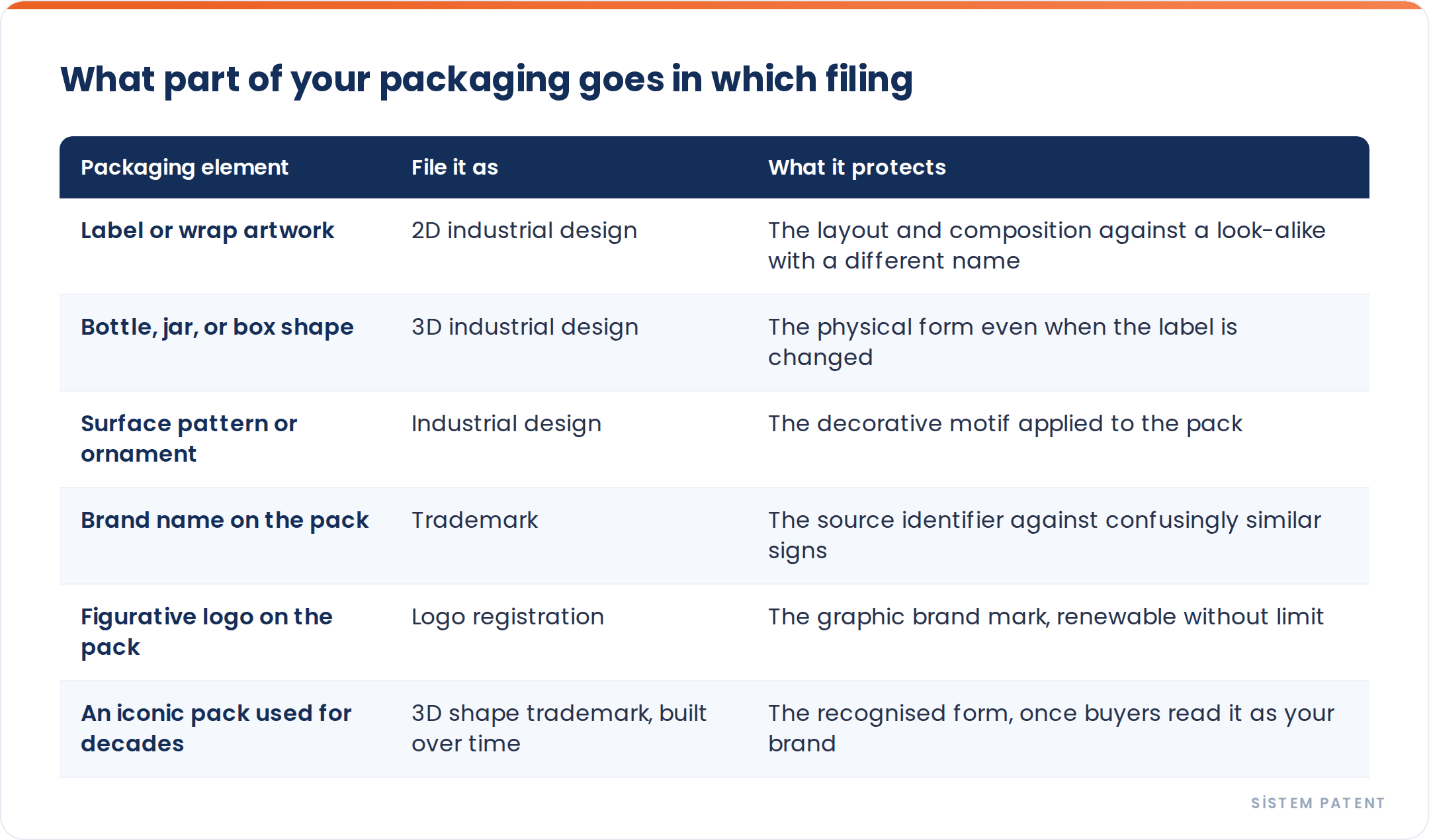
Filing both the label and the shape, sometimes as separate applications, sometimes as multiple designs in one application, is what gives packaging real coverage. One without the other leaves an obvious route in. The register allows several designs to be filed together where they share the same product class, which keeps a thorough packaging filing efficient rather than expensive.
A registered design protects the look; the trademark on the package protects the brand
Packaging almost always carries a trademark already: the brand name and logo printed on the front. That mark is doing a specific job. It tells buyers who the product comes from and lets you stop a competitor whose sign is confusingly similar for related goods. What it does not do is protect the overall appearance of the package when the copier keeps their own clearly different name on it. That is the design right's job.
The two rights catch different infringers, which is why they sit side by side rather than overlap. A rival who reproduces your jar shape and label arrangement but prints their own unrelated brand on it is squarely a design problem, and only weakly a trademark one, because a shopper paying attention can read that the names differ. A rival who copies your logo onto a plainly different package is a trademark problem that a design right may not touch. Cover the package with a registered design and cover the brand on it with a trademark, and you close both routes at once. For the name and logo themselves, that protection runs through trademark registration, and for a figurative brand mark specifically through dedicated logo registration; the design filings handle everything about how the package looks rather than what it is called.
What disqualifies a packaging design, and the one deadline that ends it before it starts
Two limits decide whether a packaging design is worth filing and whether it will survive. Both are avoidable if you know them in advance.
The first is novelty, and it has a hard deadline attached. A design must be new at the moment you file, which means any public disclosure of the packaging before the application date can destroy its own registrability. Showing the new bottle at a trade fair, posting the label on social media, or sending product shots to a retailer all count as making the design available to the public. Turkish practice allows a twelve-month grace period for disclosures made by the designer or with their consent, so a launch already out in the market is not always fatal, but relying on the grace period is a gamble. The clean rule is to file the packaging design before it is shown anywhere. With packaging this is easy to get wrong, because marketing teams reveal the look long before legal is involved.
The second limit is functionality. A feature of a package that is dictated solely by its technical function is excluded from design protection, because design law protects appearance, not engineering. The threaded neck that lets a cap screw on, the standard dimensions that make a carton stack on a pallet: those are functional and cannot be monopolised through a design. What remains protectable is the part of the appearance that is a genuine aesthetic choice, the ribbing you added for grip and distinctiveness, the proportions, the curve, the ornamental layout. Frame the application around the appearance you chose, not the mechanics you needed, and the functional-exclusion objection loses its grip.
How long packaging protection lasts, and why the design clock suits it
An industrial design in Turkey is protected for five years from the application date and renews in five-year blocks up to a ceiling of twenty-five years, after which the look enters the public domain. For packaging, that capped term is usually a fair match rather than a limitation. Most packaging is redesigned well within twenty-five years as brands refresh their shelf presence, so the design right tends to cover the look for as long as that look is actually in use. A signature pack you intend to keep unchanged for decades is the exception, and that is precisely the case where you also build toward a three-dimensional trademark on the shape, which can renew without limit once the public reads the form as your brand.
This is the sequencing that mature consumer brands rely on. The design registration gives instant, recognition-free protection from launch, when the packaging is new but unknown. Over years of consistent use, a distinctive pack can earn the consumer recognition needed to register the shape itself as a trademark, a right with no expiry. The design covers the opening years; the trademark, if you build the case for it, carries a truly iconic pack indefinitely.
If you are about to put a new bottle, box, or label on the market, the move that protects it is to file the packaging as a registered design before the reveal, splitting the flat graphic from the three-dimensional form, and to keep the brand name and logo covered by their own marks. Our teams can map a single package across both layers before you spend on a filing, through industrial design registration for the shape and the label, alongside trademark registration for the name and logo registration for the figurative mark. The package is often the most valuable thing on the shelf. It is worth registering before someone else copies it.
Picked for You
Related Articles
Registered vs Unregistered Design Rights: What You Get for Free and Why It Is Rarely Enough
Read More →
Turn Your Design Investment Into a Tax Position: Design Centres, R&D and IP Incentives
Read More →