
The Amazon and Trendyol Seller IP Checklist: Trademark and Barcode, in the Right Order
A seller spends a year building a kitchenware brand on Amazon and Trendyol. The reviews are good, the listings rank, and then a copycat shows up. A second seller attaches to the same listing with a cheaper, lower-quality version, edits the product photos, and starts taking the orders. The original seller opens a complaint and gets the same answer both marketplaces give: prove the brand is yours. Without a registered trademark, there is very little to show.
That scenario is common enough that it has shaped how serious sellers set up. The marketplaces themselves now nudge you toward a registered trademark, because their own brand-protection tools are built on top of one. If you sell on Amazon or Trendyol and you have not put your intellectual property in order, the brand you are growing is sitting on someone else's permission rather than your own right.
The marketplace rewards you for owning the name, not just using it
Amazon Brand Registry is the clearest example. It is the program that gives a brand owner the tools to police their own listings: reporting hijackers, flagging counterfeits, locking down the product detail page so a stranger cannot rewrite your title and images. The entry requirement is a trademark. Amazon accepts a registered mark, and in many regions a pending application filed through an accepted office is enough to start, which is one reason the smart move is to file early rather than wait until a problem appears.
An unregistered brand has none of that. You can list and sell, but you are exposed. If someone else registers a mark similar to the name you have been trading under, the advantage flips to them, and you can find yourself on the wrong side of a complaint about your own brand. The protection is not automatic and it is not granted by selling volume. It comes from the registration certificate.
Trendyol works on the same logic from the Turkish side. Selling on Trendyol under a brand you do not own leaves you with no firm ground if a dispute starts, and a registered Türkiye trademark is the document that settles who has the right to the name in the market where most of your customers are. The principle is consistent across both platforms: the marketplace protects the registered owner, and it expects you to be one.
A GS1 barcode is the only barcode worth listing with
Every product you list needs a barcode, and where it comes from matters more than sellers expect. The clean source is GS1, the body that issues the globally unique GTIN numbers behind retail barcodes. A GS1 number is tied to your company, so the code on your packaging traces back to you. Marketplaces lean on that GTIN to match products to the right catalogue entry, which is why a code with a clean owner record behaves predictably and a borrowed one does not.
The trap is the market in cheap resold barcodes. You will find sellers offering single barcode numbers pulled from an old batch that once belonged to another company, at a fraction of the GS1 price. The problem surfaces at the listing stage. A marketplace can reject a code that does not validate against the GS1 database, or worse, accept it and later flag the listing when the number is found to be associated with a different company's products. Now your product is tangled up with someone else's history, on a number you do not actually control. Getting a clean barcode from the start is far cheaper than untangling a bad one after your listings are live. When you set up your codes, do it through proper GS1 barcodes rather than a resale shortcut.
The order matters more than the individual steps
Each of these tasks is straightforward on its own. Sellers get into trouble by doing them in the wrong sequence, most often by registering a barcode and pushing products live before they have any claim to the brand name printed on the box. Here is the order that keeps you clear.
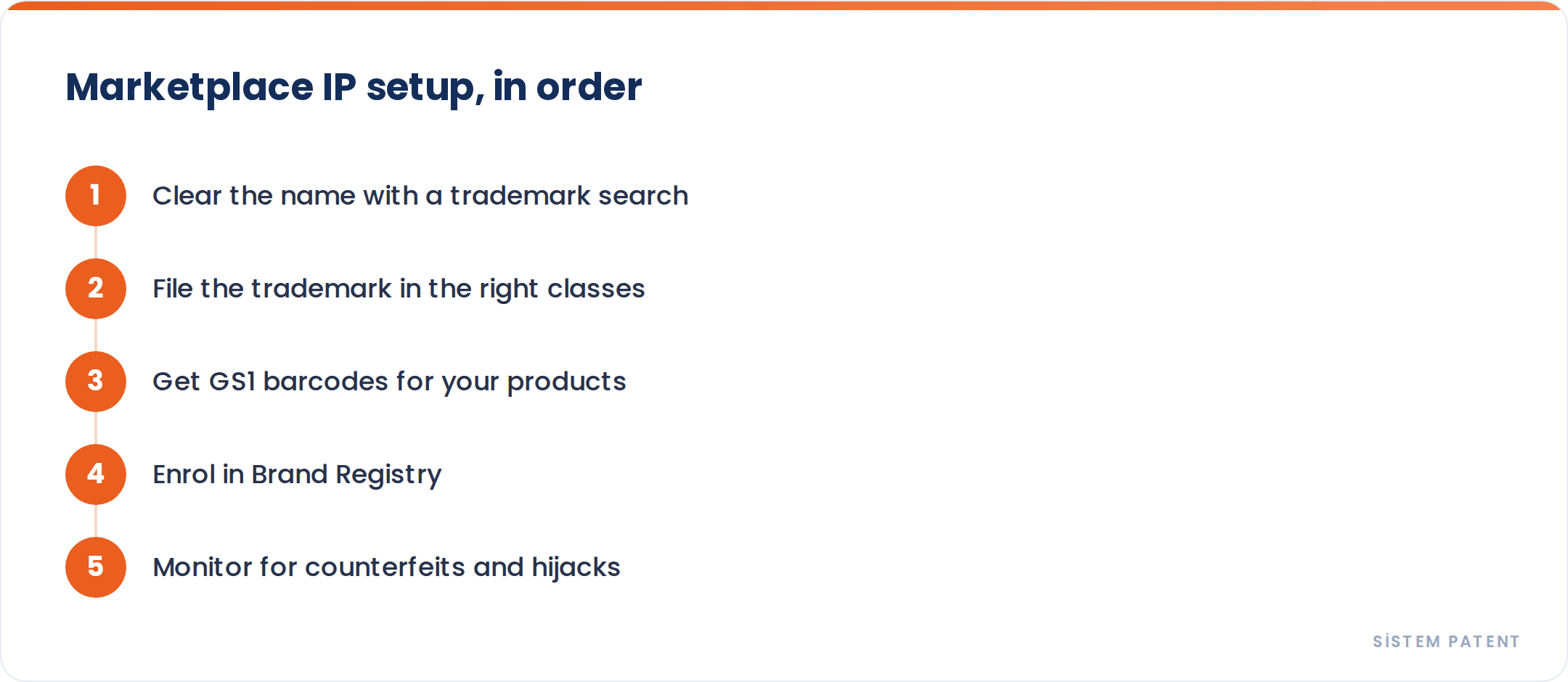
Start with the search, because it is the cheapest step and it decides everything after it. A trademark search tells you whether the name you want is actually available, or whether a similar mark is already registered in the classes you care about. Skipping it is how a seller invests in packaging, photography, and listings, then receives an opposition or an infringement notice and has to start over under a new name.
Once the name is clear, file it. A trademark registration in Türkiye runs through TÜRKPATENT (the Turkish Patent and Trademark Office), and the part that sellers underestimate is class coverage. Trademarks are registered against the Nice classification, a system of goods and services classes, and your protection only reaches the classes you actually file in. A homeware seller who registers only in one class and later expands into a related product line can find the new category unprotected. File for what you sell now, and think about where the catalogue is heading.
With the application on file, get your GS1 barcodes and prepare your listings. By this point the name underneath the codes is one you have a real claim to, which is the whole point of doing it in this order.
Then enrol in Brand Registry once you are eligible. A pending or registered mark opens the brand-protection layer on the marketplace, and from there you turn on the last step: monitoring. New similar marks get filed constantly, and listing hijackers and counterfeit sellers appear without warning. Trademark monitoring is what catches a conflicting application early, while there is still time to oppose it, instead of discovering it after it has registered.
The three mistakes that cost sellers the most
The first is selling under an unregistered brand and treating registration as a someday task. Every month of sales builds value into a name you do not own, and the day a dispute arrives is the day you wish you had filed. The cost of registering is small next to the cost of rebranding a catalogue that already has reviews, ranking, and repeat buyers attached to it.
The second is accidentally using a mark that belongs to someone else. A name can be perfect, available on the marketplace, and still collide with a registered trademark you never checked for. That is precisely the collision a search is meant to catch before you have spent anything.
The third is ignoring class coverage. A trademark is not a blanket over your whole business. It covers the goods and services you registered it for, and a gap between what you sell and what you filed is a gap a competitor can use. A seller who registers a clothing mark and then starts selling cosmetics under the same name has left the cosmetics line open for anyone to claim. As your product range grows, your registration should grow with it.
None of this is exotic. It is the ordinary groundwork that separates a brand you can defend from a name you are merely using, and the sequence is what makes it work. If you are setting up to sell on Amazon or Trendyol and want the trademark side handled correctly, our team can run the trademark search and the filing in the right classes so the rest of your build sits on solid ground.
Picked for You