
The Distinctiveness Spectrum, Explained With Real Brand Examples
Two cafes open the same month on the same street. One calls itself Fresh Coffee. The other calls itself Kraken. A year later, a competitor copies both names across town, and only one founder can do anything about it. The difference was never the coffee. It was where each name sat on the distinctiveness spectrum, a single ranking that quietly decides how much protection your brand can ever earn.
Turkish trademark law, like the systems it grew alongside in Europe, sorts every name into one of five tiers. The stronger your tier, the easier your mark clears examination at TÜRKPATENT (the Turkish Patent and Trademark Office) and the wider the territory you can defend later. This is the scale every examiner, every opposing party, and every judge has in their head when they look at your name. Learning to place your own candidate on it is the most useful half hour a founder can spend before committing to a logo.
The five tiers run from invented words down to plain category names
The spectrum is a continuum, not five sealed boxes, but the tiers give you a reliable map. At the top sit names that mean nothing until you give them meaning. At the bottom sit words the whole market needs to use. Your job is to push your candidate as far up the scale as the brand strategy allows.
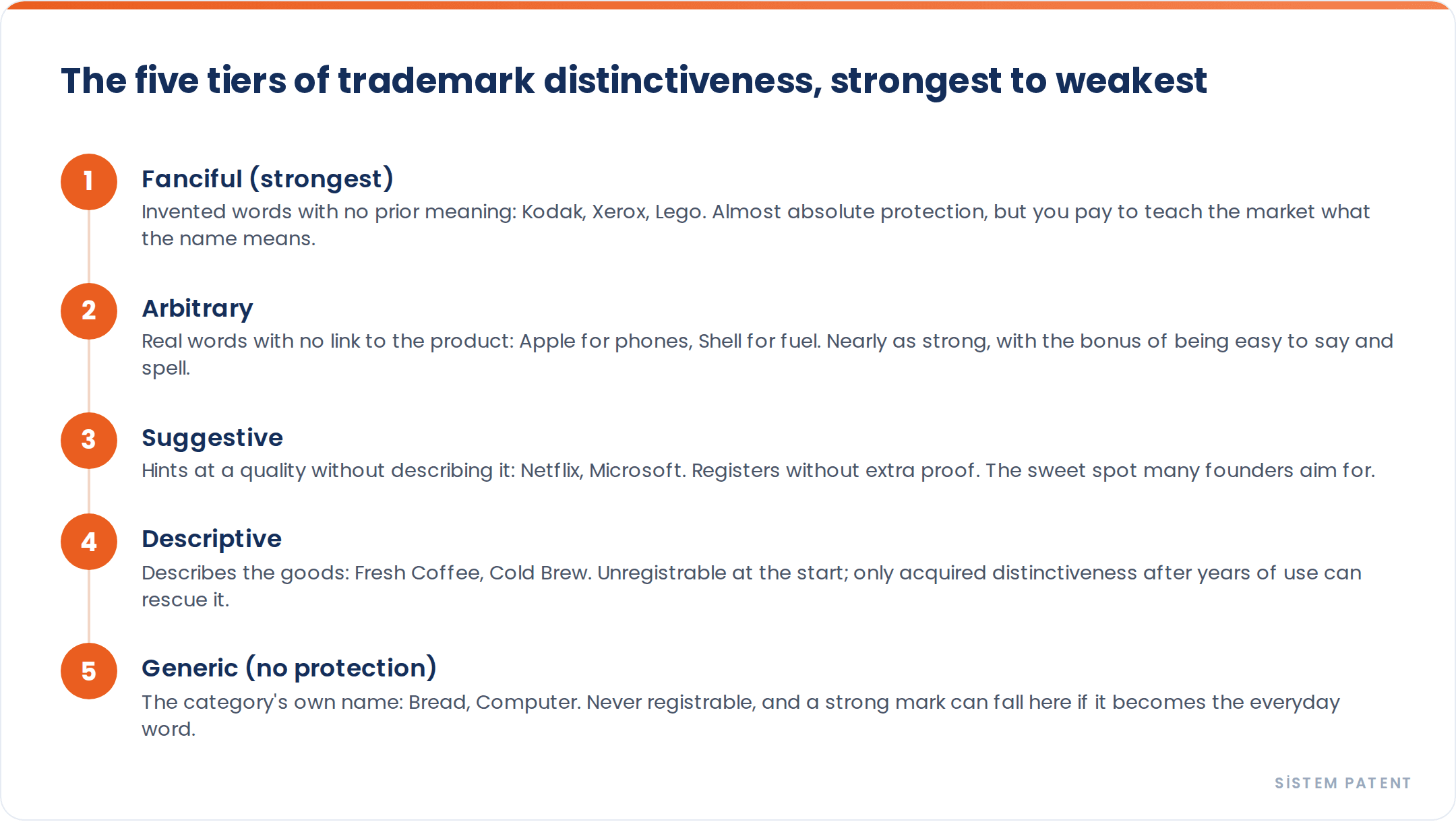
Fanciful marks are invented words, and they are the strongest you can own
A fanciful mark is a coined term that did not exist in any language before the brand used it. Kodak, Xerox, Häagen-Dazs and Lego all began as invented or constructed words. Because the term carries no prior meaning, nobody else has a legitimate reason to use it, so the protection is close to absolute. Examiners rarely block a genuinely invented word on descriptiveness grounds, and a clearance search returns a clean field more often than not. The trade-off is marketing cost: a made-up word tells the customer nothing on day one, so you pay to teach the market what it means. For a brand planning to last, that investment is usually the cheapest insurance it will ever buy.
Arbitrary marks are real words used where they have no connection
An arbitrary mark takes an existing word and attaches it to goods it has nothing to do with. Apple means nothing about phones or computers. Shell has no link to fuel. A Turkish reader knows what each word means, yet in its product category the word is effectively a blank slate, so it earns protection almost as strong as a fanciful mark. The advantage over an invented word is familiarity: people can already pronounce and spell it. The risk to watch is choosing a word that is arbitrary for your product today but common in an adjacent category you later expand into, which is exactly the kind of overlap a proper trademark search exists to surface before you file.
Suggestive marks hint at a quality without describing it
A suggestive mark asks the customer to take one small mental step. It implies something about the product without spelling it out. Netflix suggests film delivered over a network. Microsoft hints at software for microcomputers. The line that matters in practice is the one between suggestive and descriptive, because suggestive marks register without proof of anything extra, while descriptive ones do not. The test an examiner applies is roughly this: if the meaning lands instantly, with no imagination required, the name is descriptive; if the customer has to make a leap, however short, it is suggestive. Suggestive is the sweet spot many founders aim for, since it carries a whisper of marketing built in while still standing as a protectable mark.
Descriptive marks describe the product, and they start life unregistrable
A descriptive mark names a feature, quality, ingredient, purpose or geographic origin of the goods. Names like Fresh Coffee, Istanbul Carpets or Cold Brew describe exactly what is in front of the customer. The Industrial Property Code (Law No. 6769) bars the registration of marks that consist only of signs describing the goods, for a sound commercial reason: no single trader should be allowed to monopolise the ordinary words competitors need to describe their own products. A descriptive name can sometimes climb into protection through acquired distinctiveness, meaning years of heavy, consistent use until the public reads the word as your brand rather than a description. That is a long, evidence-hungry road, and it is no substitute for choosing a stronger name at the start.
Generic terms are the category itself, and no one can ever own them
A generic term is the common name of the product. You cannot register Bread for bread or Computer for computers, ever, under any amount of use. Granting one company the word would hand it the entire category. Worse, a strong mark can fall to this level if the owner lets the public turn the brand into the everyday word for the product, the fate that has threatened names like Aspirin and Thermos in various markets. A mark sitting safely near the top of the spectrum still needs active policing to stay there, which is why protection is a habit, not a one-time filing.
Why the tier you pick changes the registration odds before you file
The practical payoff of the spectrum is prediction. Once you can place a name, you can forecast how the application is likely to go. A fanciful or arbitrary name walks through absolute-grounds examination and leaves you a wide lane to oppose copycats. A suggestive name clears too, with a little more room for argument at the margins. A descriptive name invites a refusal letter and, at best, a slow climb through acquired distinctiveness. A generic name is a dead end no fee can rescue.
This is also why two names that feel equally catchy in a brainstorm can have completely different legal futures. The catchiness lives in marketing; the protection lives in the tier. The founders who get burned are usually the ones who fell for a descriptive name because it explained the product so well in the pitch, then discovered they had built a brand they could not defend.
Place your shortlist on the scale before you spend on design
Run each candidate name through one question: how much does it tell a stranger about the product before you have said a word? The less it gives away, the higher it sits and the stronger it is. Then pressure-test the survivors with a real search, because even a perfectly fanciful word is worthless if someone registered it first. A name that scores well on distinctiveness and comes back clear is the one worth building a logo around and carrying into trademark registration.
The spectrum will not make a creative decision for you, and the strongest brands often balance a memorable identity against maximum legal strength rather than chasing one at the expense of the other. What it does is stop you walking into a fight you cannot win. If you want a second pair of eyes on where your shortlist sits and which names will actually survive examination, our trademark agents place candidate names on this scale every day, and a short trademark search before you file is the cheapest move on the board.
Picked for You