
The Central Attack Trap: How One Cancellation Can Topple Your Whole Madrid Portfolio

A Turkish manufacturer files one Madrid application from Ankara and, within a year, holds trademark protection in eleven export markets. Clean, fast, paid for in a single set of fees. Three years later a competitor cancels the original Turkish registration on a non-use ground, and every one of those eleven foreign registrations falls with it on the same day. The owner did nothing wrong abroad. The foreign marks were used, renewed, defended. They died anyway, because of something that happened back home.
This is central attack, and it is the single most misunderstood feature of the Madrid System. The international registration you build on top of a home mark is not independent for its first five years. It hangs from that home registration like fruit from a branch. Cut the branch, and the fruit comes down everywhere at once.
Your international registration is tethered to the home mark for exactly five years
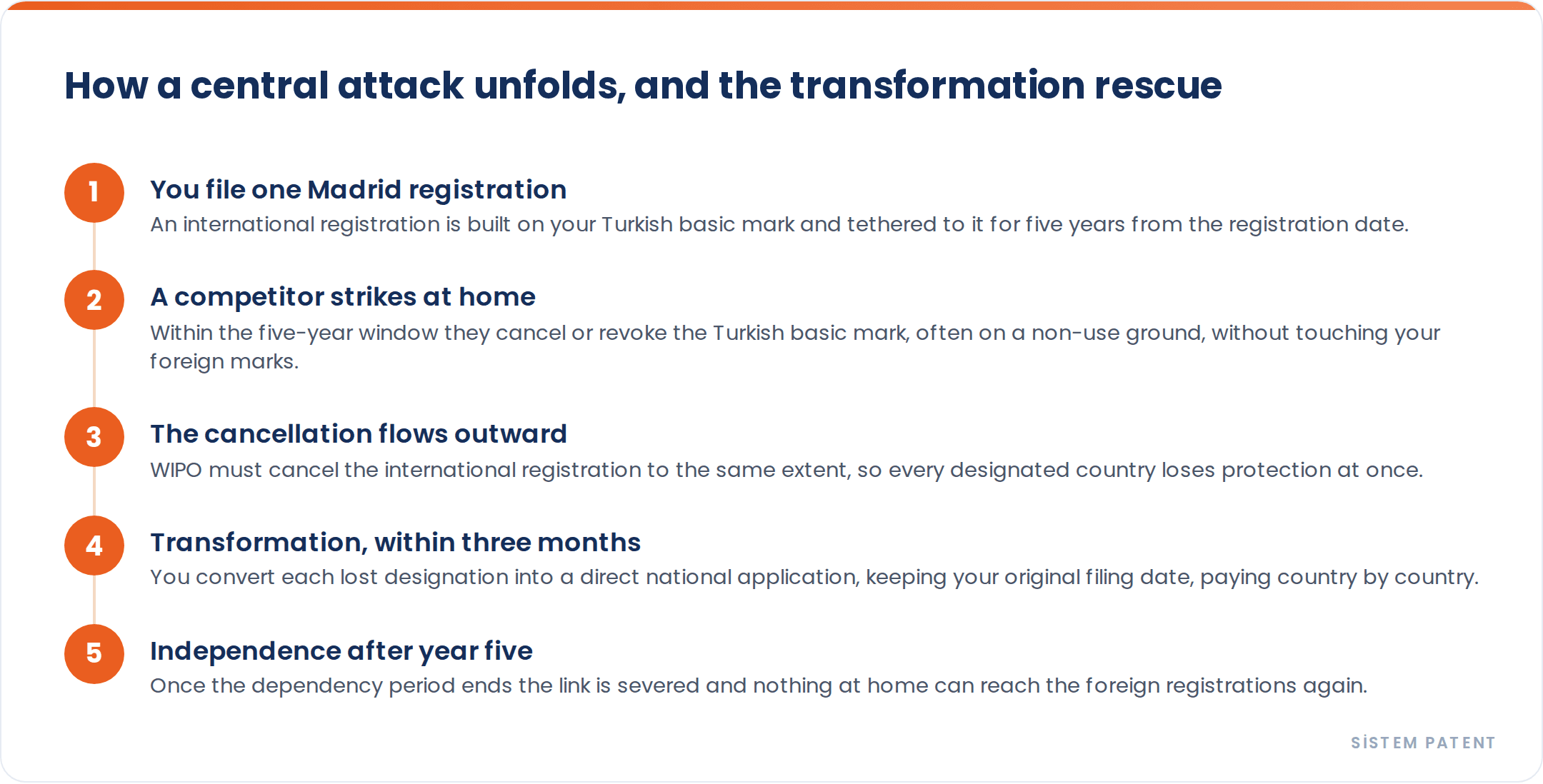
When you file through the Madrid System, you do not file separate national marks. You file one international registration with WIPO (the World Intellectual Property Organization), and that registration is anchored to a basic mark, the application or registration you already hold at your home office. For an applicant based in Turkey, that basic mark sits at TÜRKPATENT (the Turkish Patent and Trademark Office).
For five years counted from the date of the international registration, the two are legally linked. If the basic mark ceases to have effect during that window, WIPO must cancel the international registration to the same extent. The cancellation flows outward to every designated country in one motion. This is why practitioners call the five-year link the dependency period, and why central attack is named for the fact that an opponent strikes once, at the centre, instead of fighting you in eleven separate jurisdictions.
After the five years elapse, the link is severed. From that point each national designation stands on its own feet, and nothing that happens to the Turkish mark can reach across borders. The danger lives entirely inside that opening window.
Almost anything that kills the home mark in five years pulls the rest down with it
The trap is wide because the triggers are wide. The international registration becomes vulnerable if, within the dependency period, the basic mark is:
- refused or withdrawn before it ever registers, if you filed Madrid on a pending application rather than a granted one
- cancelled or declared invalid through an opposition or court action
- revoked for non-use in Turkey
- voluntarily surrendered, in whole or for some of the goods and services
- cut back so that certain classes are struck from the home registration
Two of these deserve emphasis because owners rarely see them coming. The first is filing on a pending application. Madrid lets you base an international registration on a home application that has not yet matured into a registration, which speeds you to a filing date. But a pending application is far easier to derail than a granted one. A successful opposition in Turkey against that base application takes the entire international registration down with it, and the opponent only had to win at home.
The second is partial loss. Central attack is not all or nothing. If your Turkish registration is narrowed so that, say, class 25 is removed, the international registration loses class 25 in every designated country, while the surviving classes carry on. An opponent who cannot kill your mark outright may still carve out the exact goods they care about, everywhere, by attacking only at home.
Transformation is the escape hatch, and it has a hard ninety-day clock
Central attack is dangerous, but it is not the end of the road. The Madrid Protocol built in a rescue mechanism precisely because the dependency rule is so harsh. It is called transformation, and it lets you convert each lost foreign designation into a direct national application in that country, keeping your original filing date.
The mechanics matter. Once the international registration is cancelled because the basic mark fell, you may, within three months of that cancellation, file a national application in any designated country where you want to preserve protection. That national application is treated as if it had been filed on the date of the international registration, or its priority date. You do not lose your place in the queue against later third parties. You convert what was one cheap centralized right into several standalone national rights.
The catch is cost and effort. Transformation undoes the very economy that made Madrid attractive. You now file, and pay, country by country, often through local agents, exactly the path the international registration let you avoid. If your mark was designated in eleven countries, transformation can mean eleven national filings on a ninety-day deadline. That is recoverable, but it is expensive and it is stressful, and it only works if you act inside the window. Miss the three months and the protection in that country is simply gone.
Transformation preserves your filing date, not your budget. It is a lifeboat, not a refit. You still reach shore, but you pay for every seat.
You reduce the risk before you file, not after you are attacked
Because the dependency period cannot be waived, the real protection is in how you set up the filing in the first place. A few decisions made at the outset change your exposure for the whole five years.
Base Madrid on a granted registration where you can
If your Turkish mark is already registered and unopposed, building the international registration on that granted right rather than a raw application removes the easiest line of attack. A registration that has already survived its Turkish opposition window is a far sturdier foundation than an application still exposed to one. When speed forces you to file on a pending application, treat the home opposition period as a live risk to the entire portfolio, not a domestic footnote, and watch it accordingly.
Make the home mark unattackable on non-use
Non-use revocation is a central-attack trigger that you control entirely. Keep genuine, documented use of the Turkish mark across the classes the international registration relies on, so that no competitor can hollow out your foundation on non-use grounds during the dependency years. Strong home rights begin with a clean filing and a properly scoped registration, which is where careful trademark registration in Turkey earns its keep.
Weigh Madrid against direct national filings for your crown-jewel markets
Madrid is the efficient route for breadth. But for one or two markets you cannot afford to lose, a direct national filing is independent from day one and immune to anything that happens to the Turkish mark. Many Turkish brands use a hybrid: a Madrid international trademark via the Madrid Protocol for the wider footprint, plus standalone national trademark registrations in the handful of countries that justify the extra cost and full independence. That way a central attack can never reach the markets that matter most.
The link is temporary, but the first five years decide everything
Central attack sounds like an exotic risk until it happens, and then it is total. The mechanism is simple: for five years your international portfolio is only ever as strong as the Turkish mark underneath it. After that the portfolio stands alone and the threat evaporates. The work, then, is front-loaded. Choose the right basic mark, keep it in genuine use, decide which markets deserve independent national protection, and know that transformation exists with a ninety-day fuse if the worst arrives. If you are mapping out where a Turkish brand should be protected and how those filings should be sequenced against this risk, our Madrid Protocol filing team can structure the portfolio so a single cancellation at home can never bring the whole thing down.
Picked for You