
Knockout Search vs Clearance Search: How Deep to Look Before You File
A founder types her brand name into the TURKPATENT register, finds no exact match, and files the next morning. Six weeks later the application is published, and a company she had never heard of files an opposition. Its mark is spelled differently, sounds almost the same, and covers the same goods. She did search. She just searched the wrong way, at the wrong depth, for the question she actually needed answered.
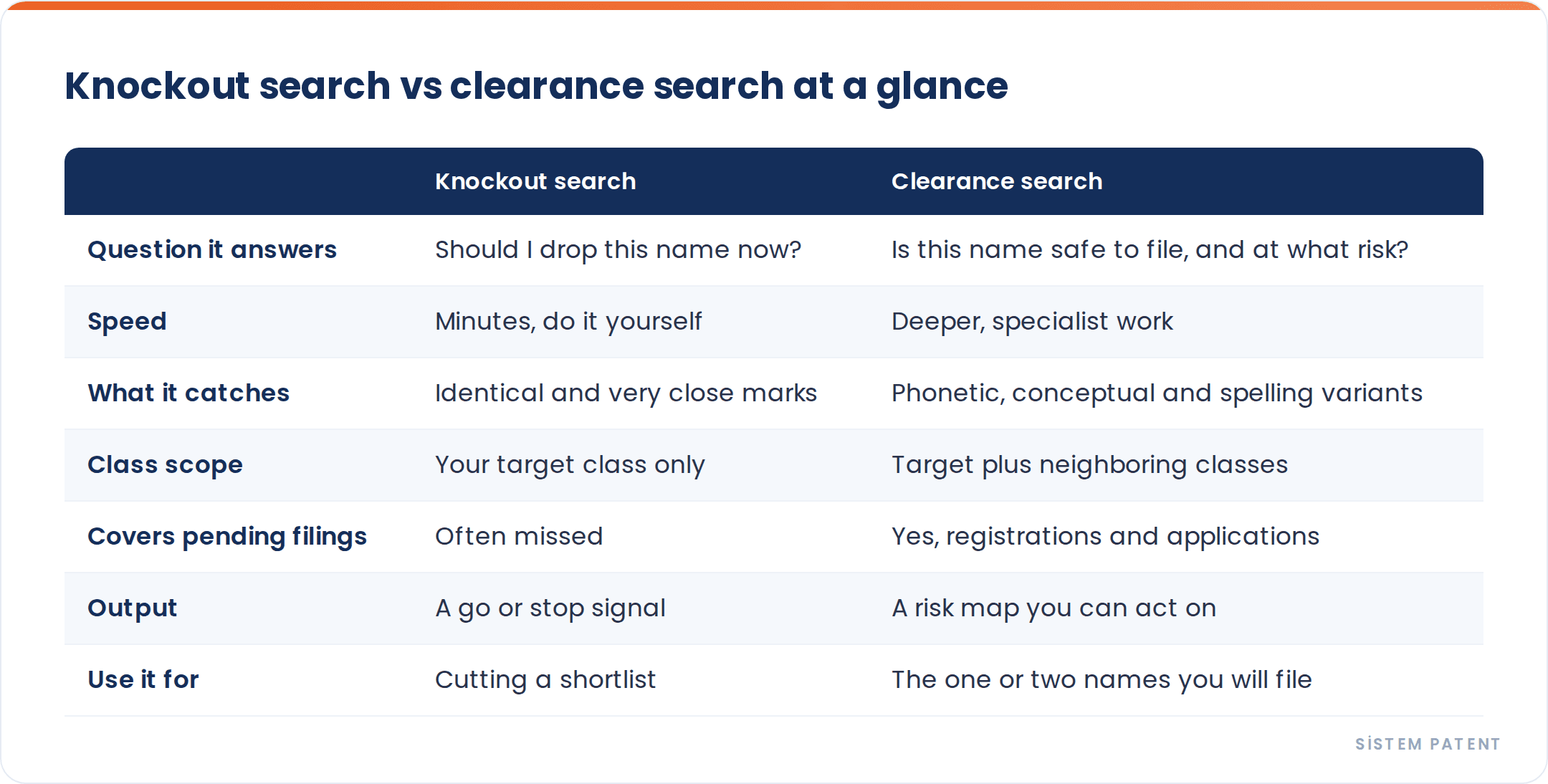
Two searches sit behind every safe filing decision, and they are not interchangeable. A knockout search is the fast gate: it tells you whether to stop. A clearance search is the deep read: it tells you whether to file, and what the risks look like if you do. Knowing which one you are running, and how far it reaches, is the whole skill.
A knockout search exists to kill bad names quickly, not to clear good ones
The point of a knockout search is speed. You have a shortlist of candidate names, often four or five, and you want to drop the obvious losers before anyone spends money on a logo, a domain, or packaging. So you run each name through the register, look for identical and near-identical marks in the classes you care about, and cut anything that hits a wall.
It is a coarse filter by design. A knockout search reading the register for exact and very close matches will catch the name that is already registered outright. It will catch the blatant copy. What it will not reliably catch is the mark that is dangerous for a reason a quick scan cannot see: a different spelling that sounds the same, a translation, a word that means the same thing to a consumer. A clean knockout result is permission to keep going, not permission to file. Treating it as a green light is the single most common way a Turkish application walks straight into an opposition.
Run the knockout yourself early, on your own shortlist. A free pass through a trademark search on the public register is enough to eliminate the names that were never going to work, and that alone saves weeks.
Exact-match searching misses the conflicts that actually block you
Here is the trap. The register's basic search rewards exact strings. You type KORDA and it shows you KORDA. It does not volunteer CORDA, KHORDA, QORDA, or KORDAH, and under Turkish examination practice every one of those can be close enough to block you or to support an opposition. Confusion is not judged by whether two strings are identical. It is judged on three axes at once.
Visual similarity is how alike the marks look on the page or the shelf. Length, shared letter sequences, a dominant prefix, a logo that echoes another logo. FLORANCE and FLORENZA read as cousins even though no exact search connects them.
Phonetic similarity is how alike they sound when spoken. This is the one exact-match searching is blindest to, and the one that does the most damage. A consumer asking for a product out loud does not spell it. SELLEX and CELEX, KWIK and QUICK, NUVO and NOUVEAU collide by ear long before they collide on paper. In Turkish, the way letters map to sounds means a creatively spelled name can be phonetically identical to a registered one while looking nothing like it in a text box.
Conceptual similarity is how alike they are in meaning. A Turkish word and its English equivalent, two different words pointing at the same idea, a direct translation of an existing mark. Yildiz and Star in the same class are not strangers to an examiner. An exact-match search has no way to surface a conceptual neighbor, because nothing in the two strings overlaps.
This is exactly why a real clearance search runs phonetic and conceptual variants on purpose. It searches the name you want and the names that merely behave like it.
A clearance search reads for risk across the whole field of conflict
A clearance search starts where the knockout stops. It is built to find the marks a fast scan would never surface and then to weigh them. In practice it reaches across several layers at once.
- Phonetic and spelling variants of your name, including the way it would be misspelled, transliterated, or pronounced by a Turkish speaker.
- Conceptual equivalents: translations, synonyms, and same-meaning words in both Turkish and the languages your market uses.
- The right class scope, meaning not only the Nice class you will file in but the neighboring classes where similar goods and services live and where a conflict can still be raised.
- Pending applications, not just registrations, because a mark filed last month and not yet granted can still block you, and it will never show up if you only look at registered marks.
- Figurative and composite marks, where the conflict lives in a logo or a stylized element rather than the plain word.
The output is not a yes or a no. It is a map of who else is in your space and how close they sit. That is the deliverable a fast search can never produce, and it is what turns a name choice into a filing decision you can defend.
Read the results as a risk gradient, not a pass or fail light
The mistake non-specialists make with any search result is binary thinking: a match means stop, no match means go. Real results sit on a gradient, and reading where a hit falls on it is the actual work.
Weigh each hit on two questions at once. How similar is the mark across the visual, phonetic, and conceptual axes? And how close are the goods or services, from identical, to the same class, to a neighboring class, to plainly unrelated trade? A mark that is identical in an unrelated class is usually noise. A mark that merely rhymes with yours but sits on the exact same products is a serious blocker. The dangerous hits are the ones that score high on both, and a results list dumps the trivial and the fatal into the same column. Sorting them is judgment, not lookup.
Three tiers are usually enough to act on. A high-risk hit is an identical or strongly similar mark on identical or closely related goods: this is a stop-or-rethink signal. A medium-risk hit is some similarity with some overlap: this is where a small change to the name, a narrower specification, a disclaimer, or a coexistence approach can clear the path. A low-risk hit is a distant similarity or an unrelated class: usually safe to note and move on. Two applicants can read the same list and reach opposite conclusions, which is precisely why interpretation, not the raw search, is where a professional clearance search earns its keep.
Match the depth of the search to how much rides on the name
Not every name deserves a full clearance, and not every name survives without one. The right depth tracks the stakes. A throwaway internal project name or a sub-line you can rename next week needs little more than a knockout. A flagship brand you will print on packaging, build a domain around, and carry into export markets deserves the deep read before a single design file is commissioned.
The sequence that protects you is simple and worth following in order: knockout your shortlist to cut the obvious conflicts, run a full clearance on the one or two survivors, read the results as a risk gradient rather than a verdict, and only then move to trademark registration. Reversing that order, filing first and searching later, is how avoidable oppositions and refusals happen.
The cost of searching deeper before you file is small and known. The cost of skipping it surfaces later as an opposition, a refusal, or a rebrand after launch, and that bill is neither small nor predictable. If a name matters to your business, the honest move is to register it only after a clearance has shown you the field, not before. The point of looking deeper is not caution for its own sake. It is filing once, with your eyes open.
Picked for You