
How to Protect Your Source Code: A Layered Strategy Beyond Copyright Registration
A founder once told me his entire codebase was safe because he had filed a copyright record for it. Two months later a senior engineer left, joined a competitor, and shipped a product that behaved suspiciously like his. The record was real and it was useful, but it was protecting one door while three others stood open. The departing engineer had no signed agreement about what he could take. The repository had been shared with a contractor years earlier under no written terms. And the company had no way to prove which secrets the engineer actually carried out, because nothing was ever marked as confidential. A single filing was never going to hold all of that.
Source code is unusual as an asset. It is simultaneously a literary work, a trade secret, a contract problem, and an access-control problem, and each of those needs a different kind of protection. Treating copyright registration as the whole answer is like fitting one good lock to a building with no walls. The registration matters. It is just one layer in a stack, and the stack is what actually keeps your code yours.
Copyright protects the expression, not the idea behind it
Under the Law on Intellectual and Artistic Works (Law No. 5846), software is protected by copyright from the moment original code is written, with no filing required. A formal record adds something specific on top of that automatic right: a dated, official statement that a named author deposited this exact code on this exact day. In a dispute, that turns proof of authorship from a forensic reconstruction into a certificate you can put on the table.
What copyright does not reach is the idea, the method, or the functional logic underneath the code. It protects the way you wrote something, not the thing the software does. A competitor who studies your product and writes their own clean implementation of the same feature has not infringed your copyright at all. They have copied your concept, and concepts are not what this right covers. That gap is exactly why registration alone leaves a software business exposed, and why the other layers exist to cover what copyright structurally cannot.
Trade-secret hygiene covers what copyright leaves open
The logic, architecture and know-how that copyright ignores can often be protected as a trade secret instead, but only if you actually treat them as secret. This is the layer most companies assume they have and do not. A trade secret is not a thing you own automatically. It is a status you earn by taking reasonable steps to keep information confidential, and a court will look hard at whether those steps existed before it gives you any protection.
In practice this means access to the code is limited to people who need it, repositories carry clear confidentiality markings, secrets and keys are not sitting in plain text where any contractor can read them, and there is a record of who could see what. None of this is exotic. It is the difference between being able to say in court that you guarded the information and being forced to admit that anyone in the building could have walked off with it. When code leaks, the value of the trade-secret claim is decided almost entirely by the hygiene you practised before the leak, not after.
Contracts decide who owns the code in the first place
The most common way a software company loses control of its code is not theft. It is never having owned the code cleanly to begin with. Under Turkish law, work created by an employee within the scope of their duties generally vests in the employer, but the lines blur fast once freelancers, agencies and side-project contributors are involved. A contractor who writes a module without a written assignment may hold rights in that module, even though you paid for it. A co-founder who left early may still own part of the early codebase. These are the cracks that surface years later, usually during due diligence for a funding round or a sale, at the worst possible moment.
Two contract layers close most of these gaps. The first is the assignment: every employee, contractor and contributor signs over their rights in what they create for you, in writing, before or as they start. The second is confidentiality: a non-disclosure agreement that defines what counts as confidential and binds the person not to use or share it. Neither is glamorous, and both are far cheaper to put in place at the start than to reconstruct after someone disputes ownership. When you finally move to enforce, the strength of your registered work and your trade-secret claim both rest on a clean chain of ownership that only these contracts can prove.
Open-source compliance is part of owning your code
One contract problem hides inside the codebase itself. Most modern software pulls in open-source components, and each of those arrives under a licence with conditions. Some are permissive. Some, the copyleft licences, can require you to release your own source code if you distribute software that incorporates them. A team that copies a snippet from an online forum or links a strong-copyleft library without reading the terms can quietly compromise the ownership of the whole product. Knowing what is in your dependency tree, and on what terms, is not a side issue. It is a direct part of being able to say the code is yours to protect.
Escrow and access control protect the code as it moves
The last layer addresses code in motion. When you license software to a major customer, that customer often worries about what happens to them if your company disappears. Source-code escrow answers this: a neutral third party holds a copy of the code and releases it to the customer only under defined conditions, such as your insolvency. It is a commercial tool that lets you sell to cautious buyers without handing over your source outright, and it doubles as an independent, dated record of what the code contained at deposit.
Access control is the quiet partner to all of this. Most code does not leak through dramatic hacking. It walks out through over-broad permissions, shared logins, repositories that were never locked down, and offboarding that forgets to revoke access. The technical discipline of granting the least access necessary, logging who reached what, and cleanly cutting off departing staff is not separate from your legal protection. It is what makes the legal protection believable. A trade-secret claim is far stronger when you can show the information was genuinely hard to reach, and far weaker when the truth is that half the company could clone the repository on their way out.
The layers only work as a set
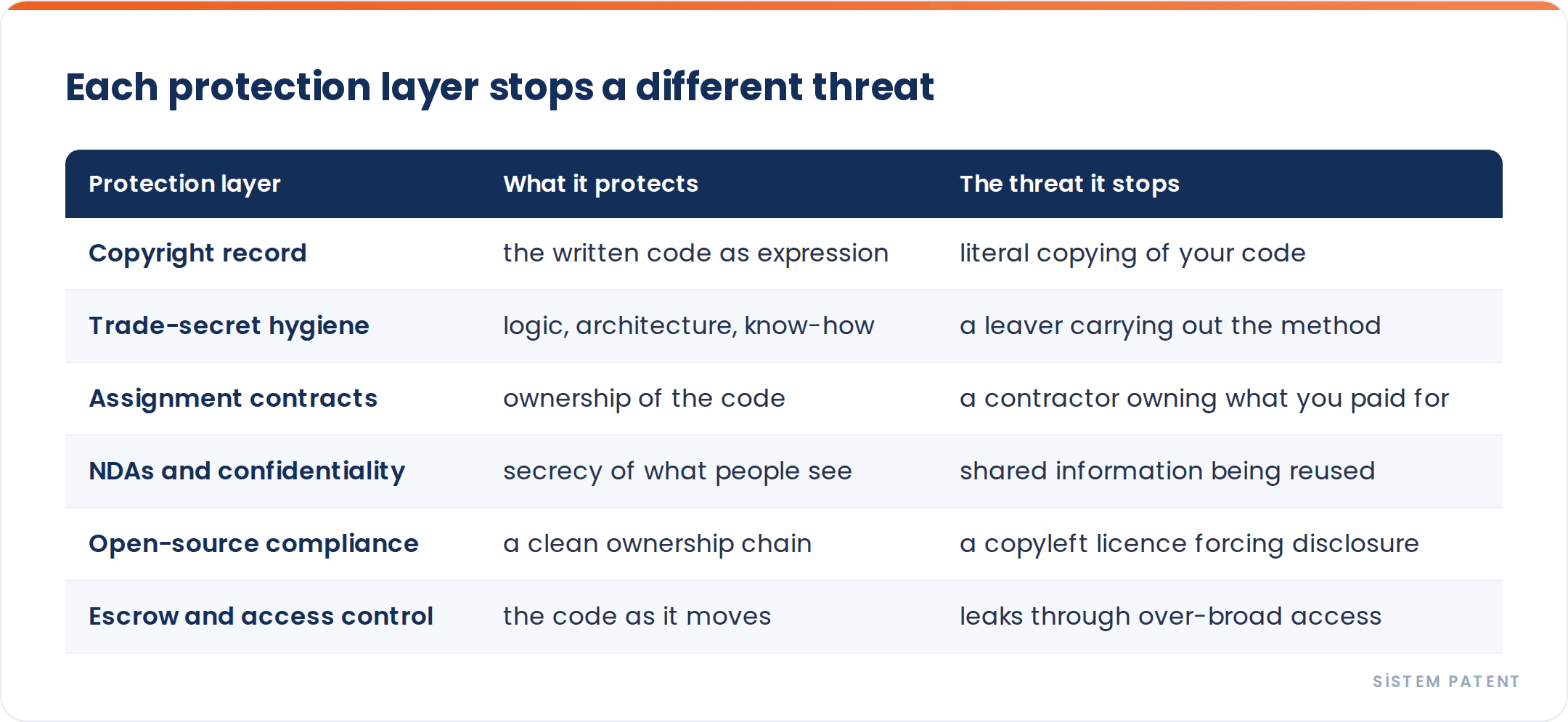
No single one of these defences is sufficient, and that is the real point. Copyright registration proves authorship and a date but not the idea or the ownership chain. Trade-secret hygiene protects the logic but collapses without real confidentiality practices. Contracts settle ownership but prove little if the work was never documented. Escrow and access control govern the code in motion but say nothing about who wrote it. Each layer covers a threat the others miss, and a gap in any one is usually where the loss actually happens. A business that maps its own exposures and closes them deliberately ends up with protection that holds together under pressure, rather than a single certificate it hopes will do everything.
If you are building software you would one day defend, the practical move is to treat protection as a stack and check each layer against a real threat. A dated software copyright registration anchors your authorship; written assignments and confidentiality agreements settle ownership and secrecy; access discipline and escrow govern the code as it travels. Sistem Patent can review where your code sits across all of these layers and help you put a coherent intellectual property protection plan in place, with the software copyright record as the documented core rather than the whole of your defence.
Picked for You
Related Articles
Who Owns Your Reels: A Creator's Guide to Copyright, Music and Brand Deals
Read More →
Work-for-Hire and Freelancers: Who Owns the Design, Code or Copy You Paid For
Read More →