
Novelty and Individual Character: The Two Tests Every Registered Design Must Pass

A studio spends eight months on a kettle. The body is a soft cylinder, the handle a clean loop, the spout a short angled cone. It looks considered, it photographs well, and the founder is sure it is original. Then a competitor points to three kettles already on the market with the same soft cylinder, the same loop handle, the same angled spout. The new kettle is attractive. It is not, in the eyes of the law, a protectable design. That gap between "looks new to me" and "is legally new" is what novelty and individual character measure, and almost every weak design application fails on one of the two.
Turkey protects the appearance of a product through industrial design rights under the Industrial Property Code (Law No. 6769). A design is the look of the whole or a part of a product: its lines, contours, colours, shape, texture, materials and ornamentation. To be registered and to stay valid if challenged, that appearance has to clear two separate tests. They sound similar and people blur them together, but they ask different questions, and a design can sail through one while sinking on the other.
Novelty asks a yes-or-no question: has this exact look been shown before?
A design is new if no identical design has been made available to the public before your filing date, or before your priority date if you claim one. "Identical" is read strictly but with a small allowance: designs that differ only in immaterial details are treated as the same. A change you need a ruler and good light to notice does not make a design new. Move a logo two millimetres, round a corner that nobody would register as different, recolour a part in a shade the eye reads as the same, and the law still sees the earlier design.
The word that does the heavy lifting is public. Disclosure is not limited to earlier registrations. A design has been made available to the public if it was published, exhibited, used in trade or otherwise disclosed anywhere in the world, in a way that the relevant business circles in the sector could reasonably have become aware of it. A catalogue from a trade fair in another country counts. A product already sold abroad counts. Your own social media post showing the design counts, which is why early posting destroys novelty unless the grace period rescues it. Prior art does not have to be Turkish, and it does not have to be a competitor's. Your own earlier disclosure is the most common novelty-killer of all.
Think of novelty as the floor. It is a clean pass or fail, decided by comparing your design against single earlier designs one at a time. There is no blending. An examiner or a court cannot stitch a handle from one prior kettle onto a body from another and say the combination anticipates you. Each earlier design stands alone, and the question is whether any one of them is, give or take immaterial details, the same as yours.
Individual character asks a harder question: does it feel different to someone who knows the field?
Clearing novelty is not enough. A design also has to have individual character, which means the overall impression it produces on the informed user differs from the overall impression produced by any design already disclosed. This is where most genuinely borderline cases are won and lost, because it is a question of impression rather than measurement.
The informed user is a specific, useful fiction. This person is not the average shopper who glances at a shelf, and not the design engineer who can name every screw. The informed user is someone who knows the products in the category, has used several of them, and pays a reasonable degree of attention to detail. For a kettle, picture a buyer for a homeware chain who has handled hundreds of kettles. For a chair, an interior architect who specifies seating for a living. That person notices the things a casual customer skims past, but is not hunting for microscopic differences either.
The designer's freedom shifts the bar
Individual character is assessed against the degree of freedom the designer had in developing the design. Where function, technical constraints or established expectations leave little room to manoeuvre, small differences carry more weight, because every designer in that space is forced toward similar solutions. A standard pallet, a screw, a basic plug: the room to be different is narrow, so a modest variation can be enough to create a different overall impression. Where freedom is wide, as it is for a decorative lamp or a perfume bottle, the same small variation reads as trivial and the design has to differ more boldly to clear the bar. This is why two patterns that look "close" can land on opposite sides of the line depending on how crowded their field already is.
The single most important consequence: novelty and individual character are also the grounds on which a granted design is later cancelled. Turkish design applications are registered after a formal examination without a full novelty search up front, so a registration certificate is not proof that your design was actually new. If it lacked novelty or individual character at the filing date, a competitor you try to stop can ask for it to be invalidated, and the certificate will not save you. This is the quiet risk inside every design registration: the two tests do not end at the certificate. They are the permanent fault lines your right can crack along.
Reading the two tests through three products
The abstract language gets concrete fast when you hold a candidate design next to what already exists.
A chair
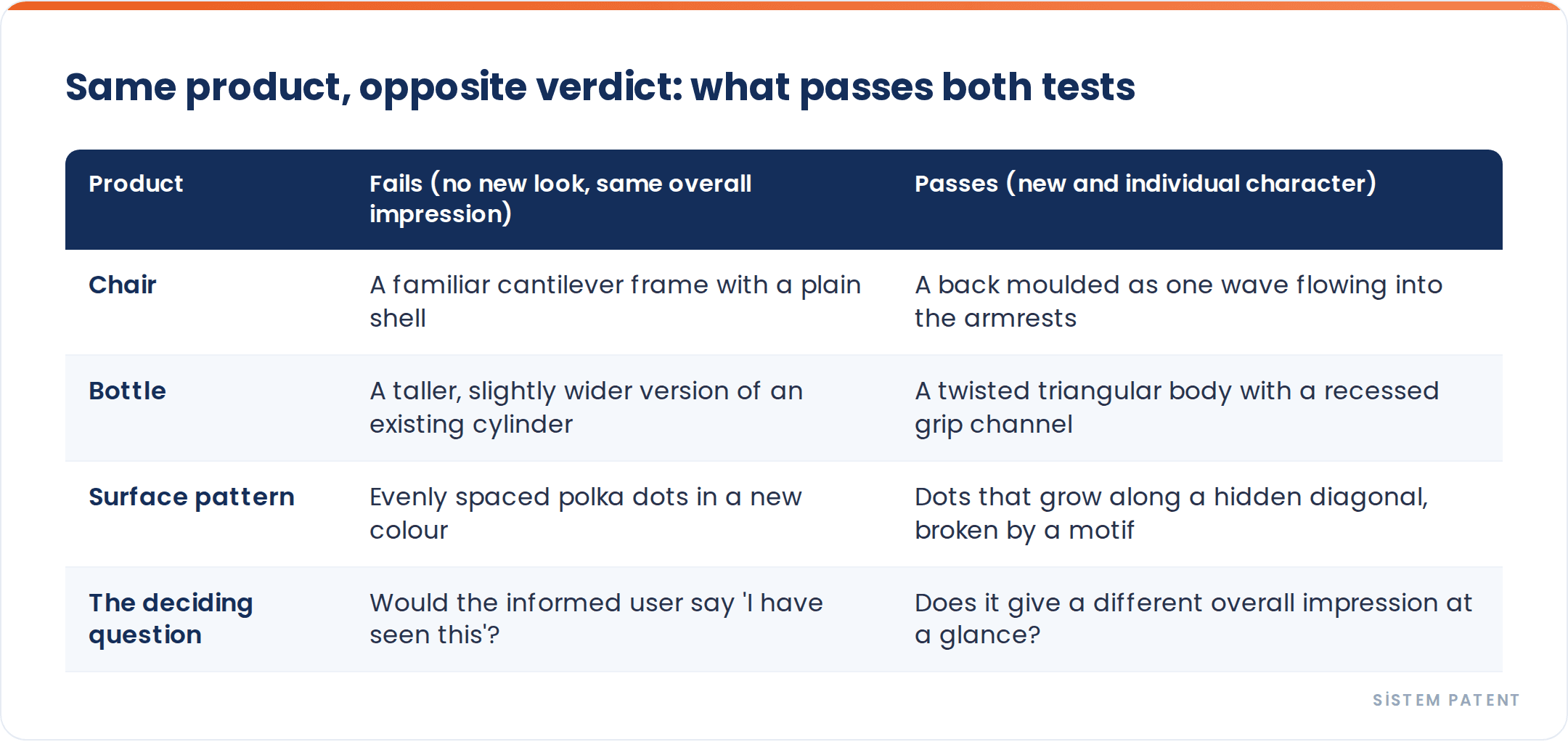
Take a cantilever chair: a seat and back held by a curved tubular frame with no back legs. That silhouette has been public for nearly a century, so a new cantilever chair with a familiar frame and a plain shell is not new, and even where the proportions differ a little it rarely has individual character, because the informed interior architect has seen the form a thousand times. Now give the same chair a back moulded as a single continuous wave that flows into the armrests, a profile nobody in the category is using. It passes novelty, no identical chair exists, and it has individual character, because to the informed user the overall impression is genuinely its own. Same product, same starting point, opposite outcome, decided entirely by how the form reads against the existing field.
A bottle
A water bottle is a tall cylinder with a screw cap. The freedom here is wide, drinks come in countless shapes, so a cylinder that differs from earlier cylinders only by a slightly taller neck or a marginally wider base will clear novelty on a technicality and then fail individual character, because the informed buyer's overall impression is "another cylinder". A bottle whose body is a twisted triangular prism with a recessed grip channel, by contrast, produces a different overall impression at a glance. The lesson the bottle teaches is that wide design freedom raises the bar: when you could have done almost anything, doing almost the same thing as everyone else is fatal.
A surface pattern
A textile print of evenly spaced polka dots is, as a layout, ancient and public, so a new polka-dot fabric is not new and has no individual character whatever colours you choose, because colour alone sits at the immaterial-detail end of the scale. Recast the same idea as dots that vary in size along a hidden diagonal grid, interrupted by a recurring motif, and you have a layout the informed user has not seen, which can carry both novelty and individual character. Patterns are the clearest reminder that the tests look at the overall visual impression of the design as applied, not at any one element in isolation.
How to stress-test a design before you spend on filing
Both tests are decided against what already exists, so the work that protects you happens before you file, not after. A focused prior-design search across the Turkish register, the EUIPO design database, and ordinary market and catalogue sources tells you what your design will be measured against and surfaces the close calls early. Build the application around the features that actually create your different overall impression, and use disclaimed (broken-line) views to fence off the generic parts that drag you toward the prior art. Done well, this is the difference between a certificate that holds when you wave it at a copyist and one that evaporates the moment they push back.
The practical rule is simple to state and easy to underrate. Novelty keeps out the identical; individual character keeps out the merely similar. A design that is plainly new but produces the same overall impression as something already on the market is the most common way a registration turns out to be worthless. If you are weighing a new product look and want the two tests applied to your actual design rather than to a kettle in a blog post, our team handles design clearance and design registration day in and day out, and an early read on where your design sits saves the expensive surprise later. For products you intend to manufacture and sell at scale, the same analysis feeds straight into a sound industrial design registration strategy, filed on the features that will actually survive a challenge.
Picked for You
Related Articles
Registered vs Unregistered Design Rights: What You Get for Free and Why It Is Rarely Enough
Read More →
Turn Your Design Investment Into a Tax Position: Design Centres, R&D and IP Incentives
Read More →