
Pharma and Medical Device IP in Turkey: Patents, Brand Names and Regulatory Timing
A medical device company spends three years and a small fortune developing a new infusion pump. The mechanism is genuinely original, the housing looks like nothing else on a hospital shelf, and the brand name tested well with clinicians. Then, six weeks before the planned launch, the regulatory team presents the device at a major industry congress to build pre-market interest. That single presentation just made the core mechanism part of the prior art, and the patent the company had been planning to file is now far weaker than it should have been. Nobody did anything reckless. The intellectual property work simply ran on a different clock than the regulatory and commercial work, and the two clocks were never synchronised.
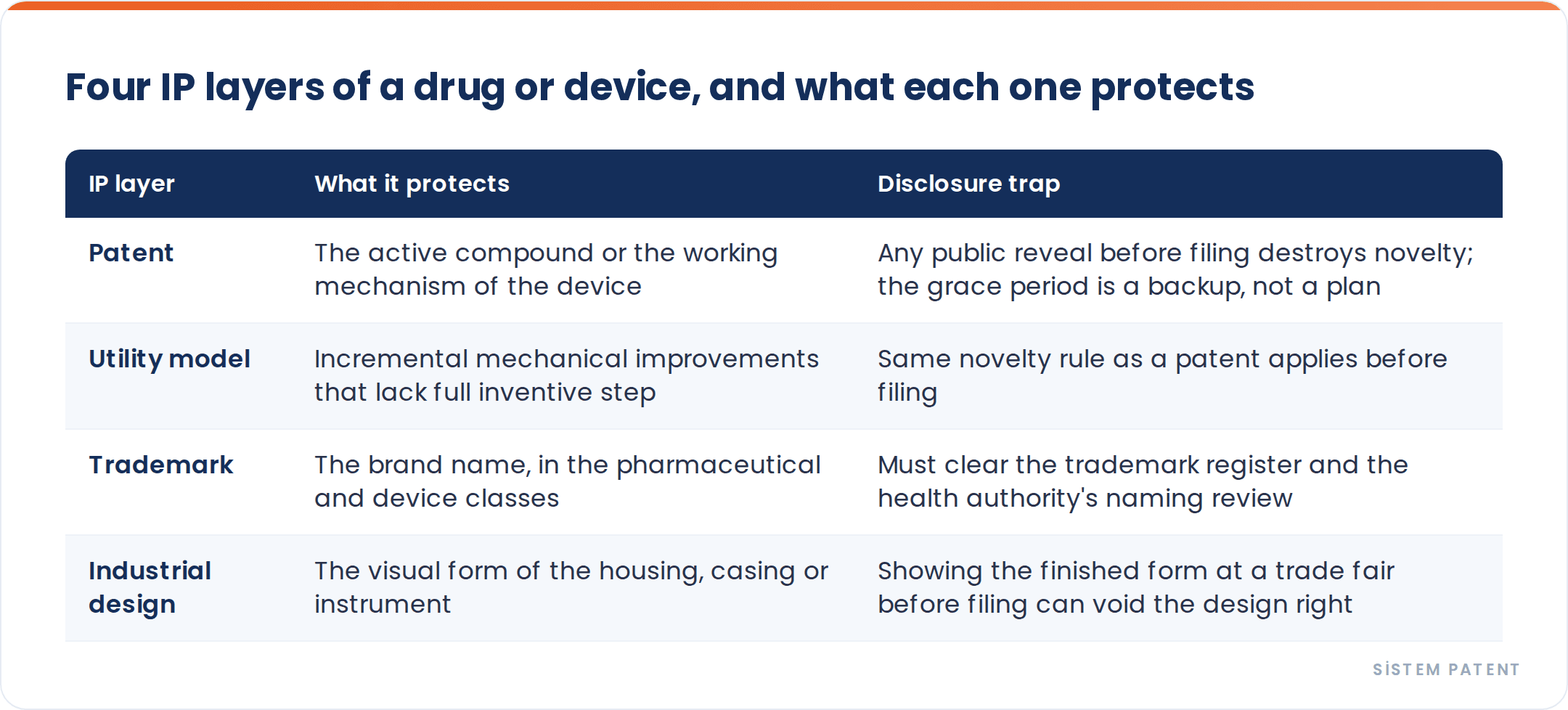
Pharma and medical device businesses carry a heavier IP load than almost any other sector. A single product can sit on top of a patented compound or mechanism, a trademarked brand name that must clear both the trademark register and the health authority, an industrial design protecting the physical form, and sometimes a utility model covering an incremental improvement. Each of these has its own filing logic, and all of them have to fit around a regulatory approval and launch timeline that is unforgiving about public disclosure. Getting the sequence wrong is expensive in a way that is hard to undo.
The patent protects the molecule or the mechanism, not the product you sell
For a pharmaceutical, the foundational asset is usually a patent on the active compound itself, or on a formulation, a method of manufacture, or a specific medical use. For a device, it is typically a patent on the working mechanism: how the pump meters a dose, how a sensor reads a signal, how a stent deploys. This is the layer that keeps a competitor from making the same thing, and it is the layer most sensitive to timing, because a patent rewards the first to file a genuinely novel invention.
Novelty in Turkey is absolute. Under the Industrial Property Code (Law No. 6769), an invention is no longer new once it has been made available to the public anywhere in the world, in any language, by any means. A conference abstract, a poster at a trade fair, a clinical-trial registry entry that discloses how the device works, a journal article, even a detailed pitch to an investor without a confidentiality agreement can all count as disclosure. Turkey does provide a twelve-month grace period for disclosures that originate from the inventor, which can rescue a premature reveal, but it is a safety net, not a strategy. Many countries grant no such grace at all, so a disclosure that is forgivable in Turkey can still destroy your patent rights in the export markets that matter most to a pharma or device company. The discipline that protects you is simple to state and hard to enforce internally: file before you disclose. A clean patent registration filed ahead of the first public presentation anchors your priority date and keeps the grace period in reserve for genuine accidents rather than spending it on a planned launch event.
Not every improvement deserves a full patent. A device maker who has patented the core mechanism will keep refining it, and many of those refinements, a better seal, a smarter clip, a more reliable housing latch, are incremental rather than inventive in the patent sense. Turkey offers a second-tier right for exactly this situation. A utility model protects an invention that is new and industrially applicable without demanding the same inventive step a patent requires, which makes it a practical tool for the steady stream of small mechanical improvements that medical devices accumulate over a product life. Using patents for the breakthroughs and utility models for the increments keeps a device portfolio both strong and affordable to maintain.
A drug or device brand name has to pass two gatekeepers, not one
The brand name of a medicine or a device is a commercial asset worth protecting as a trademark, but in this sector the name faces a second examiner that ordinary consumer brands never meet: the health authority. A pharmaceutical name has to clear the trademark register for distinctiveness and prior-rights conflicts, and separately it has to satisfy the medicines regulator, which screens names for safety. Regulators reject names that look or sound too close to an existing product, because a confusable name on a prescription is a dispensing error waiting to happen. They also reject names that overstate efficacy, imply a therapeutic claim the dossier does not support, or could mislead a patient about what the product does.
The result is a narrow corridor. A name that sails through trademark examination can still be blocked by the regulator, and a name the marketing team loves for its clinical-sounding confidence can be exactly the kind of overclaiming a health authority refuses. The way to avoid burning months is to develop a shortlist of candidate names and test them against both gates in parallel rather than in sequence. Run the trademark clearance and the regulatory naming check at the same time, on the same shortlist, so a name only survives if it passes both. Once a candidate clears both screens, securing it through a trademark registration in the correct classes, principally the pharmaceutical and medical-device classes, locks in the commercial right while the regulatory dossier proceeds.
There is a sequencing subtlety here that catches companies out. File the trademark early enough to secure the name, but be aware that a registered mark you do not use can become vulnerable to non-use cancellation after five years. For a drug that spends years in trials before approval, that clock can start running while the product is still in development. The answer is not to delay filing, which exposes the name to a competitor or a squatter, but to file deliberately and keep the registration aligned with a realistic launch horizon, renewing and defending it as the regulatory path unfolds.
The housing and the form belong on the design register
A patent covers how a device works. It does not cover how it looks. The shape of an inhaler, the contoured grip of a surgical instrument, the distinctive casing of a diagnostic reader, these are aesthetic and ergonomic features that competitors copy precisely because they signal a product to clinicians and patients. Turkey protects the appearance of a product through industrial design rights, which sit on the EU and UK style register rather than under any patent. A design registration protects the visual form, the lines, contours, shape, texture and ornamentation, independently of the technical function underneath.
The same novelty discipline applies, and it trips up device companies that think of the housing as an afterthought. A design must be new and have individual character at the moment of filing, so showing the finished casing at a trade fair or in marketing renders before you file can destroy the design right just as a premature lecture destroys a patent. There is a feature worth knowing: a design also has a limited grace period in which the designer's own prior disclosure does not count against the application, which gives a little breathing room, but again, relying on it is weaker than filing first. Where a single product carries both a working mechanism and a distinctive form, the patent and the design are filed as a coordinated pair so that a copycat cannot take the look by avoiding the mechanism, or take the mechanism by restyling the shell.
Export markets force the timeline decision early
Pharma and medical device companies rarely stay domestic. A compound or a device built for the Turkish market is usually aimed at the EU, the Gulf, and beyond, and the regulatory submissions in those territories are themselves a form of disclosure that can interact with patent novelty. This is why the international filing decision cannot wait until after launch. The twelve-month priority window under the Paris Convention lets you carry your Turkish filing date into foreign applications, so an international patent registration built on the priority of your first Turkish filing preserves novelty abroad even as the home product moves toward approval. Miss that window, and a disclosure that was timed correctly for Turkey can leave you unprotected in the very markets that justified the investment.
The practical takeaway for anyone running IP inside a pharma or medtech business is that the filing calendar and the regulatory calendar are the same calendar. Map them together from the start. Decide what gets a patent and what gets a utility model, run the brand name through both the trademark register and the health authority at once, register the device form before it appears in public, and lock the priority date before any submission or congress puts the invention into the open.
If you are building the IP foundation for a new drug or device and want the patent, brand and design filings sequenced to fit your approval timeline rather than fight it, our patent and trademark agents can structure the plan around your regulatory milestones. Start with the patent registration that anchors your priority date, and build the rest of the portfolio out from there.
Picked for You
Related Articles
Turning University Research Into Patents and Revenue
Read More →
The One Disclosure That Kills a Patent: Novelty and the Grace Period Before You File
Read More →