
How to Choose a Trademark That Survives Examination
A founder falls in love with a name, commissions a logo, prints the packaging, and only then sends the mark to be registered. Months later the rejection arrives: the name describes the product, so it cannot be owned by one company. Now there is a brand identity built around a word the founder will never control, and the choice is to start over or to trade under a name anyone can copy. The expensive part was never the filing. It was choosing the name without knowing whether it could be a trademark at all.
The good news is that the strength of a name is not a matter of taste or luck. There is a recognised scale, used by examiners and courts, that sorts names by how well they can function as a trademark. Learn to place a candidate on that scale and you can predict, before spending a lira on design, whether the name is a fortress or a liability. This is the framework to run your shortlist through.
The distinctiveness spectrum decides whether a name can be owned
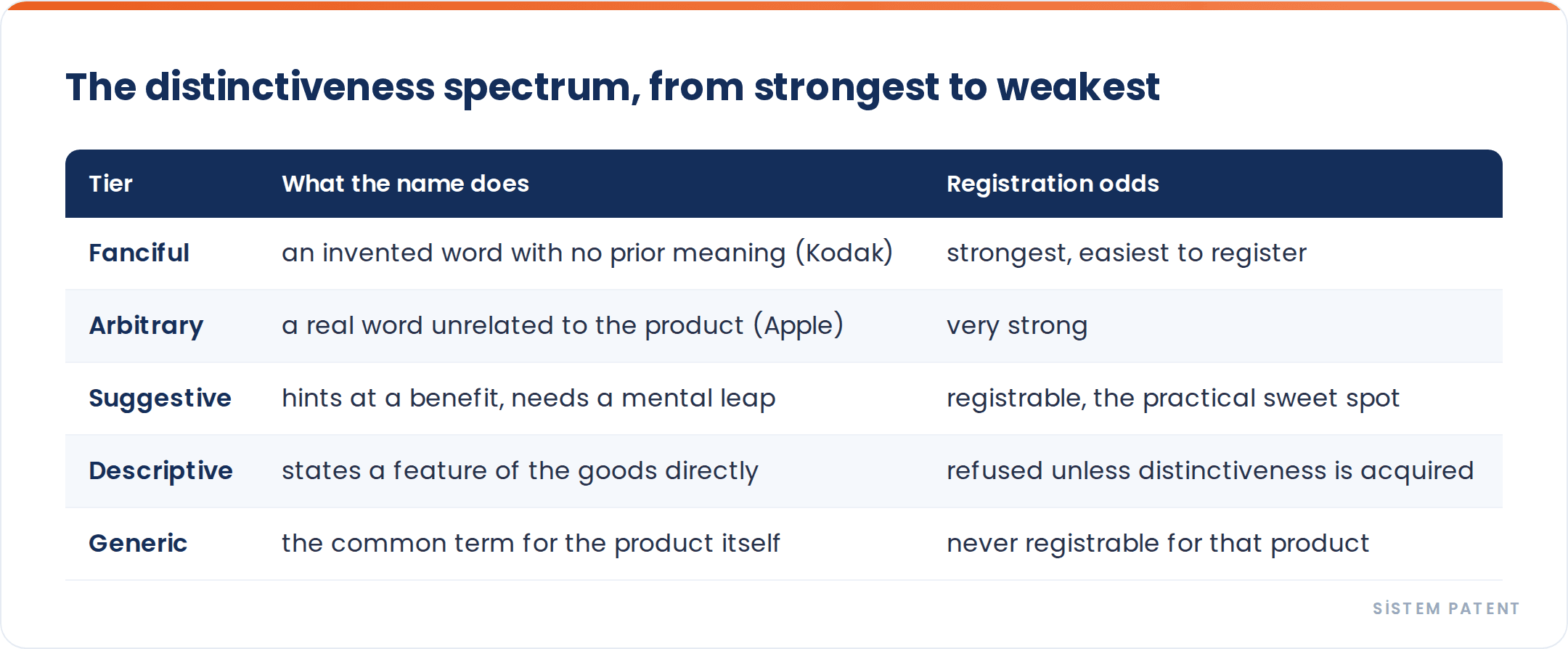
Every brand name sits somewhere on a five-tier scale that runs from the strongest, most protectable names to the ones that can never be registered. The tiers, from strongest to weakest, are fanciful, arbitrary, suggestive, descriptive, and generic. The single most useful skill in naming is being able to tell which tier a candidate belongs to, because that placement is the best early signal of whether it will clear examination at TÜRKPATENT (the Turkish Patent and Trademark Office) under the Industrial Property Code (Law No. 6769).
A fanciful name is an invented word that meant nothing before the brand gave it meaning. Kodak and Xerox are the textbook cases. They have no dictionary definition, so no competitor has any honest reason to use them, and they are the easiest of all to register and defend. An arbitrary name is a real word used in a context that has nothing to do with its meaning. Apple is the famous example: a common word for fruit, applied to computers, where it describes nothing about the product. Arbitrary marks are almost as strong as fanciful ones.
A suggestive name hints at a quality or benefit without describing it outright, so the customer has to make a small mental leap. It tells you something about the product through implication rather than statement. Suggestive marks are registrable and commercially attractive, because they carry a whiff of meaning while still pointing to a single source. This tier is where most well-advised founders aim, since it balances marketing pull against legal strength.
Then the ground gives way. A descriptive name states a characteristic of the goods directly: what they are, what they do, a quality, an ingredient, the place they come from. Names like these feel attractive because they explain the product instantly, which is exactly why the law is reluctant to hand one company a monopoly over them. Competitors need ordinary descriptive words to describe their own goods. A descriptive mark is refused on absolute grounds unless it has acquired distinctiveness through long and heavy use, and proving that is a slow, evidence-heavy road most new businesses cannot walk. A generic name is the common term for the product itself, and it can never be a trademark for that product. No one gets to register Bread for bread.
Read the name from the buyer's side, not the boardroom's
The trap that catches founders is judging a name by how it sounds in a pitch rather than how an examiner will classify it. A name can feel clever and still be legally descriptive. The test is not whether you like it. The test is what the word communicates to an ordinary buyer of those specific goods or services.
This is why the same word can sit in different tiers depending on what it is sold against. A word that merely hints at a benefit for one product may flatly describe another. Place the name next to the actual goods and ask what an average customer would understand from it at first glance. If the word tells the customer what the product is or does, it leans descriptive and the registration odds drop. If the customer has to pause and make a connection, it leans suggestive and the odds improve. If the word means nothing until your brand fills it with meaning, you are in fanciful territory and the path is clearest.
One more habit separates a strong shortlist from a weak one: distinctiveness is judged in the language of the market. A word that is invented in Turkish may be an ordinary descriptive term in another language for an export market, and the reverse happens just as often. A name that is meaningless and strong at home can collapse into a plain description abroad. If the brand has any international ambition, the name has to be read through the languages of every market it will enter, not just Turkish.
Stress-test the shortlist before you spend on a logo
Naming works best as a filter, not a single decision. Start with more candidates than you need and let the weak ones fall away in a fixed order, so design budget only ever attaches to a name that has already survived scrutiny.
Begin by scoring each candidate on the spectrum. Drop anything generic immediately, since it can never be registered for the product. Treat descriptive candidates with suspicion: they may be the most tempting on the list because they explain the product, and they are the ones most likely to fail examination or to leave you with a mark too weak to enforce. Push the survivors toward the suggestive, arbitrary, and fanciful tiers, where a registrable mark actually lives.
Next, pressure-test the front-runners against reality. A name that scores well on distinctiveness is still worthless if someone already owns it for related goods. This is where a trademark search earns its place, run across the Nice classes that match what you sell, looking not only for identical marks but for names close enough to be confused with yours. A strong, distinctive name that collides with an earlier registration is a dead end you want to find now, while changing course costs nothing but a different word on a slide.
Only then does design enter. Once a candidate is both distinctive on the spectrum and clear in a search, it has earned the investment in a logo, packaging, and a launch. At that point you move to a trademark registration in the classes that cover your current and near-future goods and services, so the name you have just validated is locked to your business rather than left open for a competitor to claim. Doing it in this order means you never pour money into design around a word you cannot own.
A quick way to run the test on one name
Take a single candidate and walk it through four questions. What does this word mean to an ordinary buyer of these exact goods? Does it describe the product, hint at it, or mean nothing until my brand defines it? Is the same word descriptive or offensive in any language of a market I plan to enter? And does a search turn up an earlier mark for related goods that I would be fighting from day one? A name that survives all four is worth building on. A name that stumbles on any of them is cheaper to replace today than to defend later.
The strongest name is the one a rival cannot honestly use
A good trademark is not just a name customers remember. It is a name your competitors have no legitimate reason to reach for, because it was never theirs to describe their goods with. Fanciful and arbitrary names give you that exclusivity outright. Suggestive names give you most of it while keeping marketing appeal. Descriptive and generic names give you a label everyone shares, dressed up as a brand.
If you are weighing a shortlist right now, score each name on the spectrum first, then clear the front-runners with a proper clearance search before a single design file is opened. When a name comes through both filters intact, our team can move it straight into a trademark registration in the right classes, so the brand you build is one you actually own.
Picked for You