
Patent Assignment vs Licensing: Sell the Invention or Rent It Out
A manufacturer in Bursa holds a granted patent on a valve mechanism that a larger competitor now wants. The competitor's offer arrives as a single number: a lump sum to take the patent off your hands for good. It looks generous until you do the arithmetic on what the same technology might earn over its remaining life if you kept it and let the buyer pay to use it instead. That is the whole question in one sentence. Do you sell the invention, or do you rent it out?
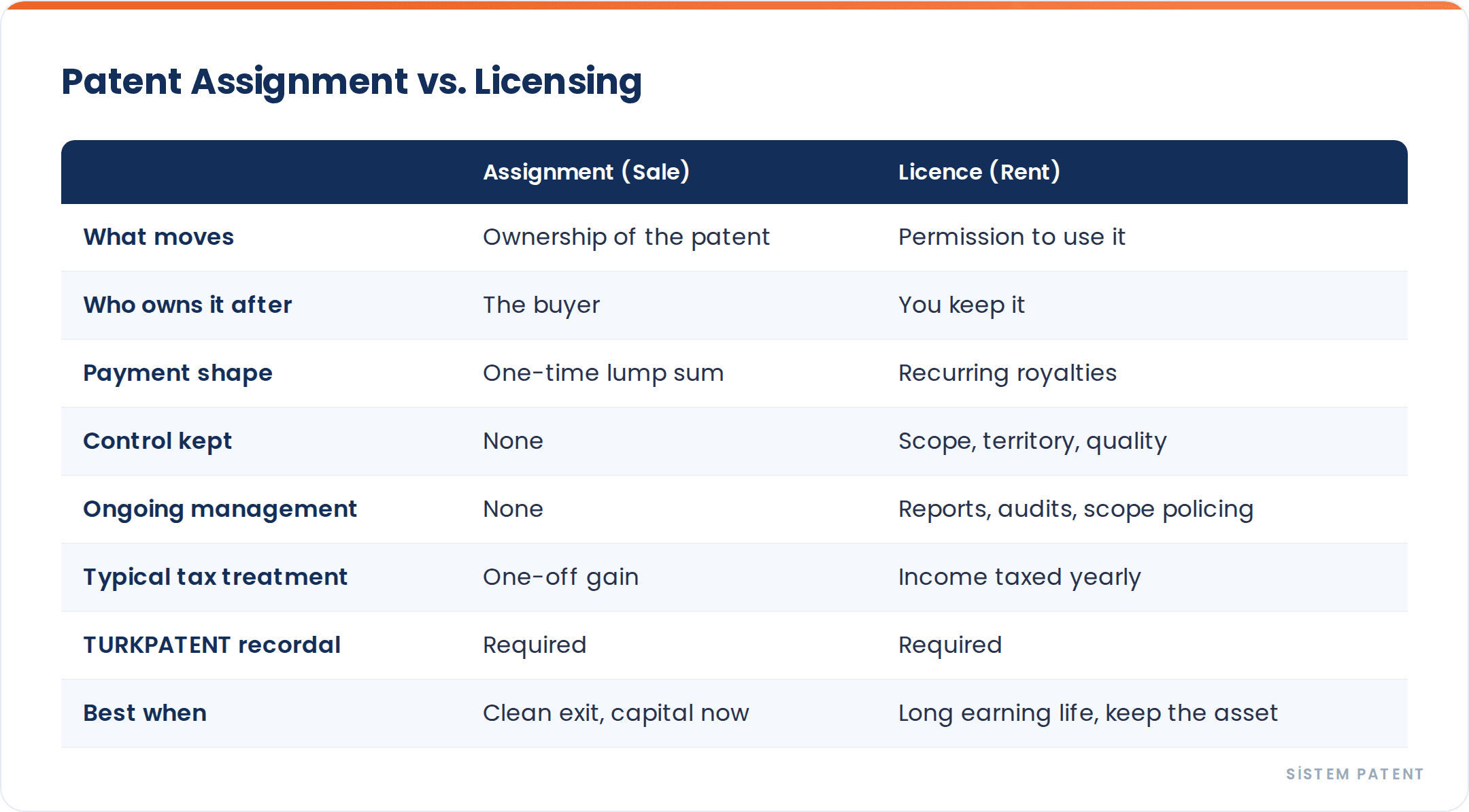
In legal terms, selling is an assignment and renting is a licence. They are governed by the same Industrial Property Code (Law No. 6769) and both have to be recorded at TURKPATENT (the Turkish Patent and Trademark Office) to be effective against third parties, but they hand the other side completely different things. An assignment moves ownership. A licence moves permission. Choosing the wrong one can cost an inventor either control of the technology or years of income, and the offer on the table rarely makes the difference obvious.
An assignment is a clean sale: you give up the patent and walk away
When you assign a patent, you transfer the ownership of the right itself to the buyer. After the assignment is signed and recorded, you are no longer the proprietor. You cannot license it to anyone else, you cannot enforce it, and you do not share in whatever the buyer earns from it afterward. In exchange you usually get a one-time payment, and your relationship with the technology ends there.
That finality is the appeal. An assignment is simple to administer because there is nothing ongoing to manage: no royalties to chase, no usage reports to audit, no quality terms to police. For an inventor who wants cash now, who lacks the capital or the appetite to commercialise the invention themselves, or who is exiting a business line entirely, a clean sale can be exactly right. It is also the natural mechanism inside a wider deal. When a company is acquired, its patents are typically assigned across as part of the asset package rather than licensed back to a seller who no longer exists.
The risk sits in the irreversibility. You are pricing twenty years of potential exclusivity, minus whatever has already elapsed, into a number you have to get right today. If the technology turns out to be the foundation of a category, the buyer captures all of that upside and you captured none of it. This is the point at which a defensible number matters more than a confident one. A proper patent valuation before you accept an offer is the difference between selling an asset and giving it away, because the first real figure most inventors hear is the buyer's, and the buyer is not incentivised to make it generous.
A licence keeps the patent yours and turns it into an income stream
A licence does not move ownership at all. You stay the proprietor of the patent and grant the other party permission to use the invention on terms you set, usually in return for royalties: a percentage of sales, a per-unit fee, a fixed annual amount, or some blend. The patent stays on your balance sheet, and the income recurs for as long as the agreement and the patent both live.
The strategic advantage is that you keep the asset while monetising it. You can license the same patent to several companies at once if the licence is non-exclusive, license it in one country and exploit it yourself in another, or carve the grant by field of use so a partner gets the medical application while you keep the industrial one. None of that is available once you have sold the patent outright. A licence also lets you stay in the driver's seat on quality and reputation, which matters when the invention carries your name or feeds a product line you still sell.
The cost of all that flexibility is that a licence is a living relationship, not a closed transaction. Someone has to track royalty reports, confirm the licensee is paying on the right revenue, watch that the use stays inside the agreed scope, and step in when a term is breached. The mechanics of structuring that grant well, where exclusive, sole and non-exclusive scopes pull in different directions and where the royalty model is set, are a subject in their own right, and our note on how to license a patent covers the deal terms in depth. For the decision in front of you here, the point is simpler: a licence trades the certainty of a single cheque for the upside, and the upkeep, of an ongoing income stream.
The money looks different to the tax office, not just to you
Assignment and licensing are not only commercially different, they are usually treated differently for tax, and that gap can move the real value of a deal more than the headline number does. A lump-sum assignment is the disposal of an asset and tends to be taxed as a one-off gain in the year it lands. Licence royalties are recurring income and are taxed as they are received, year after year, and cross-border royalties can carry withholding obligations that depend on the treaty position between the two countries.
We are deliberately speaking in general terms here, because the precise treatment turns on how the parties are structured, whether the deal is domestic or international, and rules that change. The practical takeaway is that the structure of the transfer, sale versus rent, has tax consequences that should be modelled before you sign, not discovered afterward. An offer that looks larger as a lump sum can be the smaller one once tax and timing are accounted for, and the reverse is just as true. Run both shapes past someone who can read your specific position rather than assuming the bigger gross number wins.
Neither transfer is real until it is recorded at TURKPATENT
This is the step that quietly undoes deals, and it applies to both routes. Under Law No. 6769, an assignment or a licence is valid between the two parties as a contract, but it does not take effect against third parties until it is entered in the patent register at TURKPATENT. An unrecorded assignment leaves the register still naming the seller as proprietor, which means a later good-faith buyer, a creditor, or an opponent sees the old owner, not the new one.
The consequences of skipping recordal are concrete rather than theoretical. A buyer who never records the assignment can find their right to enforce or to renew the patent challenged because the register does not reflect that they own it. A licensee whose licence is not recorded may be unable to assert it against a third party. And a broken chain of title, an assignment somewhere in the patent's history that was signed but never recorded, surfaces years later during due diligence and can stall or sink the next transaction. Recording the transfer, with the right documents and signatures, is the cheap step that makes the expensive deal hold. If you are handling either side of a sale, our teams manage patent assignment recordal so the register actually reflects who owns what.
How to decide between selling and renting
Strip away the legal labels and the choice comes down to a few honest questions about the invention and what you want from it.
Do you need the technology to stay yours?
If the invention still feeds a product you sell, carries your brand, or sits at the centre of where the business is going, licensing keeps it under your control while it earns. Assignment makes sense when you have genuinely finished with the technology, commercially or strategically, and the cleanest outcome is to hand it over and move on.
Do you want cash now or income over time?
A business that needs capital today, or that simply prefers certainty to potential, is well served by an assignment and its single, known payment. A patent owner who can wait, and who believes the technology has a long earning life, usually does better holding the asset and licensing it, because the royalties compound over years the lump sum cannot.
How confident are you in the valuation?
The more uncertain the invention's eventual value, the more a licence protects you, because the royalty rises with the licensee's actual success instead of being locked at today's guess. When the value is genuinely knowable and the buyer is paying a fair figure for it, an assignment removes the risk and the management burden in one move. Either way, the figure has to be grounded. A serious valuation is what lets you tell a strong offer from a low one, and it is worth getting before any number is signed, whether you end up selling the patent or renting it out.
There is no answer that is right in the abstract. The assignment is the efficient choice when you want a clean exit and a sum you can rely on, and the licence is the stronger one when the patent has years of earning ahead and you would rather own the asset than spend it. If you want help reading a specific offer, weighing the tax and control trade-offs, and getting the transfer recorded so it actually holds, our teams handle both routes from the first assessment through registration, and the early conversation is usually the one that protects the most value.
Picked for You
Related Articles
Turning University Research Into Patents and Revenue
Read More →
The One Disclosure That Kills a Patent: Novelty and the Grace Period Before You File
Read More →