

Your trade-name registration protects nobody from your brand
A founder sets up a limited company, files the paperwork at the Ticaret Sicili, and watches the name go on the register. The lawyer confirms the incorporation, the tax office issues a number, and the first invoices go out under the new name. In the founder's mind the brand is now locked down. It is not. A trade-name registration confirms that a legal entity exists and may trade under that name. It says nothing about who owns the brand.
This gap catches careful people. They did everything by the book at the registry, so they assume the brand side is handled too. The two registrations live in different places, under different law, and protect different things. Treating one as a substitute for the other is how a company ends up paying a competitor for the right to keep using its own name.
A trade name names the company; a trademark owns the sign
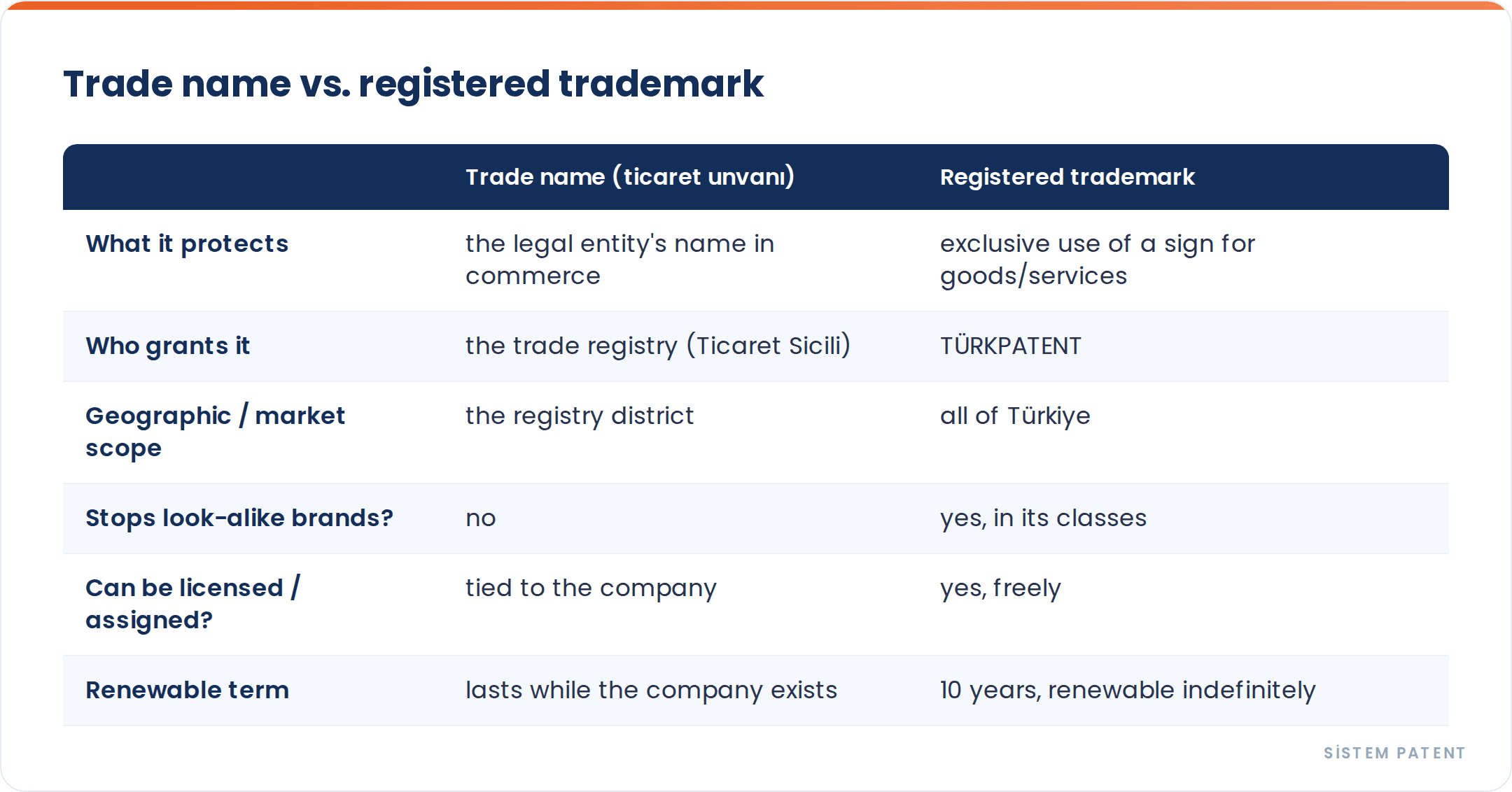
A trade name, the ticaret unvani, is the formal name under which a legal entity acts in commerce. It identifies the merchant. When you sign a contract, open a bank account, or appear on an invoice, the trade name is the legal label for the business doing the deal. It is recorded at the trade registry under the Turkish Commercial Code, and it answers one question: which legal person is this?
A registered trademark answers a different question: who has the exclusive right to use a particular sign for particular goods and services? Under the Industrial Property Code (Law No. 6769), a trademark is granted by TÜRKPATENT (the Turkish Patent and Trademark Office). It gives the owner the right to use the sign for the goods and services it covers, and the right to stop others from using an identical or confusingly similar sign for the same or related goods and services. One register tracks legal entities. The other tracks brand rights. They do not overlap, and one does not stand in for the other.
The practical line is the scope of the right. A trade name lets you call your business by that name. A trademark lets you tell a competitor to stop. If you have only the first, you have an identity, not a defensible brand.
It helps to see what each office actually examines. When the registry accepts a trade name, it checks that the name is not already taken by another company in the same field within that registry's area, and that it meets the formal rules for an entity name. It is a check about company identity, not about brand rights across the market. TÜRKPATENT runs a different examination: it assesses whether the sign is distinctive enough to function as a trademark and whether it clashes with earlier marks for the same or related goods and services. Clearing one examination tells you nothing about the other. A name can sail through the registry and still run straight into an earlier trademark the moment you try to register it.
Being first to incorporate does not make you first to the brand right
Here is the part that surprises founders. Registering a trade name at the registry does not block anyone from going to TÜRKPATENT and applying to register that same name as a trademark. The registry and TÜRKPATENT do not clear filings against each other. A trade name on the commercial register is not automatically a bar to a later trademark application for the same wording.
So picture a competitor, a former partner, or an alert third party. They notice your name is building recognition in the market and they notice it is not registered as a trademark. They file it as a trademark in the Nice classes that match your actual goods and services. If that application proceeds to registration, the trademark right sits with them, not with you. You incorporated first. They registered the brand first. In a trademark dispute, the second fact usually carries more weight than the first.
From there the position can turn uncomfortable. The trademark owner can object to your use of the sign for the goods and services they have registered, can oppose your own later trademark filing, and can press you to stop using a name your customers already associate with your business. You may have arguments based on prior use, and Turkish practice does give weight to genuine earlier use of a sign. But arguing prior use after the fact is slow, evidence-heavy, and uncertain. It is the expensive way to defend something a timely registration would have secured cleanly.
The evidence problem is the real sting. To rely on earlier use, you have to prove it: dated invoices, advertising, packaging, contracts, and proof that customers connected the sign to your business before the other side filed. Many companies discover that the paper trail they need is thin, scattered, or never kept. Even with a strong file, an opposition or cancellation action takes time and legal cost, and during it the other party holds a registered right while you hold a claim you still have to make good. A clean registration in your own name skips that entire fight. It puts the presumption on your side instead of theirs.
Three steps that turn a name into a protected brand
The fix is straightforward and it follows a clear order. Do it when you incorporate, not after a dispute lands.
- Search before you commit. Run a proper trademark search across the relevant classes to see whether your name, or something close to it, is already registered or pending. A clear search result tells you the name is available to register. A conflicting earlier mark tells you to rethink the name now, while changing it is cheap, rather than after you have printed signage and built a customer base around it.
- Register the mark in the correct Nice classes. Once the name is clear, register it as a trademark for the goods and services you actually offer, classified under the Nice system. The classes you choose define the boundary of your protection, so they should map to what the business sells today and to the lines it realistically plans to add. A registration in the wrong classes can leave the products you care about exposed.
- Watch for later filings that crowd your mark. Registration is the foundation, not the finish. New applications for similar signs appear continuously, and TÜRKPATENT does not warn you when one targets your space. It is worth setting up a service to monitor for later conflicting filings so you can file an opposition inside the legal window, instead of discovering a competing mark once it is already registered and far harder to remove.
Two registrations, one brand, no shortcut between them
The trade registry and TÜRKPATENT are not rivals and they are not redundant. A company needs its trade name to exist as a legal person and to trade lawfully. It needs a registered trademark to own its brand and to stop look-alikes. Incorporating gives you the first. Only a trademark filing gives you the second, and nothing about the first delivers the second by default.
If your business is trading under a name that lives only on the commercial register, the sensible next move is to confirm the name is still clear and secure it as a registered trademark in the classes that matter to you. It is a far smaller cost than buying back a brand you built but never owned.
Picked for You