

Five reasons trademark applications get refused in Turkey, and how to avoid each
A bakery owner in Izmir picks a name she loves, prints the signage, orders the packaging, and files the trademark application herself to save a fee. Eight months later a refusal letter arrives. The name was too close to a coffee chain already registered in the same class, and now the signage, the packaging, and the filing fee are all wasted. This is the most ordinary IP story we see, and almost every version of it was preventable before a single lira went out the door.
A trademark in Turkey is examined by TURKPATENT (the Turkish Patent and Trademark Office) against the rules in the Industrial Property Code (Law No. 6769). The examiner checks the mark on absolute grounds, things wrong with the mark itself, and the office also looks for earlier identical or confusingly similar marks. After that, the application is published and third parties get a window to oppose it. A refusal can come from the examiner or from a competitor who spots your mark in publication. Knowing where the wall is lets you walk around it.
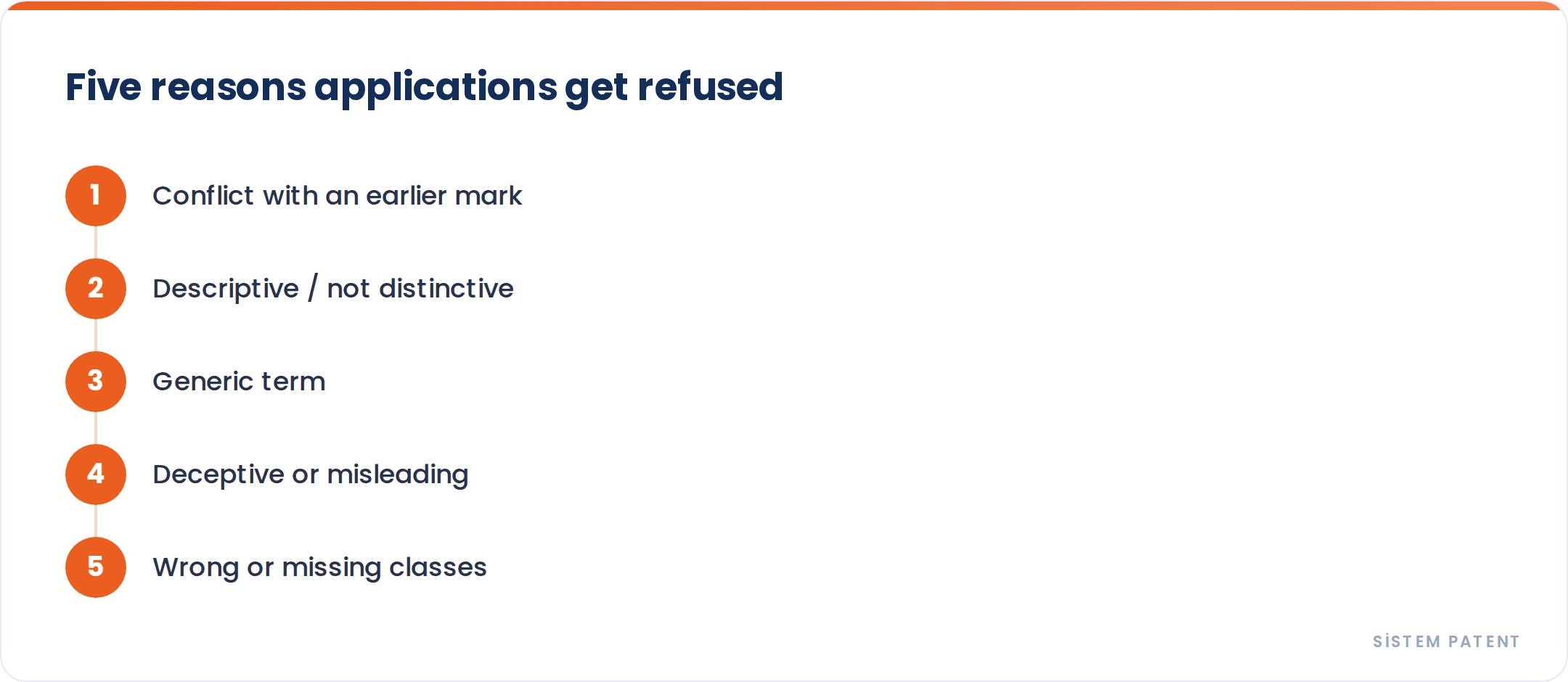
Refusals cluster into five recurring problems
Across the thousands of files an attorney firm handles, the reasons an application dies are remarkably repetitive. Five of them account for the great majority. Here they are, each with a plain example and the move that prevents it.
1. It collides with an earlier mark in the same or a related class
This is the single largest cause of refusal and of opposition. If an identical or confusingly similar mark is already registered or applied for, in the same goods or services or in goods the public would assume come from the same source, your application is blocked. The test is the likelihood of confusion in the mind of an average consumer, not whether the two words are spelled identically. Teknova and Teknoova for the same electronics fall foul of it. So can a visually different logo that conveys the same idea to the same buyers.
The fix is unglamorous and decisive: search before you file. A proper pre-filing trademark search covers the exact mark, near variants, phonetic equivalents, and the relevant Nice classes plus adjacent ones, not just an internet lookup of the literal spelling. If a senior mark exists, you learn it while you can still change course cheaply, which is the entire point of searching first.
2. The mark only describes the product, a quality, or an ingredient
A mark that simply tells the consumer what the product is, or praises a feature of it, is not distinctive, and TURKPATENT will refuse it on absolute grounds. Fresh Bread for a bakery, Extra Strong for an adhesive, Vitamin for a supplement: each describes rather than identifies, so no single trader is allowed to monopolise it. The harder the word works as a plain description, the weaker it is as a trademark.
Distinctiveness is something you design in. Coined words such as Kodak, or arbitrary ones such as Apple for computers, sit at the strong end of the scale because they say nothing about the goods and everything about the source. The practical principle: the further your mark sits from a description of what you sell, the stronger and safer it is. If you are weighing a name, our note on the trademark registration criteria sets out what the office actually looks for.
3. The term is generic or customary in the trade
One step past descriptive is the word everyone in the sector already uses. Generic and customary terms, the common name of the product itself or jargon that the whole trade shares, cannot be owned by anyone, because granting them would hand one company a monopoly over ordinary language. You cannot register Bread for bread or Bazaar for a marketplace. A term can also become generic over time through loose use, which is its own slow danger for famous brands.
Avoiding this is the same discipline as building distinctiveness, applied earlier in the naming process. Before a name reaches the shortlist, ask whether a competitor could reasonably need that word to describe their own product. If the answer is yes, it is trade vocabulary, not a trademark, and it belongs in the bin before it reaches a filing.
4. The mark deceives, misleads on origin, or offends public order
Some refusals are about what the mark tells the public rather than how distinctive it is. A mark that deceives consumers about the nature, quality, or geographical origin of the goods will be refused. Calling a product Swiss Watch when it is made elsewhere, or Pure Silk for a polyester scarf, misleads the buyer and fails on that ground alone. The same article also blocks marks contrary to public order or accepted morality, and marks that copy state emblems, official hallmarks, or the flags and signs of international organisations protected under the Paris Convention.
The avoidance here is judgement, not search. Keep the mark honest about what the product is and where it comes from, and steer well clear of official symbols, religious or national emblems, and anything a reasonable examiner would read as offensive or as a false claim of endorsement. When a name flirts with a geographic origin or an official-sounding seal, treat that as a flag to get advice before you commit.
5. The classes are wrong or missing, or the application has formal defects
The final group is procedural, and it is the most frustrating because the mark itself might be perfectly registrable. Trademarks are filed against the Nice Classification, and protection only reaches the goods and services you actually list. File in the wrong class and you protect nothing useful. List too narrowly and a competitor can register the same name for the products you forgot. Beyond classification, missing information, an unclear representation of the mark, or an applicant detail that does not match can stall or sink a filing on formal grounds.
Correct classification is a drafting skill. Map every product and service you sell now, plus the ones you realistically plan to, onto the right Nice classes before filing, and get the representation and applicant details right the first time. This is precisely the work a trademark registration through an attorney firm is meant to remove from your plate.
Three habits that prevent most of these refusals
The five reasons collapse into a short set of disciplines. Search thoroughly before filing, so a senior mark surfaces while changing course is still cheap. Choose distinctiveness on purpose, favouring coined or arbitrary marks over descriptions, which defeats reasons two and three at the same time. Classify deliberately and file cleanly, covering the goods you sell now and will sell soon. None of these is technically hard. Each is easy to skip when you are in a hurry to launch, which is exactly why the same refusals keep recurring.
One habit sits after filing rather than before it. Once your mark is accepted and published, there is a set window in which third parties may oppose it, so the job is not finished at acceptance. Watching the bulletin, and watching for later marks that encroach on yours, is how you defend the registration you worked to earn. If a conflicting mark appears in publication, a timely opposition during the publication period is the tool that protects your position before the rival mark is granted.
Most refusals are not bad luck. They are a search that was skipped, a name that described too much, or a class that was left off the list. If you would like a senior mark checked or a name pressure-tested before you file, our trademark agents can run the search and read the result with you.
Picked for You