
Copyright vs Patent for Software: How Do You Actually Protect an App?
A founder ships a scheduling app that quietly does something clever: it predicts no-shows from past booking behaviour and overbooks just enough to keep a clinic full. Six months later a competitor launches a near-identical feature. The founder calls a lawyer expecting an open-and-shut case, then hears something that lands badly. The code the competitor wrote is their own, so copyright does not reach it. The prediction method might have been patentable, but it was launched, demoed and described in a public changelog long before anyone filed. Two different rights, two different answers, and a product left far less protected than the founder assumed.
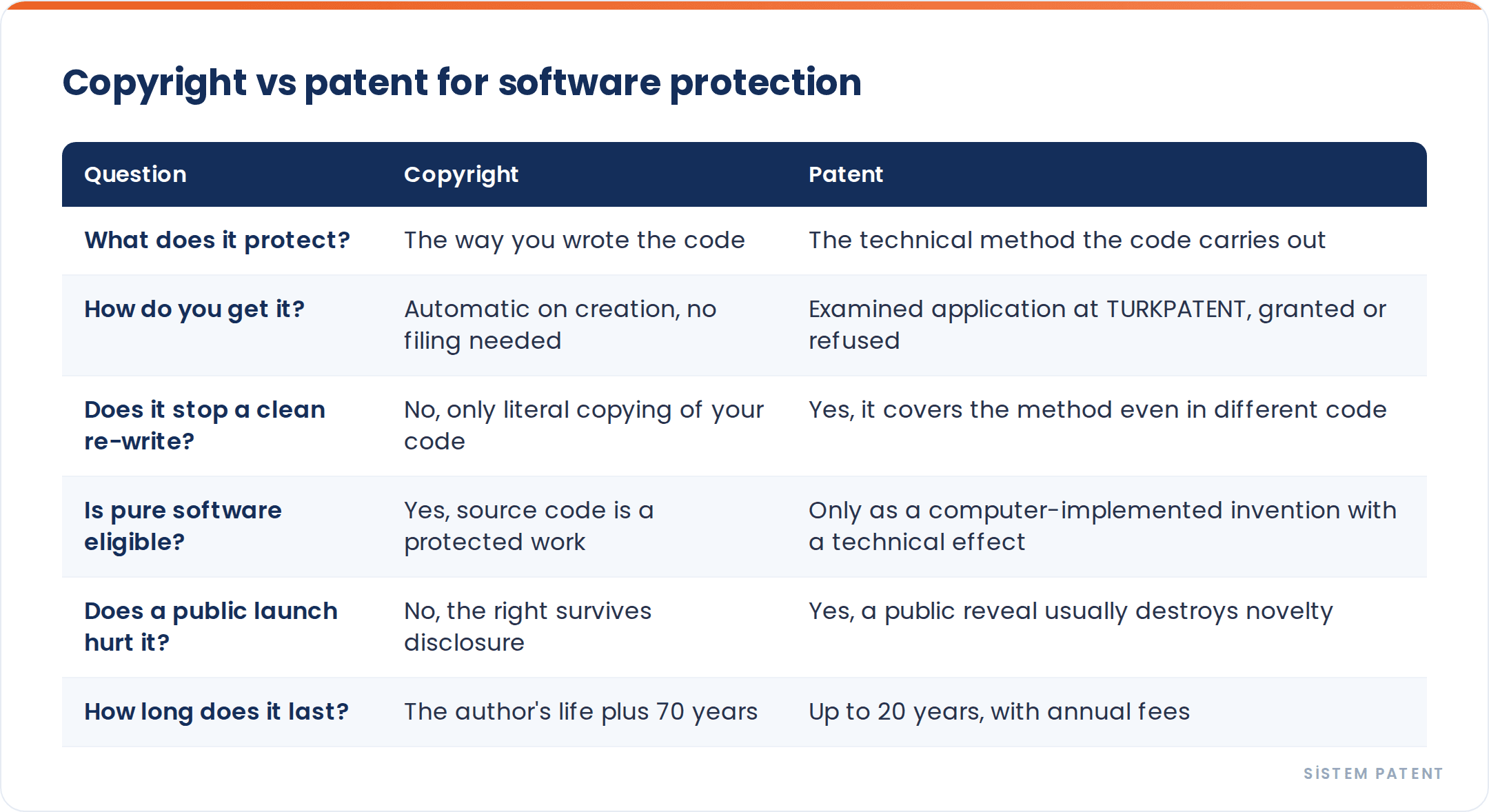
This is the question every software business eventually asks in the wrong order. People reach for "should I copyright or patent my app" as if the two are competing options for the same thing. They protect different layers. Copyright covers the way you wrote the code. A patent covers the technical method the code carries out. Confuse the two and you either spend money patenting something a patent will never grant, or you lean on copyright to defend an idea copyright was never meant to touch. Getting software protection right in Turkey starts with separating those layers cleanly, then deciding which ones are worth defending.
Copyright protects your code the moment you write it, and nothing more
Under the Law on Intellectual and Artistic Works (Law No. 5846), source code is protected as a literary work. Protection is automatic. The instant your code is fixed in a tangible form, typed into a file and saved, the right exists, with no filing and no fee required to bring it into being. Nobody may copy, distribute or adapt your specific code without permission. For a software business that is a genuinely strong starting point, and it is free.
The limit sits exactly where most founders wish it did not. Copyright protects expression, not the idea behind it. It guards the particular lines you wrote, the structure of your modules, the literal text of your program. It does not protect what the program does. A competitor who studies your app, understands the logic, and writes their own clean code to achieve the same result has copied your idea, not your expression. Unless they lifted your actual code, they have not infringed your copyright. This is the gap that surprises people: the more valuable part of a product is often the method, and copyright leaves the method open.
What copyright does well is prove ownership and stop literal copying, which covers a large share of real-world software disputes: a former developer who walks out with the repository, an outsourcing partner who resells your build, a clone that reuses your assets. For those fights, a dated record of authorship is decisive, and that is where a formal software copyright registration earns its place. The right exists without it, but registration gives you an official, dated statement of who authored which version, the kind of proof that turns a slow "prove it was yours" argument into a fast takedown.
A patent protects the method, but pure software is hard to patent in Turkey
A patent reaches the part copyright cannot: the technical function. If your app solves a problem in a genuinely new and inventive way, a patent can stop others from using that method even if they write entirely different code. That is a far broader monopoly than copyright offers. It is also much harder to get, slower, and not free.
Turkish law follows the European approach here, and the European approach is sceptical of software patents. the Industrial Property Code (Law No. 6769), excludes "computer programs as such" from patentability, and the European Patent Convention that the EPO applies takes the same line. Read literally, that sounds like software cannot be patented at all. The reality is narrower and more useful. What is barred is software claimed as nothing more than a program. What can be patented is a computer-implemented invention that produces a further technical effect beyond the ordinary running of code on a machine.
The distinction decides most cases. A method that improves how a device works, processes a signal more efficiently, controls a physical system, or solves a concrete engineering problem can clear the bar, because the contribution is technical. A method whose only novelty is a business rule, a financial calculation, or a way of presenting information to a user usually cannot, because there is no technical effect, only an idea running on a generic computer. The same scheduling app from the start of this article sits right on that line. Framed as "a smarter way to book appointments" it is a business method and goes nowhere. Framed around a specific technical mechanism, with a real engineering problem and a concrete solution, it might survive examination. How the invention is described to the examiner often matters as much as what the invention is.
Most apps need both layers, used for different jobs
The practical answer for a SaaS founder is rarely one or the other. The two rights protect different assets, so a serious product uses them in parallel, each doing the job it is suited to.
Copyright is the default floor under everything you build
Every line of code, every screen design, the text and graphics in your interface: all of it carries copyright automatically, and registering the key releases gives you dated proof for the whole product. This is your defence against literal copying and the cheapest protection you own. A startup that has filed nothing else still has this, and a copyright application over the work as a whole makes that protection provable on day one rather than reconstructable under deadline.
A patent is a deliberate bet on one genuinely technical core
If, and only if, your product contains a specific technical method that is new and inventive, a patent is worth the cost and the wait. You do not patent the app. You patent the one mechanism that a competitor could copy by writing their own code, the part copyright cannot reach. Because the process is involved and the subject matter is sensitive, this is where a patent application drafted with the technical-effect test in mind makes the difference between a granted right and a wasted filing.
There is a third layer worth naming, because for a lot of software it is the real crown jewel: trade secrets. An algorithm you never disclose, kept confidential and protected by access controls and contracts, can be defended as a trade secret for as long as it stays secret, with no expiry and no registration. The trade-off is the mirror image of a patent. A patent demands full public disclosure in exchange for a time-limited monopoly. A trade secret demands secrecy and gives you nothing if a competitor reaches the same result independently. Many software companies keep their core method as a secret precisely because publishing it in a patent, where it might not even be granted, would hand rivals the blueprint.
The one mistake that closes the patent door for good
Whatever route you choose, sequence matters more than founders expect, and one mistake is close to fatal. A patent requires novelty, and novelty in Turkey and at the EPO is absolute. The moment you show the invention to the public, in a launched product, a demo, a pitch deck, a conference talk, a public commit, it generally stops being new and can no longer be patented. Software moves fast and ships in public, which is exactly why the patent door so often closes before anyone thinks to ask about it.
Copyright has no such trap, since it arises from creation regardless of who has seen the work, which is part of why it is the reliable floor. A patent must come first or not at all. The discipline that protects the option is simple: if there is any chance a method is patentable, file before you launch, before the demo, before the public changelog. For a SaaS team that means a single decision early in the build. Identify whether a real technical invention sits inside the product, and if it does, treat the filing date as a launch dependency, not an afterthought.
Software protection is layered by nature, and the businesses that defend their products well are the ones that stop asking "copyright or patent" and start asking which layer guards which asset. Copyright is automatic and covers your code. A patent is hard-won and covers a technical method, if you have one and if you file in time. A trade secret covers what you can keep quiet. If you are mapping out how to protect an app and want to know which of these layers actually applies to your product, Sistem Patent can help you separate the code from the method, register what should be registered through the right copyright filing, and judge honestly whether a patent is within reach before a public launch quietly takes it off the table.
Picked for You
Related Articles
Who Owns Your Reels: A Creator's Guide to Copyright, Music and Brand Deals
Read More →
Work-for-Hire and Freelancers: Who Owns the Design, Code or Copy You Paid For
Read More →